
Skip to main content Skip to search

Archives for Tax

U.S. Inflation Uncertainty in 2026: What It Means for Financial Planning, Audits, and Business Stability

By 2026, inflation has transitioned from a temporary economic blip to a persistent structural issue that impacts how businesses operate, how they plan their finances, and their choices for the future. Increasing expenses, volatile interest rates, and unpredictable consumer demand are compelling companies to reconsider their established approaches.

For companies operating in dynamic environments, especially in the U.S. market, the key question is no longer “How does inflation impact us?” but rather “How do we adapt and remain stable despite inflation?”

Understanding the Real Impact of Inflation

Inflation’s impact on businesses differs, especially between manufacturing and services. It affects production costs, cash flow, and investment. Businesses unaware of these effects face profitability and sustainability issues.

Manufacturing Sector: Direct Exposure to Inflation

Manufacturing businesses are among the most affected during inflationary periods due to their dependency on physical inputs and supply chains.

Key Impact Areas:

  1. Rising raw material and energy costs directly increase production expenses
  2. Labor cost pressures due to wage adjustments
  3. Supply chain disruptions leading to inconsistent pricing
  4. Reduced profit margins due to inability to fully pass on costs

Unlike other sectors, manufacturing companies face immediate cost pressure, making inflation a critical operational risk.

Working Capital Stress: The Hidden Challenge

Inflation significantly impacts working capital management, often creating liquidity challenges even when revenues grow.

ComponentInflation ImpactBusiness Outcome
InventoryHigher procurement costsIncreased capital blockage
ReceivablesSlower customer paymentsCash flow strain
PayablesSupplier price hikesReduced negotiation flexibility
Cash ReservesLower purchasing powerLiquidity pressure

Why it matters

A business may appear profitable on paper but still face cash shortages, making working capital management critical during inflation.

Pros and Cons of Inflation: A Balanced Perspective

Advantages (Short-Term Gains)

Inflation can occasionally lead to short-term financial advantages. Companies might see increased income because of higher prices, and goods bought at earlier, lower prices can appreciate in worth. In some instances, reported profits might seem more robust.

Challenges (Long-Term Risks)

However, these benefits are often outweighed by long-term risks. Rising costs compress margins, borrowing becomes expensive, and demand becomes unpredictable. Strategic planning becomes more complex, increasing overall business uncertainty.

Impact on Investment and Expansion Decisions

Inflation and rising interest rates often work together to slow down business growth.

  • Cost of borrowing increases
  • Capital expenditure becomes expensive
  • Expansion plans are delayed or restructured

Strategic Shift

Businesses move from aggressive expansion to cost control and efficiency optimization.

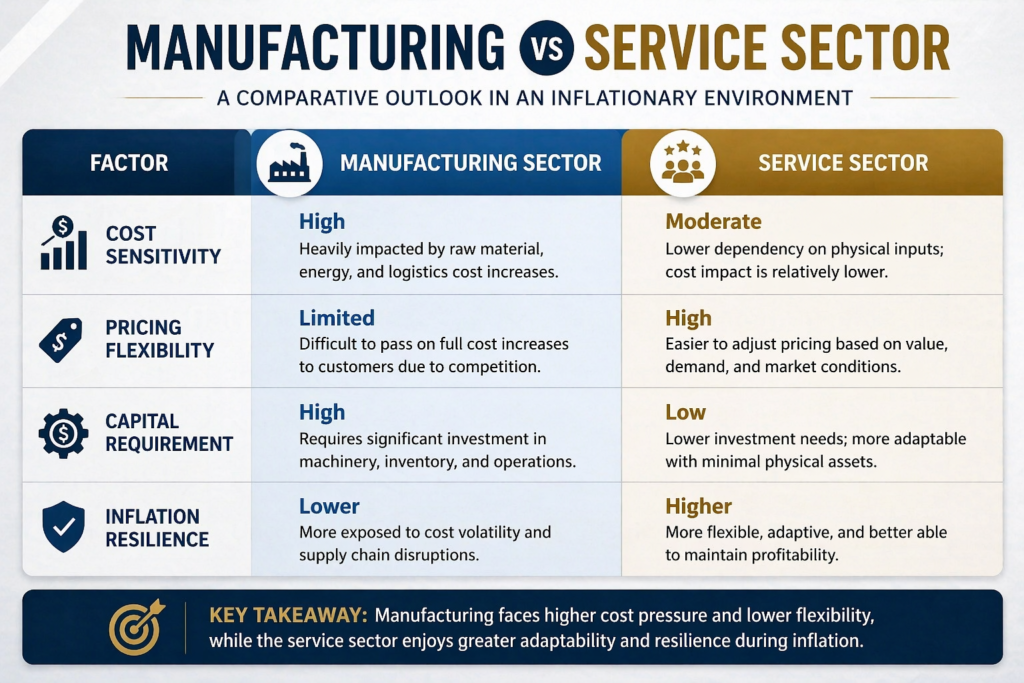
Manufacturing vs Service Sector: Comparative Outlook
Risk Management: A Critical Priority

Inflation introduces multiple financial and operational risks:

  1. Profitability Risk due to rising costs
  2. Liquidity Risk due to working capital pressure
  3. Financing Risk due to high interest rates
  4. Operational Risk due to supply disruptions

Kariwala Insight

Businesses that actively monitor and manage these risks are better positioned to maintain stability and avoid financial shocks.

How Service Businesses Survive

✔ Adjust pricing dynamically
✔ Shift to remote or hybrid models
✔ Automate repetitive processes
✔ Focus on high-margin services
✔ Reduce dependency on fixed costs

Outcome: Better control over profitability

Strategic Shift: From Growth to Sustainability

In inflationary environments, the focus shifts from aggressive growth to:

  • Cost efficiency
  • Cash flow stability
  • Risk control

Businesses that prioritize sustainability over expansion tend to perform better in uncertain conditions.

Conclusion

In 2026, inflation presents businesses with a strategic shift. Manufacturers face rising costs and reduced profits, while service firms gain from their agility. Success hinges on forward looking financial plans, strict cost control, and robust risk management. Prioritizing long term viability over immediate profits will help companies manage inflation and sustain financial health.

Final Thought (Kariwala Perspective)

Kariwala & Co. LLP posits that during periods of uncertainty, a distinct advantage in the competitive landscape is achieved through financial data clarity and strategic foresight. Enterprises that prioritize organized accounting practices, precise reporting, and proactive analysis are positioned for prosperity, transcending mere survival.

Read more

When Global Conflict Disrupts Supply Chains: Accounting Questions Businesses Forget to Ask

Global conflict is now a direct financial risk to businesses, not just a distant geopolitical concern. Supply chains in 2026 face ongoing disruption from geopolitical tensions, tariffs, climate events, and economic instability. 

Rising supply chain pressures are fueling inflation, cost volatility, and U.S. economic uncertainty. While operations teams focus on rerouting and securing suppliers, a crucial area is often neglected.

The Real Shift: From Cost Stability to Cost Volatility

Historically, businesses operated with relatively stable:

  • Supplier pricing
  • Freight costs
  • Lead times

Today, those assumptions are no longer valid.

Costs are dynamic, unpredictable, and often retroactive forcing accounting teams to rethink how financial data is recorded, adjusted, and reported.

Critical Accounting Questions Businesses Overlook

Are Contract Terms Still Financially Relevant?

Supply disruptions often lead to:

  1. Renegotiated supplier contracts
  2. Changed delivery terms
  3. Volume commitments not being met

But accounting teams often continue applying old contract assumptions.

What gets missed:

  • Revised cost obligations
  • Penalty clauses or waivers
  • Changes in payment timelines

Key Question:
Are contract modifications being reflected accurately in financial reporting and accruals?

Are We Properly Accounting for Price Variance and Volatility?

Frequent price changes create:

  1. Purchase price variances
  2. Budget vs. actual mismatches
  3. Margin unpredictability

Without proper tracking, these variances get buried in overall expenses.

Key Question:
Are we isolating and analyzing price variances to understand their real impact on profitability?

Are Our Accruals Still Reliable?

In a disrupted supply chain:

  1. Invoices are delayed
  2. Goods are received without billing
  3. Services are partially completed

This makes accruals significantly more complex.

 Many companies either:

  • Under-accrue (understating liabilities)
  • Or over accrue (distorting profitability)

Key Question:
Are accrual estimates aligned with actual supply chain delays and uncertainties?

How Are Currency Fluctuations Impacting Our Books?

Global conflict often triggers:

  1. Currency volatility
  2. Exchange rate fluctuations
  3. Increased hedging activity

If not tracked properly, this impacts:

  • Payables and receivables
  • Imported inventory costs
  • Financial reporting accuracy

Key Question:
Are foreign exchange impacts being consistently measured and recorded across transactions?

Are We Overlooking Impairment Risks?

Disruptions can lead to:

  1. Obsolete or slow moving inventory
  2. Supplier failures
  3. Idle or underutilized assets

Yet many businesses delay recognizing impairments.

This leads to:

  • Overstated asset values
  • Misleading balance sheets

 Key Question:
Do we need to reassess inventory, receivables, or asset impairment due to ongoing disruptions?

Is Our Budgeting and Forecasting Model Still Valid?

Traditional budgets assume:

  • Predictable supply
  • Stable costs
  • Consistent timelines

But in today’s environment, those assumptions break down quickly.

 Static budgets become irrelevant within months.

Key Question:
Are we using flexible, scenario based forecasting models that reflect supply chain uncertainty?

Are We Capturing the Financial Impact of Strategic Decisions?

To mitigate disruption, businesses often:

  1. Shift to local suppliers
  2. Increase inventory buffers
  3. Diversify sourcing

While operationally necessary, these decisions have financial consequences:

  1. Higher working capital requirements
  2. Reduced margins
  3. Increased carrying costs

 Key Question:
Are strategic supply chain decisions being evaluated through a financial lens?

Do Our Financial Reports Reflect Reality or Lag Behind It?

One of the biggest risks today is timing gaps in financial reporting.

By the time reports are generated:

  1. Costs may have already changed
  2. Inventory positions may be outdated
  3. Margins may have shifted

 Key Question:
How close is our financial reporting to real time operational reality?

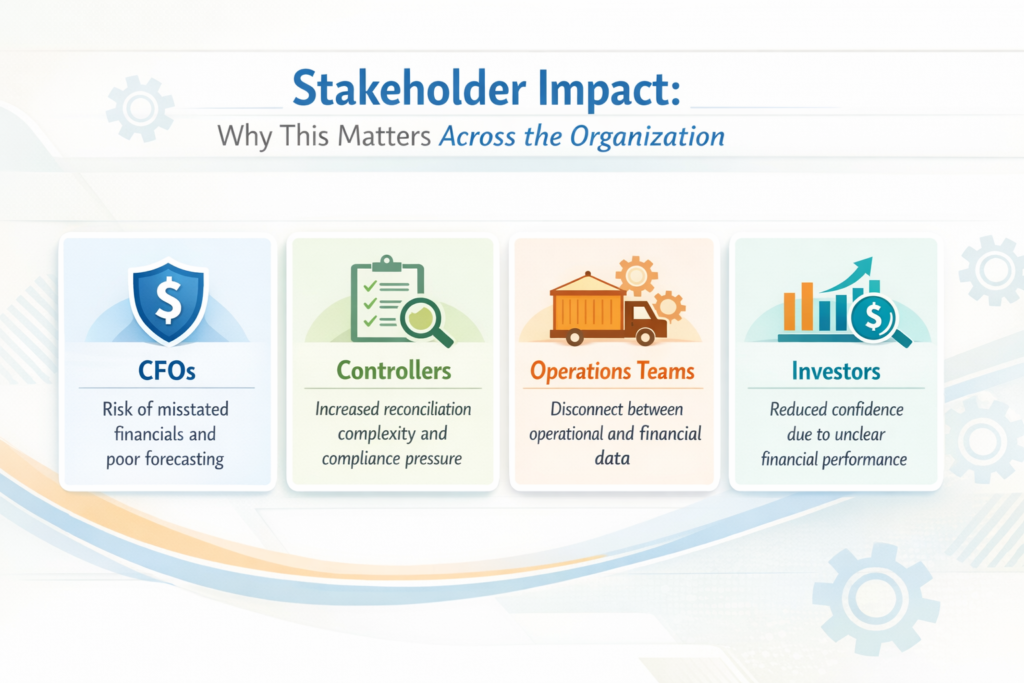
Stakeholder Impact: Why This Matters Across the Organization

Forward Thinking Companies Are Doing

Leading businesses are adapting their accounting approach to match the new reality:

  • Implementing dynamic accrual and estimation models
  • Integrating FX risk tracking into daily accounting
  • Moving to rolling forecasts instead of annual budgets
  • Enhancing inventory and asset impairment reviews
  • Aligning finance teams closely with supply chain operations

Why This Matters: The Risk of Financial Lag

In a volatile environment, the biggest danger is not disruption itself, it is delayed financial awareness.

If accounting does not evolve:

  • Risks remain hidden
  • Decisions become reactive
  • Financial statements lose reliability

Conclusion: Accounting Must Evolve with Disruption

Global conflict has altered supply chains and accounting’s role. Today, financial reporting needs constant adaptation to cost fluctuations, operational uncertainty, and changing strategies, not static assumptions or delayed data. Companies not aligning accounting with these realities risk poor decisions. Proactive businesses improving financial processes, visibility, and real-time data integration will better handle disruption. In an unpredictable world, accurate, adaptive accounting is key to resilience and success.

Read more
Difference Between Accounts Payable and Accounts Receivable

Financial Reporting Risks from Improper Revenue Recognition

Revenue is a key performance metric in U.S. businesses, directly impacting profitability, valuation, investor confidence, and regulatory compliance.Errors in revenue recognition, whether intentional or procedural, present significant risks to financial reporting.

Under U.S. GAAP (ASC 606), revenue must be recognized when performance obligations are satisfied and control is transferred, not merely when cash is received. Noncompliance can result in misstated financial statements, regulatory scrutiny, audit findings, and diminished valuation.

What This Topic Really Means

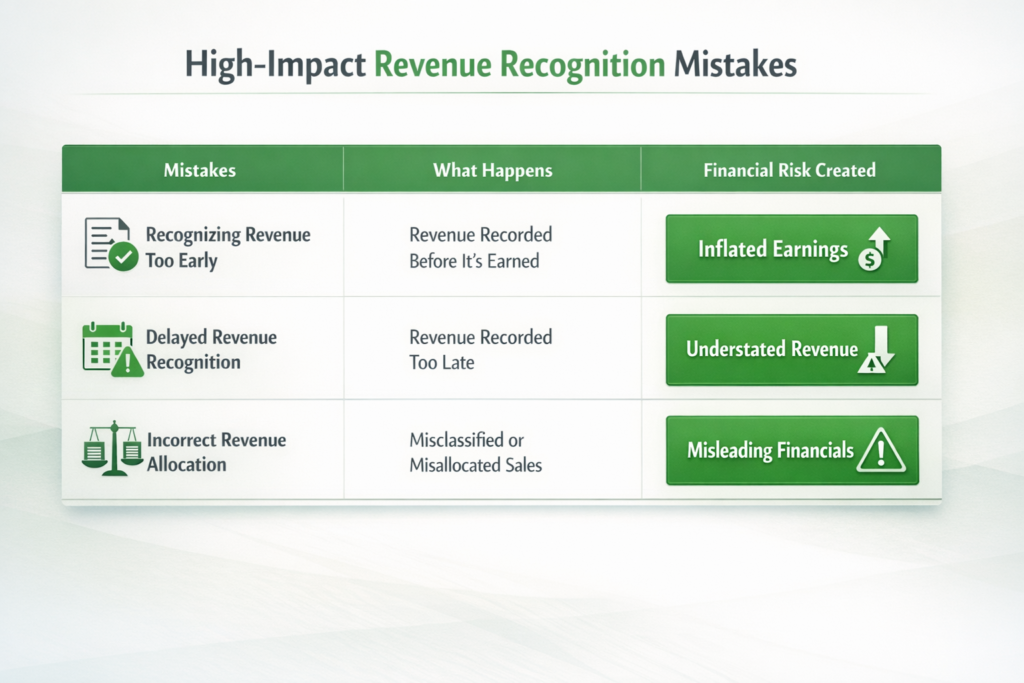
Improper revenue recognition includes:

  • Recording revenue prematurely
  • Delaying revenue recognition
  • Misclassifying revenue streams
  • Recognizing revenue without fulfilling performance obligations
  • These practices result in financial statements that do not accurately reflect the economic reality of the business.

Behavioral Red Flags Inside Organizations

Improper revenue recognition is often driven not only by technical gaps but also by behavioral factors.

Common internal patterns include:

  • Pressure to meet quarterly financial targets
  • Lack of coordination between sales and accounting teams
  • Overreliance on manual adjustments
  • Weak internal control review processes
  • These behaviors increase the likelihood of both intentional and unintentional misstatements.

The Real Problem: Timing vs. Economic Reality

At its core, improper revenue recognition is a timing issue:

  • Early billing
    • Business practice: Recognize immediately
    • U.S. GAAP requirement: Recognize when earned
  • Advance payments
    • Business practice: Treat as revenue
    • U.S. GAAP requirement: Record as liability
  • Long-term contracts
    • Business practice: Recognize upfront
    • U.S. GAAP requirement: Recognize over time
  • Bundled services
    • Business practice: Lump sum recognition
    • U.S. GAAP requirement: Allocate across obligations
  • The disconnect between cash flow and revenue recognition is the underlying cause of most reporting risks.

The 5 Step Revenue Recognition Model (U.S. GAAP – ASC 606)

Businesses are required to follow a structured framework:

  1. Identify the contract with a customer
  2. Identify performance obligations in the contract
  3. Determine the transaction price
  4. Allocate the transaction price to performance obligations
  5. Recognize revenue when performance obligations are satisfied

Stakeholder Impact Breakdown

1. Business Owners

  • Improper revenue recognition creates a misleading view of growth
  • Leads to flawed strategic decisions
  • Results in potential future corrections

2. Investors and Buyers

  • Increases perceived risk
  • Often results in:
    • Lower valuation multiples
    • Extended due diligence timelines
    • Deal renegotiations

3. CPA Firms and Auditors

  • Increases audit complexity
  • Requires:
    • Additional testing procedures
    • Revenue restatements
    • Enhanced compliance reporting

High Impact Revenue Recognition Mistakes

Advanced Risk Scenarios

  1. Multi-Element Arrangements
    Bundled service offerings often create challenges in properly allocating revenue across performance obligations.
  2. Variable Consideration
    Discounts, incentives, and rebates are frequently overlooked, resulting in overstated revenue.
  3. Contract Modifications
    Contract changes are not consistently updated in accounting systems, leading to reporting inconsistencies.
  4. Cutoff Errors
    Revenue recognized in the incorrect period remains one of the most common audit findings in the United States.

How to Fix and Prevent Revenue Recognition Errors (Step-by-Step)

Step 1: Standardize Contracts
Ensure all contracts clearly define deliverables and payment terms.

Step 2: Apply ASC 606 Consistently
Train teams to rigorously follow the five-step revenue recognition model.

Step 3: Automate Revenue Tracking
Implement accounting systems that align revenue recognition with performance obligations.

Step 4: Perform Monthly Reviews
Conduct regular reviews of revenue entries and reconciliations.

Step 5: Maintain Documentation
Retain complete audit trails for all revenue transactions.

Case Insight

A U.S.-based SaaS company recognized annual subscription revenue upfront instead of over the subscription period.

Issue:
Revenue was overstated by 25%

Action Taken:
Revenue was restated in accordance with ASC 606
Financial statements were corrected

Result

Initial valuation declined
Transaction was delayed but ultimately completed after correction

Why This Matters for Business Valuation
Revenue serves as the foundation for EBITDA and valuation multiples. When revenue is overstated:

1.EBITDA (Earnings Before Interest, Taxes, Depreciation, and Amortization) becomes     unreliable

2.Buyers apply valuation discounts
3.Transactions may fail during due diligence

In many U.S. transactions, revenue-related adjustments are among the primary drivers of valuation reductions.

Conclusion

Accurate revenue recognition reflects true business performance. Improper practices introduce hidden risks that impact financial reporting, investor confidence, and valuation. A disciplined, GAAP compliant approach to revenue recognition builds a strong financial foundation for sustainable growth.

References:

Financial Accounting Standards Board (FASB)
ASC 606: Revenue from Contracts with Customers
Core framework for revenue recognition in the United States

Link:

Read more

Chart of Accounts Optimization: The Foundation of Accurate Financial Reporting

A robust Chart of Accounts serves as the fundamental framework for any accounting system, dictating the classification, aggregation, and presentation of financial transactions within financial statements. Inadequate or antiquated COA designs can lead to erroneous reporting, reduced operational efficiency, and challenges in conducting financial analysis. 

Streamlining the Chart of Accounts facilitates the systematic organization of financial data, thereby enhancing reporting precision, accelerating decision-making processes, and improving the efficacy of financial oversight.

 Why Chart of Accounts Optimization Becomes Necessary

Small companies often begin with a basic chart of accounts, but as they grow, adding accounts haphazardly leads to complexity and confusion.

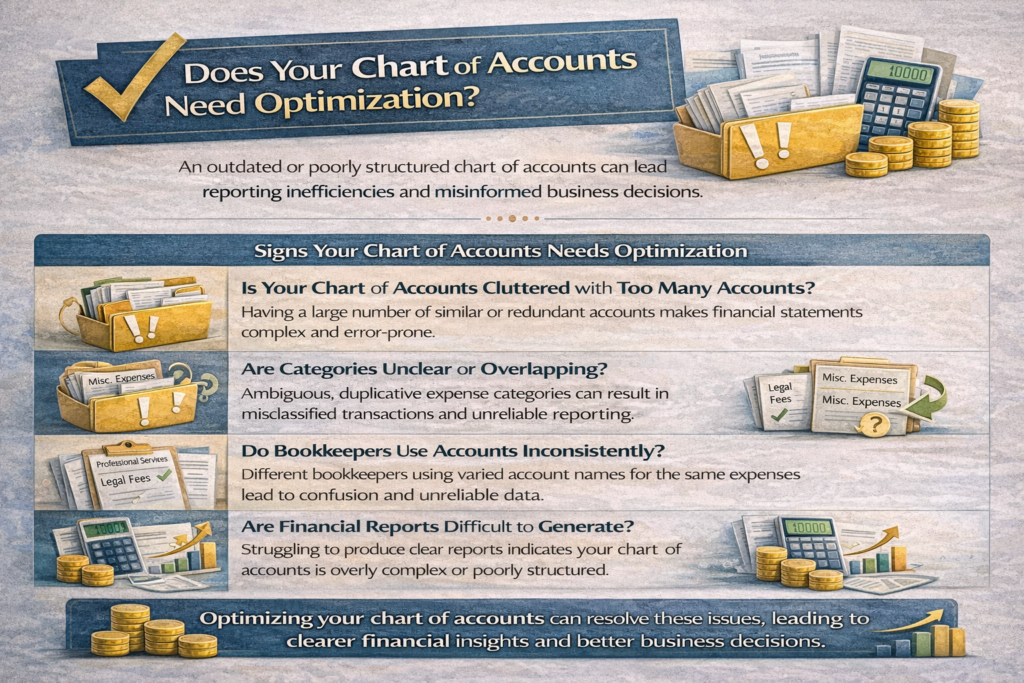
Common issues that signal the need for COA optimization include:

  • Number of accounts are excessive
  • Descriptions of accounts are unclear
  • Duplicate expense categories
  • Inconsistent account usage

Optimization ensures that the accounting structure matches the company’s operational reality.

The Relationship Between COA Design and Financial Reporting Accuracy

A well-designed Chart of Accounts is crucial for accurate financial reporting. Poorly structured accounts can lead to transaction misrecording and skewed financial outcomes, such as inaccurate profit margins from misclassified expenses or an inaccurate balance sheet from incorrect asset categorization.

An optimized chart of accounts ensures that:

  • Financial data is properly categorized
  • Reports are easier to interpret
  • Financial analysis becomes more reliable

Ultimately, the quality of financial reporting depends heavily on the quality of the COA structure.

Key Principles of an Optimized Chart of Accounts

A well designed chart of accounts follows several fundamental principles that support both operational efficiency and financial transparency.

Essential Design Principles

PrincipleExplanation
SimplicityAvoid unnecessary or duplicate accounts
ConsistencyUse standardized naming conventions
ScalabilityAllow room for future business expansion
Logical GroupingOrganize accounts by financial category
Reporting AlignmentEnsure accounts support financial reporting needs

These principles help create a COA that is both efficient and adaptable.

The Impact of COA Optimization on Business Decision Making

Financial reports are only useful if they provide clear insights into business performance.

Optimized account structures allow businesses are as follows:

  1. Analyze cost behavior
  2. Track department level performance
  3. Compare financial results across periods
  4. Financial forecasts generate more accurate data

This improves the quality of strategic decision-making.

Relationship Between COA Structure and Financial Reporting

Financial reporting quality heavily depends on how accounts are structured.

For example:

  1. Sales performance is gauged by revenue accounts.
  2. Expense classifications influence profitability analysis
  3. Asset accounts affect balance sheet accuracy

An optimized COA ensures that every transaction flows logically into financial statements, reducing the need for manual adjustments.

Industry-Specific Chart of Accounts Design

Different industries require different account structures to reflect their operational characteristics.

For example:

Manufacturers track inventory; service firms track labor and project costs.

Example-1

IndustryTypical COA Focus
ManufacturingInventory, production costs
RetailCost of goods sold, sales categories
Professional ServicesLabor, project expenses
Technology CompaniesR&D expenses, subscription revenue

Tailoring the COA to industry requirements improves reporting clarity.

Retailers need a Chart of Accounts optimized for inventory, sales, and COGS, differing from service businesses by requiring close monitoring of stock, supplier costs, and product margins.

Example 2:

Typical Retail Chart of Accounts Structure

Account CategoryExample AccountsPurpose
AssetsCash, Bank Account, Inventory, Store EquipmentManages inventory and asset data.
LiabilitiesAccounts Payable, Credit Card PayableRecords supplier obligations
RevenueProduct Sales, Online Sales Revenue, Discount SalesTracks income from different sales channels
Cost of Goods Sold (COGS)Purchase Cost, Freight-In, Inventory ShrinkageMeasures the direct cost of products sold
Operating ExpensesStore Rent, Advertising exp etc.Operational costs are tracked daily

Practical Example of COA Simplification

Before Optimization

 Office Supplies
Office Stationery
Office Expenses – Supplies
Office Materials

After Optimization

Office Supplies Expense

Consolidating categories simplifies accounting system maintenance and analysis.

Conclusion

Optimizing the Chart of Accounts is key for accurate financial reporting. Simplified, standardized, and business-aligned structures improve financial performance visibility. A good COA boosts reporting efficiency, strengthens controls, aids decision-making, and supports growth.

Reference:

Kieso, Donald E., Jerry J. Weygandt, and Terry D. Warfield – Intermediate Accounting (Widely used accounting textbook explaining financial reporting structures including the Chart of Accounts.)

Read more

Cash Flow vs Profit: Why Profitable Businesses Still Run Out of Cash

 The Profit Illusion in Modern Businesses

Profitability does not always mean financial stability. While profits suggest a healthy company, many profitable businesses face cash shortages or even bankruptcy. This is because profit measures accounting performance, whereas cash flow indicates the actual money available for operations. This difference is crucial for business leaders, as a company can appear profitable yet struggle with payments.

Understanding Profit in Accounting

Profit is the business’s financial outcome that comes after subtracting expenses from revenue, calculated by accounting rules. Under Accrual accounting, revenue is recorded when earned and expenses when incurred, irrespective of cash transactions.

ComponentExplanation
RevenueIncome generated from sales of goods or services
Cost of Goods SoldDirect costs associated with production
Gross ProfitRevenue minus cost of goods sold
Operating ExpensesAdministrative, marketing, and operational costs
Net ProfitFinal profit after deducting all expenses and taxes

Because of this accounting approach, profit often reflects economic performance rather than cash position.

The Hidden Gap Between Profit and Cash Availability

Reported profit and available cash can differ due to accounting and operational elements. Revenue recorded before payment boosts profit but not cash. Expenses like depreciation reduce profit without cash outflow, while loan principal payments decrease cash but aren’t expensed. These timing mismatches can lead profitable companies to experience cash shortages.

Real Business Scenario: Profit Without Cash

Suppose, a manufacturing company that sells goods worth ₹10,00,000 in January.

The company records the revenue immediately in its income statement because the goods have been delivered. However, customers are allowed a 90-day credit period, meaning the cash will only be received in April.

Meanwhile, the company must pay for:

  • employee salaries
  • supplier invoices
  • rent and utilities
  • loan installments

Although the income statement shows a profit, the business may struggle to meet these payments because the actual cash has not yet been collected.

Profit vs Cash Flow: A Practical Comparison

The difference between profit and cash flow becomes clearer when comparing their financial meaning and reporting structure.

Basis of ComparisonProfitCash Flow
Financial StatementIncome StatementCash Flow Statement
Accounting MethodAccrual AccountingCash Based Movement
RecognitionRevenue and expenses recorded when incurredCash recorded when received or paid
PurposeMeasures business performanceMeasures liquidity and financial stability
Impact on SurvivalIndicates profitabilityDetermines ability to operate daily

This distinction explains why profitability does not always translate into available cash.

Major Reasons Profitable Businesses Experience Cash Shortages

The following operational factors commonly lead to liquidity problems even when profits 

are strong.

Business FactorImpact on Cash Flow
Slow customer paymentsCash remains stuck in receivables
Excess inventoryMoney tied up in unsold stock
Capital expenditureLarge cash payments for equipment or assets
Loan principal repaymentsExpenses is not reflected as cash outflows
Rapid business growthIncreased need for working capital

Financial Statements and Their Role in Liquidity Analysis

Understanding the relationship between financial statements helps explain how profit and cash flow differ.

The income statement shows profitability during a period.
The balance sheet reflects assets, liabilities, and equity at a specific point in time.
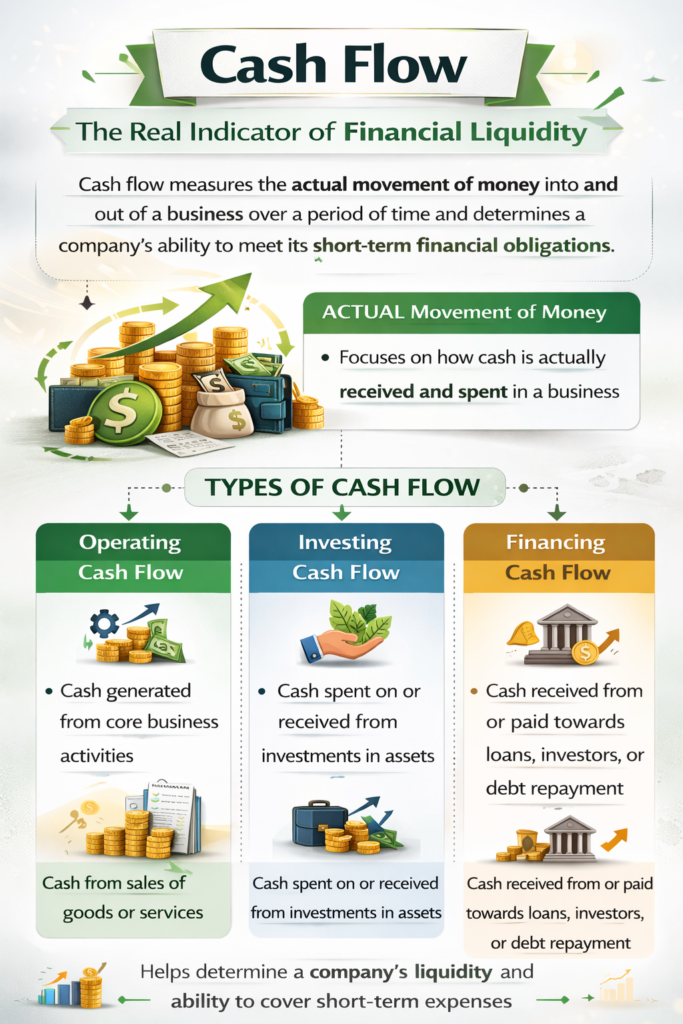
The cash flow statement tracks the actual movement of cash between these periods.

Early Warning Indicators of Cash Flow Problems

Financial analysts often rely on specific ratios and indicators to detect potential liquidity issues before they become critical.

IndicatorPurpose
Operating Cash FlowMeasures cash generated from core operations
Current RatioEvaluates short term financial strength
Quick RatioMeasures ability to meet obligations without inventory
Cash Conversion CycleShows how quickly sales convert into cash

Practical Strategies to Improve Cash Flow Management

Companies can strengthen their financial stability by implementing structured cash management practices.

Effective strategies include improving receivable collection systems, negotiating better credit terms with suppliers, maintaining optimal inventory levels, and preparing accurate cash flow forecasts.

Businesses should also maintain a liquidity buffer to handle unexpected financial obligations.

Working Capital: The Core Driver of Cash Flow

Working capital represents the funds required to operate daily business activities. It directly influences how quickly a company converts sales into cash.

Working capital consists of three primary elements:

ComponentRole in Cash Flow
Accounts ReceivableMoney customers still owe to the business for credit sales.
InventoryA business keeps goods in stock to sell or use in production.
Accounts PayableMoney the business still owes to suppliers for credit purchases.

Efficient management of these components helps businesses maintain healthy liquidity.

Conclusion

Profit shows operational success, but cash flow dictates survival and effective operation. A company can seem profitable yet struggle with immediate payments if cash is scarce. Therefore, businesses need to assess both profitability and liquidity. Recognizing the distinction between profit and cash flow, and managing working capital efficiently, ensures lasting financial health and growth.

Reference

https://www.kariwala.pro/services/accounting/

Read more
Difference Between Accounts Payable and Accounts Receivable

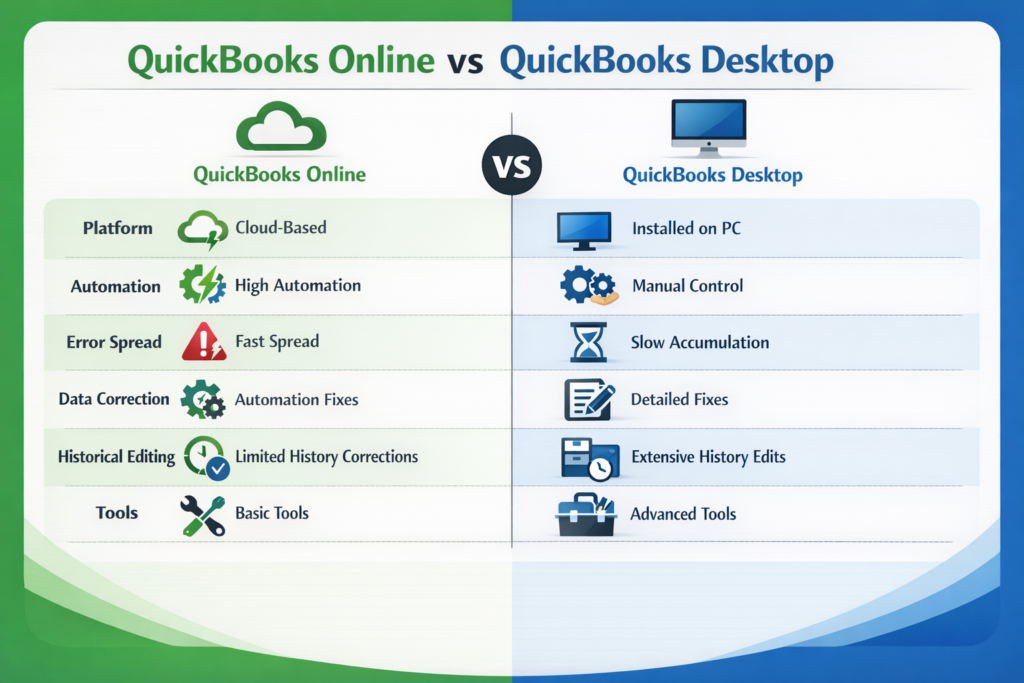
QuickBooks Online vs QuickBooks Desktop Cleanup: A Structured Guide to Restoring Accurate Financial Records

Why QuickBooks Cleanup Becomes Necessary

As companies grow, change accountants, or outsource bookkeeping, their QuickBooks files can develop errors like duplicate entries, incorrect balances, uncleared transactions, and automation issues. These inaccuracies hinder financial accuracy, complicating tax preparation, audits, and financial statement generation. A structured QuickBooks cleanup process identifies and corrects these issues, ensuring the system accurately reflects financial health. Both QuickBooks Online and Desktop require this cleanup, though methods differ due to their distinct designs and automation handling.

QuickBooks Cleanup Process: Step-by-Step Framework

A structured cleanup process typically follows these steps:

  1. File assessment and backup
  2. Review of chart of accounts
  3. Verification of opening balances
  4. Cleanup of duplicate and incorrect transactions
  5. Correction of automation rules (Online)
  6. Structural corrections and rebuild (Desktop)
  7. Sequential bank reconciliation
  8. Financial report verification

This systematic approach ensures complete restoration of accounting accuracy.

 Accessibility and Remote Working Capability

This subtopic explains how easily users can access QuickBooks and work remotely.

QuickBooks Online:
QuickBooks Online is a cloud-based accounting software accessible via a web browser from any location, supporting remote teams, external accountants, and businesses with multiple branches without requiring local software installation.

QuickBooks Desktop:
QuickBooks Desktop is installed on a local system. Access is limited to the computer where it is installed unless remote access tools or hosting services are used. This makes it less flexible for remote teams.

Why this matters:
Businesses with remote employees, outsourced accounting firms, or multiple locations benefit more from QuickBooks Online due to its accessibility.

Bank Reconciliation Cleanup and Correction Process

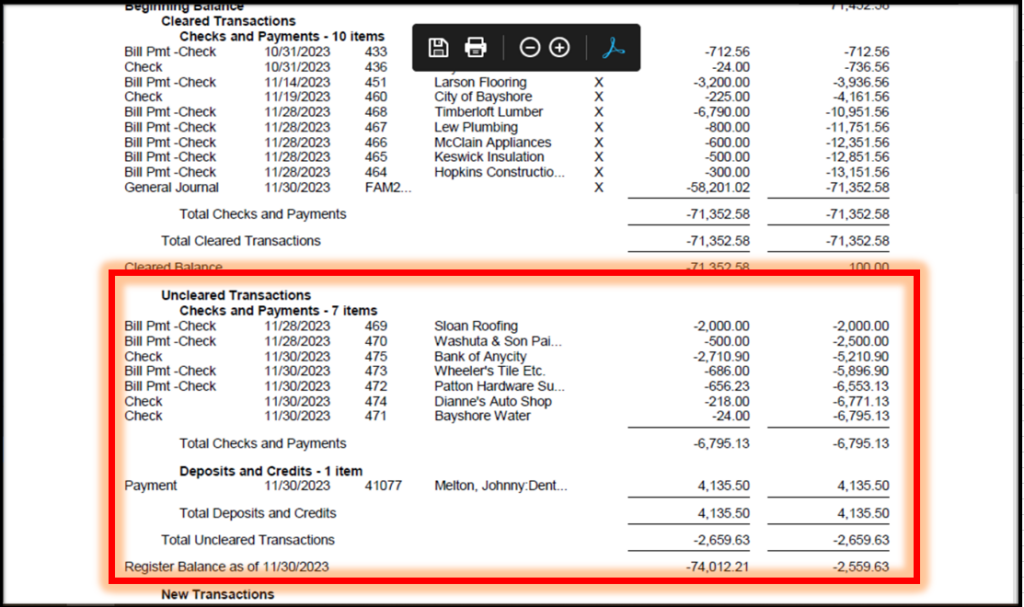
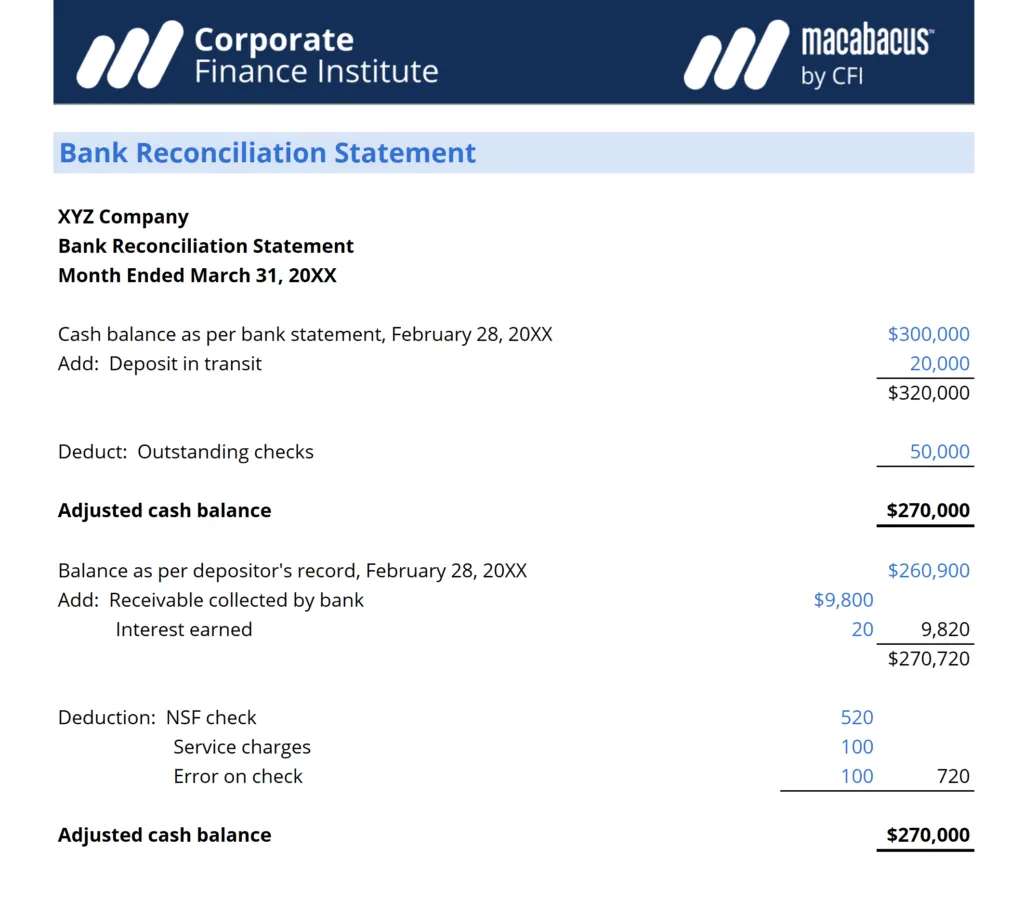
Bank reconciliation is the foundation of accurate accounting.

Cleanup involves:

  • Identifying missing transactions
  • Removing duplicate entries
  • Correcting incorrect postings
  • Ensuring balances match bank statements

Reconciled transactions must never be deleted. Corrections should always address the original error rather than forcing adjustments.

Proper reconciliation ensures accurate financial reporting and audit readiness.

Data Backup, Security, and Risk Protection

This subtopic explains how financial data is protected in both versions.

QuickBooks Online:
QuickBooks Online automatically backs up data in secure cloud servers. It uses encryption, secure login, and advanced security layers. There is no risk of losing data due to system failure or hardware damage.

QuickBooks Desktop:
QuickBooks Desktop requires manual backups or scheduled backups. If backups are not maintained properly, there is a risk of data loss due to system crashes, hardware failure, or viruses.

Why this matters:
Automatic backups in QuickBooks Online provide better protection and reduce risk, while Desktop requires more manual responsibility.

Common Problems Identified During QuickBooks Cleanup

The most frequent issues found during cleanup include:

  1. Duplicate transactions from bank feeds
  2. Incorrect automation rules
  3. Unreconciled bank accounts
  4. Incorrect opening balances
  5. Payroll liability discrepancies
  6. Inventory valuation errors
  7. Improper use of undeposited funds
  8. Incorrect journal entries

These issues accumulate over time and reduce financial reliability.

Key Differences: QuickBooks Online vs Desktop Cleanup

Business Benefits of Proper QuickBooks Cleanup

Proper cleanup provides significant benefits:

  • Accurate financial reporting
  • Reliable tax filing
  • Audit readiness
  • Better business decision-making
  • Smooth outsourcing transition
  • Improved financial transparency

Clean books improve operational confidence and financial control.

When Professional Cleanup Support Is Recommended

Professional cleanup is necessary when:

  • Multiple years require correction
  • Reconciliations are incomplete
  • Financial reports are unreliable
  • Business is preparing for audit
  • Business is transitioning to outsourced accounting

Conclusion: 

QuickBooks cleanup ensures financial accuracy, reliable reporting, and readiness for compliance, audits, and growth. QuickBooks Online and Desktop need distinct cleanup methods due to their differing operations. Proper assessment, automation control, reconciliation maintenance, and error correction restore confidence in financial data, resolving current issues and building a foundation for sustainable financial management.

Reference:

Bank reconciliation and bookkeeping best practices

Read more

Advance Interest and Principal Repayment: Accounting Treatment with Year-End and Next-Year Impact

Scenario Overview

In December 2025, a business obtained a loan of ₹10,00,000 at 10% annual interest. In January 2026, the business made a combined payment of ₹1,20,000, which included:

  • ₹10,000 for current interest (expense of FY 2025-26)
  • ₹10,000 for advance interest (benefit of next financial year)
  • ₹1,00,000 towards principal repayment (reduction of liability)

This single transaction affects three different accounting elements:

  • Expense recognition (Interest Expense)
  • Asset creation (Prepaid Interest)
  • Liability reduction (Loan Principal)

Proper classification ensures that profit, assets, and liabilities are presented accurately in the financial statements.

Why Proper Accounting Treatment is Important

If the full ₹20,000 interest is treated as expense immediately:

  • Profit will be understated
  • Assets will be understated
  • Financial statements will not reflect future benefits

Correct accounting ensures:

  • Only current period interest is treated as expense
  • Advance interest is recorded as a current asset
  • Loan balance reflects actual outstanding liability
  • Financial statements present a true and fair view

This treatment follows the Accrual Concept and Matching Principle, where expenses are recorded in the period to which they relate.

Complete Accounting Treatment and Financial Position as on 31 March 2026

Component
Amount (₹)

Accounting Treatment
Effect on Financial StatementsExplanation
Loan Taken (Dec 2025)10,00,000Loan A/c creditedLiability increasesCreates legal repayment obligation
Principal Repaid (Jan 2026)1,00,000
Loan A/c debited
Loan reduces to ₹9,00,000Improves financial position
Interest Paid (Current period)10,000Interest Expense debitedExpense recorded in P&LReduces profit of FY 2025-26
Interest Paid in Advance10,000Prepaid Interest debitedRecorded as Current AssetFuture benefit available
Total Bank Payment1,20,000Bank creditedBank balance decreasesCash outflow occurred

Closing Financial Position as on 31 March 2026

Financial ElementAmount (₹)Financial StatementPosition
Loan Outstanding9,00,000Balance SheetLiability
Prepaid Interest10,000Balance SheetCurrent Asset
Interest Expense10,000Profit & Loss AccountExpense
Bank BalanceReduced by ₹1,20,000Balance SheetAsset reduced

Key Interpretation as on 31 March 2026

As of the financial year-end, the business has correctly recognized only ₹10,000 as interest expense because it relates to the current accounting period. The advance interest of ₹10,000 remains classified as a prepaid asset, representing future economic benefit.

The loan balance has been reduced from ₹10,00,000 to ₹9,00,000 due to principal repayment. This improves the company’s financial stability by lowering its outstanding obligations.

This treatment ensures that profit is not understated, assets are correctly presented, and liabilities reflect the true financial obligation.

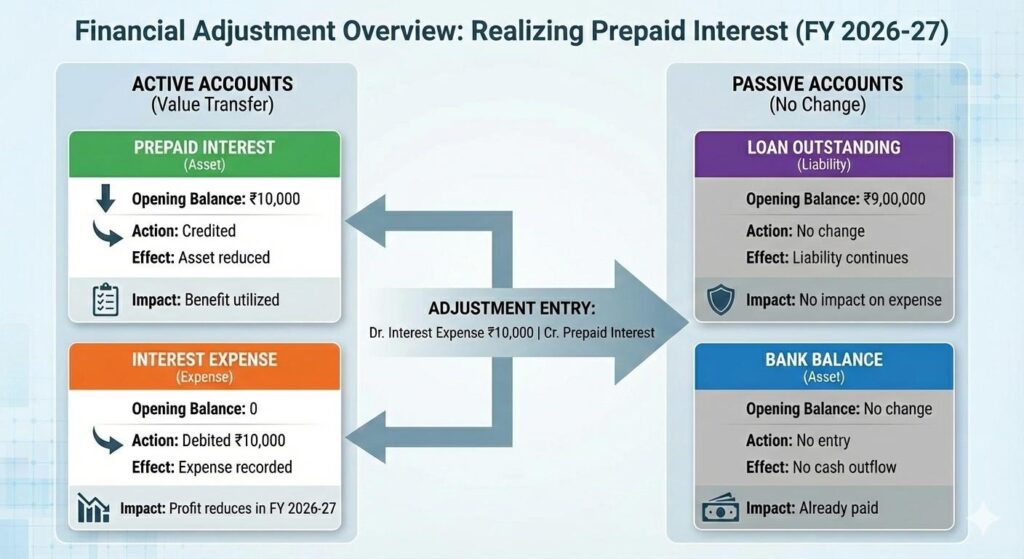
Result in April 2026

In April 2026, the prepaid interest is converted into interest expense because the benefit now relates to the current accounting period. This adjustment ensures proper matching of expense with the relevant period.

No additional cash payment occurs because the interest was already paid earlier. This ensures proper expense recognition without affecting cash flow again.

Overall Accounting Impact Summary

ComponentTreatmentFinancial Effect
Current InterestExpenseReduces current year profit
Advance InterestCurrent AssetFuture benefit
Principal RepaymentLiability ReductionImproves financial strength
Bank PaymentCash OutflowReduces bank balance

Final Financial Position Interpretation

As of March 31, 2026, the financial statements reflect the correct position of the business. The loan liability stands at ₹9,00,000, prepaid interest of ₹10,000 is recorded as an asset, and only ₹10,000 is recorded as expense in the Profit & Loss Account.

This ensures that profit, assets, and liabilities are accurately reported and financial statements present a true and fair view.

Additional Professional Subtopics 

Impact on Profitability and Financial Performance

Proper treatment ensures that only the relevant interest expense is recorded in the current financial year. If advance interest is incorrectly recorded as expense, profit will appear lower than actual, which can mislead management and stakeholders. Correct classification helps in accurate performance evaluation and decision making.

Impact on Balance Sheet Accuracy and Financial Position

Recording advance interest as a prepaid asset ensures that assets reflect future economic benefits. Similarly, principal repayment reduces liabilities, improving the company’s debt position. This ensures the Balance Sheet presents the true financial strength of the business.

Importance for Audit, Compliance, and Financial Transparency

Auditors verify whether expenses, assets, and liabilities are correctly classified. Proper accounting treatment ensures compliance with accounting standards and prevents financial misstatement. This improves transparency, builds investor confidence, and ensures reliable financial reporting.

Conclusion

When a business pays interest in advance along with principal repayment, each component must be accounted for separately. Current interest is treated as expense, advance interest is recorded as a prepaid asset, and principal repayment reduces loan liability. This ensures proper expense recognition, accurate financial reporting, and correct presentation of financial position. Such treatment supports reliable decision-making, ensures compliance with accounting principles, and maintains the integrity of financial statements.

Reference:

IFRS framework issued by the International Accounting Standards Board (IASB)

Read more

Understanding Accrual and Cash Accounting Methods for Business Expansion

As businesses grow, financial tracking becomes crucial, impacting decisions, compliance, funding, and scalability. Accrual and cash accounting methods influence profitability, tax management, and expansion planning. The right choice at the right time enhances operational clarity and financial control.

The Core Logic Behind the Two Methods

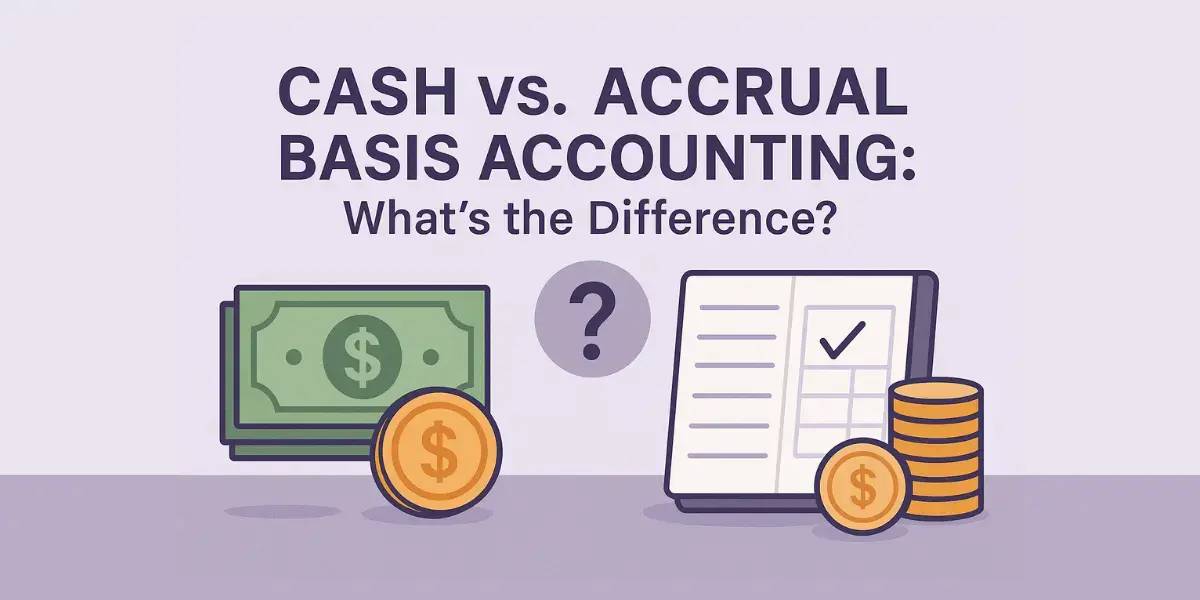
Cash accounting records transactions only when cash actually moves income when received and expenses when paid.
Accrual accounting, on the other hand, records income when it is earned and expenses when they are incurred, regardless of when cash changes hands.

How Each Method Reflects Business Reality 

This comparison highlights why many growing businesses eventually transition away from cash accounting as operations become more layered.

What Growing Businesses Prefer and Why

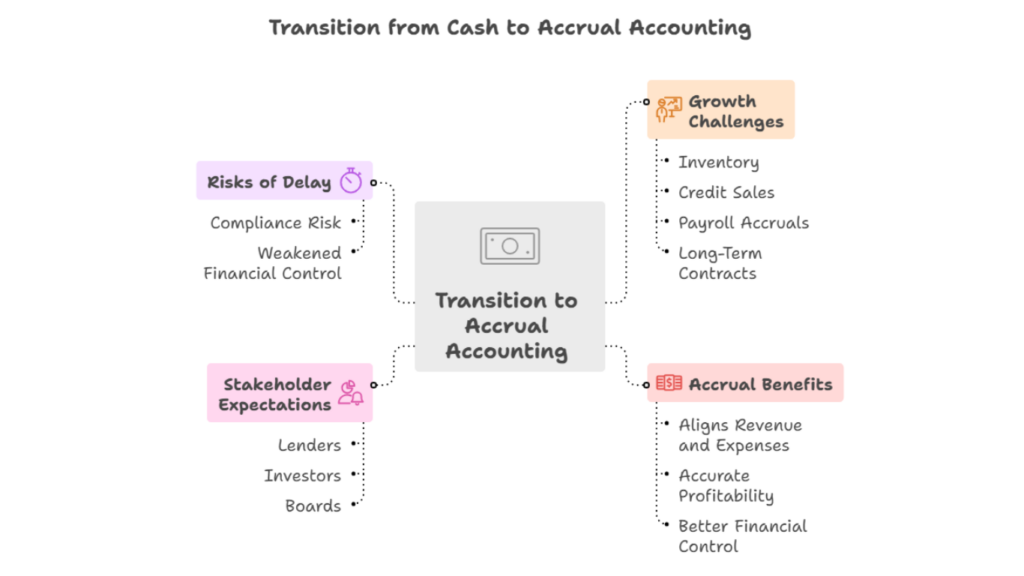
As businesses scale, their preferences tend to shift for practical reasons:

  • They need visibility into unpaid invoices and upcoming liabilities
  • They require accurate profit measurement, not just cash balance
  • They seek easier access to funding and investor confidence
  • They must comply with formal reporting standards

For these reasons, accrual accounting becomes the preferred method once operational complexity increases.

Why Early Stage Businesses Lean Toward Cash Accounting 

Startups and small businesses often prefer cash accounting because:

  • It is easy to understand and implement
  • It mirrors bank balance movements
  • It requires minimal accounting expertise

At this stage, simplicity often outweighs analytical depth.

Implementation Challenges Businesses Often Underestimate 

Challenge AreaCash Method ImpactAccrual Method Impact
System SetupMinimalRequires structured processes
Staff ExpertiseBasic accounting knowledgeTrained accounting professionals
Ongoing MaintenanceLowModerate to high
Error RiskLower complexityHigher if unmanaged

Understanding these challenges helps businesses prepare for a smooth transition rather than reacting to compliance pressure later.

Accrual Accounting as a Growth Enabler 

Accrual accounting supports expansion by enabling:

  • Revenue matching: Income is aligned with related expenses
  • Financial forecasting: Future cash flows become visible
  • Operational control: Payables and receivables are tracked
  • External credibility: Financials align with professional standards

This makes accrual accounting a preferred model for businesses planning long term scalability.

The Compliance and Regulatory 

Tax authorities in many places, like the U.S., permit small businesses below certain revenue limits to use the cash method of accounting. However, businesses with inventory, varied income sources, or external reporting needs usually must use accrual accounting. Accrual accounting also produces financial statements that better match GAAP and IFRS, making them suitable for audits, investors, and lenders.

 Impact on Performance Interpretation

Under AAP:

  • Profit reflects actual business activity
  • Management can evaluate trends and margins
  • Growth decisions are data-driven

Under cash accounting:

  • Profit fluctuates with payment timing
  • Performance may appear distorted

Long-term planning becomes difficult

Conclusion

Choosing between cash and accrual accounting affects a business’s finances, growth, and communication. Cash accounting is straightforward and shows immediate cash flow but is less detailed for complex businesses. Accrual accounting, by matching revenues and expenses, better shows profitability, which is vital for growth, funding, or meeting regulations. Growing businesses often need to update their accounting method.

Reference:

FinCEN – Beneficial Ownership Information Reporting (FinCEN.gov)


Read more

Latest Supply Chain Accounting Risks Highlighted by U.S. Government Reports (2024–2025)

Recent U.S. government reviews, regulatory briefings, and agency observations during 2024–25 have made one point clear: supply chain disruptions are no longer just operational issues, they are accounting and financial reporting risks. From inventory valuation errors to disclosure failures and forecasting distortions, supply chain instability is now directly impacting how U.S. companies prepare, audit, and rely on their financial data.

This shift has major implications for CFOs, CPAs, controllers, auditors, and offshore accounting teams supporting U.S. businesses.

Why CPA Firms Cannot Ignore Supply Chain Risks Anymore

Recent U.S. government reports from 2024–25, issued by entities like the GAO, SEC, and PCAOB, have unequivocally demonstrated that disruptions in supply chains now pose a significant financial reporting and auditing risk, extending beyond mere operational concerns. Consequently, accounting firms are facing growing expectations to pinpoint, assess, and address the accounting implications stemming from supply chain volatility. For CPA firms that cater to businesses involved in manufacturing, distribution, retail, or import reliant operations, these risks are now surfacing directly within audit conclusions, client financial assessments, and consulting projects.

Mistakes in inventory valuation can directly expose CPA firms to audit risks

Supply chain disruptions have caused volatile material costs, freight surcharges, and supplier price resets. CPA firms are now encountering inventory balances that fail LCM, NRV, or impairment tests.

How CPA firms are affected

  • Increased audit adjustments and post close corrections
  • Higher risk of inventory overstatement findings

More time spent defending valuation assumptions with regulators and lenders

How CPA firms can resolve this
CPA firms should lead clients toward:

  • Periodic inventory remeasurement (not annual only testing)
  • Clear valuation policies aligned with ASC 330
  • Documented assumptions supporting management estimates

Key Supply Chain Accounting Risk Areas Identified by U.S. Authorities (2024–25)

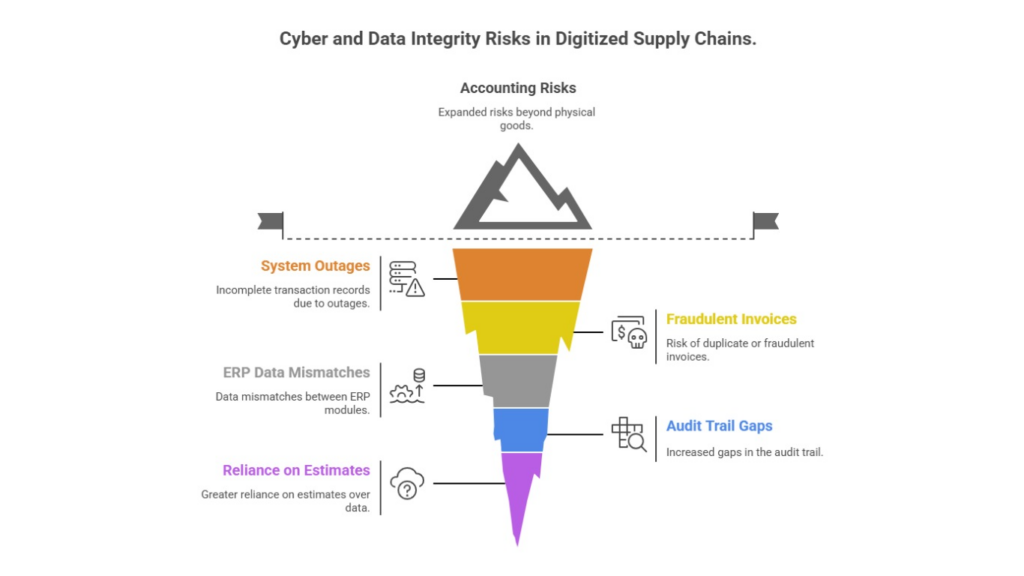
In 2024–25, U.S. government and oversight reports indicate that supply chain disruptions primarily manifest as accounting risks via issues with inventory valuation, inconsistent cost assignments, untrustworthy vendor information, delayed recording of expenses, and compromised financial projections. These vulnerabilities significantly impact an organization’s preparedness for audits, the precision of its financial statements, and the effectiveness of management’s strategic choices, thereby becoming a paramount concern for accounting departments and CPA firms assisting American enterprises.

Working Capital Stress: A Hidden Accounting Exposure

Supply Chain IssueAccounting ImpactBusiness Consequence
Over-stocking to avoid shortagesHigher inventory carrying valueCash flow pressure

Delayed supplier deliveries
Accrued liabilities misalignedVendor disputes
Advance payments to suppliersPrepaid expense complexityLiquidity risk
Slow-moving inventoryHigher write-down riskReduced ROA

Regulatory Scrutiny Is Expanding CPA Responsibilities

The PCAOB and SEC have increased attention on supply chain related audit risks.

CPA firm implication

  • Expanded audit scope
  • Higher documentation standards
  • Greater professional judgment exposure

Firm-level response
Standardizing audit programs around supply chain risks and enhancing staff training is now essential.

Disclosure & Going Concern Pressure on CPA Firms

U.S. regulators now expect enhanced disclosures around supply chain dependency.

CPA firm challenge

  • Determining when supplier concentration becomes a material risk
  • Evaluating disclosure adequacy under SEC scrutiny
  • Aligning footnotes with actual financial exposure

How CPA firms add value
By guiding clients on:

  • Risk focused disclosures
  • Dependency analysis
  • Consistency between MD&A and financial statements

This strengthens both compliance and investor confidence.

Disclosure Expectations Are Rising

The SEC has emphasized transparency around supplier concentration and supply chain dependency. This aligns with disclosure guidance discussed in the Journal of Accountancy.

CPA responsibility
Firms must evaluate:

  • Whether supply chain risk is material
  • Adequacy of footnote disclosures
  • Consistency between MD&A narratives and financial data

This has expanded the CPA’s role from preparer to risk evaluator.

 Why This Matters to Offshore Accounting Teams

While India has not issued a single consolidated supply chain accounting report like the U.S., Indian professionals supporting U.S. clients are directly impacted. Offshore accounting teams must:

  • Adjust inventory and cost models quickly
  • Support enhanced audit documentation
  • Track supplier-related cost changes accurately
  • Help U.S. firms meet rising disclosure expectations

For Indian accounting partners, understanding U.S. supply chain risk narratives has become essential, not optional.

Conclusion

Supply chain instability is a 2024-25 U.S. government reporting concern, impacting financial reporting beyond logistics. Businesses with misaligned accounting face increased audit risk, poor forecasts, and diminished stakeholder trust. CPA firms and accounting teams can help clients manage supply chain uncertainty for better financial clarity and control.

Reference:

U.S. Government Accountability Office (GAO) – Supply Chain Risk Management Reports


Read more
Difference Between Accounts Payable and Accounts Receivable

AI-Driven Fraud Detection in Accounts Payable

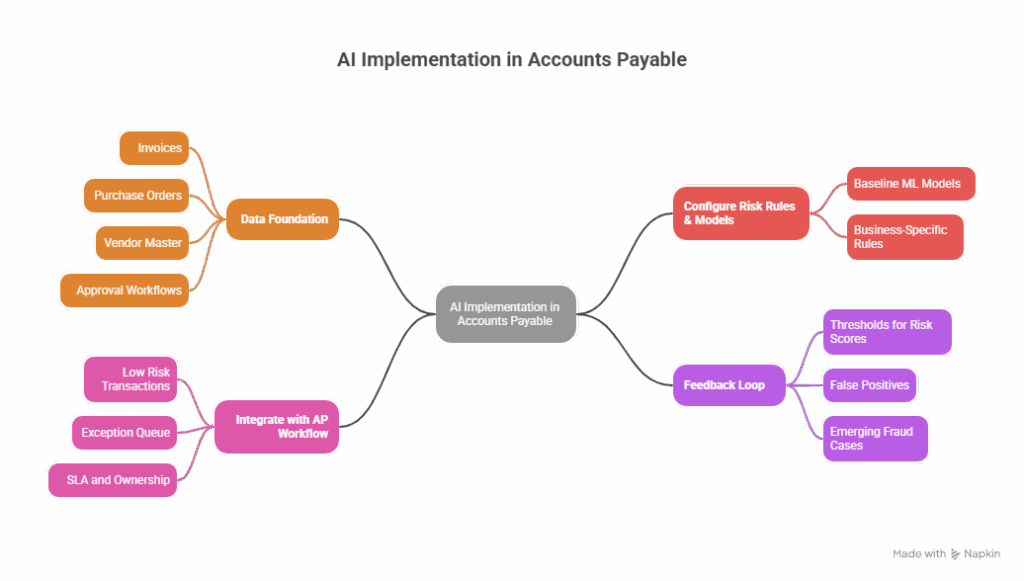
Accounts payable faces significant fraud and value loss risks in the dynamic US business landscape. Deceptive vendors, modified bank information, repeated invoices, and policy violations can silently reduce profits and harm supplier ties. Outdated controls, manual checks, and delayed audits, suited for slower, less complex operations, are inadequate for today’s high-volume, multi-entity AP processes.

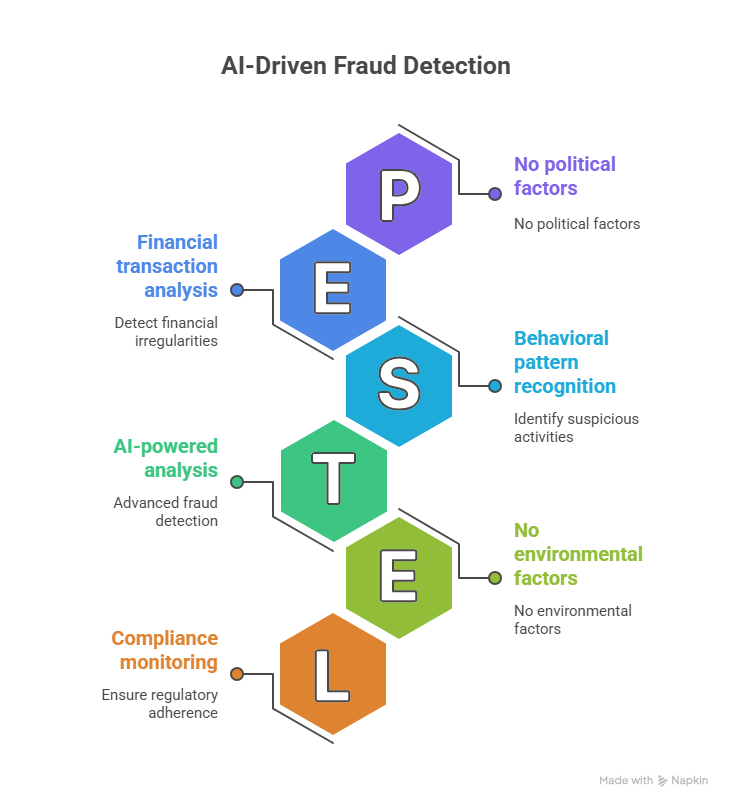
AI systems layer several methods to spot risk:

  1. Anomaly detection: unsupervised models flag items that deviate from learned norms (amount, frequency, timing, GL code).
  2. Pattern recognition / supervised ML: trained models identify known fraud signatures using labeled historical cases.
  3. Entity resolution: fuzzy matching links related records (same vendor with slightly different names/bank details).

Why Accounts Payable needs AI now

In most organizations AP teams face:

  • High invoice volume and tight payment timelines
  • Repetitive manual checks (three-way matching, vendor validations)
  • Multiple people handling invoices, vendor master, and approvals

How AI actually works in Accounts Payable

AI in Accounts Payable is not “magic”  it is a set of smart tools that read, match, learn, and flag risks across every invoice and payment. Here’s how it works in practice:

1) Intelligent data capture instead of manual typing

Traditional AP teams key in data from invoices, POs, and GRNs. AI replaces this by:

  • Using OCR + machine learning to read invoices (PDF, scans, emails) and extract key data: vendor name, invoice number, date, amount, tax, line items, payment terms, bank details, etc.
  • Learning from past corrections – if a user corrects a field once (e.g., vendor name mapping), the system remembers and improves accuracy for next time.
  • Handling different formats and layouts from multiple vendors without needing custom templates each time.

Result: High-volume data entry becomes review and approve instead of type and retype.

2) Automated 2-way / 3-way matching powered by rules + patterns

AI engines automatically link:

  • Invoices ↔ Purchase Orders (2-way match)
  • Invoices ↔ POs ↔ Goods Receipts (3-way match)

They do not just check exact matches; they:

  • Tolerate small configurable differences (e.g., quantity tolerance, rounding differences).
  • Recognize partial receipts (e.g., invoice for 80 units when 100 were ordered but only 80 received so far).
  • Flag exceptions when patterns look unusual (wrong vendor, unusual price, unexpected quantity).

This reduces manual matching work and helps AP teams focus only on true exceptions, not every single invoice.

3) Duplicate and look-alike invoice detection

Fraud and error often exploit weaknesses in duplicate checking. AI goes beyond exact matches and checks for look-alike patterns, such as:

  1. Same vendor, similar amount, but slightly different invoice numbers (I-1001 vs I-l001, 0 vs O).
  2. Same invoice number and amount but different dates.
  3. Sequential invoices arriving unusually close together or with suspiciously similar values.

By using fuzzy matching and pattern recognition, the system catches duplicates that normal ERP duplicate checks may miss.

4) Vendor master and bank detail validation

A common fraud route is changing vendor bank details or using fake vendors. AI helps by:

  1. Monitoring changes to vendor master data (address, bank account, tax ID) and flagging high-risk combinations (e.g., change requested just before a big payment run).
  2. Checking if new bank accounts are repeatedly linked to unrelated vendors.
  3. Scoring new vendors based on unusual characteristics (no history, mismatched address, abnormal invoice patterns).

This helps prevent fake vendor setups and diverted payments.

 Implementing AI in Accounts Payable: practical roadmap

AI enhances Accounts Payable by automating tasks, boosting fraud detection, and providing real-time risk analysis. It integrates with existing AP systems for invoice, vendor, and payment management, working alongside ERP and approval workflows. AI acts as a risk oversight tool, flagging suspicious items while accelerating legitimate.

 Where an outsourcing partner fits in (Kariwala & Co. LLP)

A partner like Kariwala & Co. LLP can:

  • Run the end-to-end AP process (invoice capture, validation, posting, reconciliations) with AI-based checks embedded.
  • Manage exception queues, contacting vendors for clarifications and coordinating with your internal approvers.
  • Provide regular risk reports fraud patterns spotted, duplicate payments prevented, vendor risk rankings.

Conclusion

AI fraud detection makes Accounts Payable more controlled and data-driven. It instantly analyzes invoices, vendor changes, and approvals to prevent fraud, reduce errors, and speed up processing, easing the burden on AP staff. AI in AP provides secure, intelligent fund management with strong governance and expert support.

Reference:

COSO / ACFE Fraud Risk Management Guide (2023 edition)  for the idea of structured fraud risk assessment, continuous monitoring and using analytics/automation as part of fraud controls. 


Read more

Internal-Use Software Costs — Financial Accounting Standards Board (FASB) ASU

Software is indispensable to contemporary business functions, encompassing everything from enterprise resource planning  systems to customer support interfaces and internal data analysis tools. For accounting, bookkeeping, and finance professionals in the United States, including those involved in outsourced or shared service arrangements, grasping the new guidelines is paramount. These guidelines impact the timing and classification of capitalizable costs, the methods for assessing development risks, and the disclosures required for software-related expenditures. This article delves into the key areas that must be understood to successfully implement ASU 2025-06.

What Is Internal-Use Software?

Internal-use software, as defined by FASB’s guidelines, encompasses any software that is purchased, created, or altered exclusively for a company’s internal business activities rather than for external sale, leasing, or marketing purposes.

For Example:

  • Payroll processing systems
  • Accounting and financial reporting applications
  • Customized enterprise resource planning (ERP) systems

Internal use software is distinct from software developed for sale (covered under ASC 985-20) or hosted arrangements provided to customers (ASC 350-40).

Capitalization Guidelines and Illustrations

Capitalization begins when:

  1. Preliminary stage is complete,
  2. Management authorizes funding and
  3. It’s probable the project will be completed and used internally.

Capitalizable costs include:

  1. Direct labor of employees developing the software
  2. Costs of materials and services
  3. Interest costs incurred during development (if material)

Non-capitalizable costs include:

  1. General overhead
  2. Training or maintenance costs
  3. Data conversion and re-engineering expenses

Cloud Computing and SaaS Arrangements

ASU 2025-06 introduces changes to how organizations handle cloud computing and Software-as-a-Service (SaaS) agreements.

  • When a client possesses the right to manage software via a license, it is categorized as software intended for internal use and is therefore subject to capitalization according to ASC 350-40.
  • If it is  not a pure SaaS model, you can still record the costs of setting it up as prepaid assets and spread them out over the contract period following the rules in ASU 2018-15.

Amortization and Impairment

Once the software is ready for use the capitalized cost is amortized over its estimated useful life (typically 3–7 years).

  • The method should reflect the pattern of expected benefit; straight line is used if no better estimate is available.
  • Software undergoes impairment testing when alterations in its usage, capabilities, or underlying technology suggest that its recorded value might not be recoverable in accordance with ASC 360 principles.

 Disclosure Requirements under ASU 2025-06

Enhanced disclosures aim to improve transparency for investors and stakeholders. Entities must disclose:

  • Total capitalized internal-use software costs
  • Amortization expense for each period
  • Impairment losses recognized
  • Description of software types and useful lives

These disclosures provide insight into the technological investment and operational efficiency of a company.

Comparison with Previous Guidance (Pre-ASU 2025-06)


Area

Before (ASC 350-40)

After (ASU 2025-06)

Capitalization trigger

Ambiguous between preliminary and application stages

Clear criteria for capitalization authorization and completion probability

Cloud/SaaS treatment

Limited clarity

Specific treatment aligning with ASU 2018-15

Disclosure

Minimal

Expanded and standardized

Transition

N/A

Prospective adoption from FY 2025-26

 Relevance for U.S. Businesses

Internal software development investments will be handled more uniformly and openly thanks to the modification.

  • Companies with significant IT spending (financial institutions, manufacturers, healthcare, etc.) will see a clearer impact on their balance sheet.
  • It boosts industry comparability and boosts investor trust.

How Kariwala & Co. LLP Helps U.S. Businesses

At Kariwala & Co. LLP, we help U.S. firms understand and implement ASU 2025-06 by:

  • Evaluating which internal-use software costs qualify for capitalization.
  • Assisting in documentation and disclosure preparation as per FASB standards.

Ensuring that your financial reporting reflects technological investments accurately.

Conclusion

The FASB ASU 2025-06 ensures more accurate and transparent reporting by streamlining and updating how businesses account for internal-use software costs. It unifies financial statements with today’s technology-driven company models and clarifies capitalization regulations. At Kariwala & Co. LLP, we help U.S. businesses navigate these new standards with precision and compliance confidence.

References:

Financial Accounting Standards Board – Accounting Standards Update 2025-06, Intangibles—Goodwill and Other—Internal-Use Software (Subtopic 350-40): Targeted Improvements to the Accounting for Internal-Use Software (September 18, 2025). 

Read more

Strategies to Reduce Accounts Receivable Delays

In today’s fast-paced business environment, money locked in outstanding invoices represents more than just an annoyance; it creates obstacles to expansion. When accounts receivable payments are delayed, companies lose their capacity to make investments, compensate vendors, and capitalize on new prospects. Both American businesses and accounting firms can benefit from minimizing Accounts Receivable delays, converting their collections process from a passive liability into a competitive advantage. This piece presents professionally backed strategies to accelerate payment timelines, enhance customer relations, and establish robust cash flow stability consolidated in a single resource.

The Cost of Every Day Late

Every extra day an invoice remains unpaid adds hidden cost. It eats into working capital, increases reliance on credit lines, and creates ripple effects through vendor terms, operational flexibility, and profitability. It may seem routine, but delayed receivables often hide deeper issues: inconsistent billing, weak client onboarding, or neglected credit terms. Recognizing that each outstanding invoice is a small yet significant drag on financial momentum is the first step toward change.

Establishing Clear Credit and Collection Policies

Establishing clear credit policies stands as one of the most powerful approaches for avoiding payment delays. By outlining terms, payment requirements, and collection processes from the beginning of business partnerships, companies can avoid conflicts later on. Credit limits ought to be determined through analytical risk evaluations instead of guesswork. Conducting periodic assessments of client financial stability enables organizations to modify terms when market circumstances or customer situations change. An organized credit policy converts accounts receivable management from a responsive approach into a preventive control system.

Transform Billing into an Immediate, Clear-Cut Procedure

Payment delays often originate from billing-related issues such as confusing invoice layouts, absent reference information, or sluggish problem resolution. Contemporary accounts receivable methods eliminate these obstacles by automatically creating invoices immediately upon delivery completion or service fulfillment. However, automation by itself is insufficient: invoices need to be clear and comprehensive, including purchase order details, service explanations, payment deadlines, and convenient payment options. When billing occurs promptly and invoices are user-friendly, payment processing accelerates accordingly.

Personalize Communication & Build Payment Culture

Prompt receivables are not automatic occurrences they result from established relationships and clear expectations. When collection efforts are viewed as an essential component of customer service, it facilitates quicker payment processing. Customized payment reminders, transparent communication about payment status, and recognition of punctual payments help establish an environment of mutual respect and responsibility. Customers who experience appreciation and receive clear guidance throughout the payment procedure are more likely to pay promptly with minimal conflicts.

Data Analytics for Smarter Decision-Making

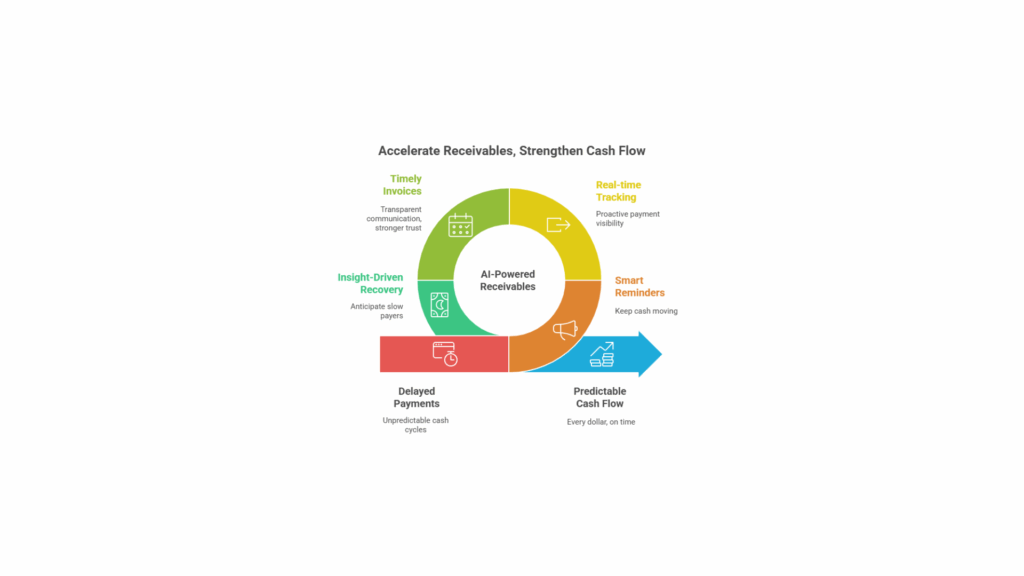
AI and data analytics are reshaping how companies manage accounts receivable. Predictive analytics can assess payment patterns, identify clients likely to delay, and help teams prioritize efforts effectively. These insights also assist in forecasting cash flow, allocating resources, and optimizing collection timelines. By transforming raw receivable data into actionable intelligence, businesses gain a powerful tool for preventing delays and improving financial predictability.

Utilize Information to Forecast and Prevent Disruptions

Leading finance departments today rely equally on data analysis and communication. Data analytics tools can identify customers experiencing changes in payment behavior, pinpoint bills at risk of late payment, and suggest modifications to payment terms or follow-up schedules. Rather than pursuing overdue payments, organizations transition to preventing payment delays, evolving from reactive to preventive accounts receivable strategies. These forecasting tools particularly benefit accounting firms handling numerous clients by improving financial projections, optimizing staff allocation, and enhancing cash flow management.

Early Payment Incentives and Strategic Negotiations

A balanced mix of incentives and structured negotiation can accelerate payments without compromising client relationships. Offering small discounts for early payments can motivate clients to clear dues promptly. At the same time  formal late fee clauses serve as a gentle deterrent against habitual delays. However, applying these measures strategically  based on client behavior and business volume  ensures fairness and long-term collaboration.

Continuous Monitoring, Process Refinement & Governance

Minimizing accounts receivable delays requires an ongoing systematic transformation rather than a single initiative. Financial departments must consistently track essential metrics including Days Sales Outstanding invoice maturity periods, disagreement frequencies, and recovery performance. Routine assessment sessions, thorough analysis of delayed payment causes, and workflow improvements are crucial. Companies that regularly evaluate and modify their accounts receivable processes each month typically experience enhanced cash flow results and improved financial reputation.

Conclusion

Delayed accounts receivable extends beyond mere accounting challenges it signifies locked capital, postponed expansion, and heightened exposure. Through implementing structured credit policies, streamlining invoice processes, maintaining proactive client communication, utilizing analytics, and tracking metrics regularly, American companies and accounting practices convert Accounts Receivable management into a strategic advantage. 

Kariwala & Co. LLP collaborates with clients to execute these approaches, accelerating payment collection, enhancing cash flow, and fostering robust financial health ensuring each outstanding receivable transforms into capital that powers business expansion.

Reference:

Accounts Receivable Management Best PracticesJohn G. Salek
https://www.kariwala.pro/services/accounting/


Read more

Vendor Due Diligence and GST Compliance in India: How Kariwala & Company LLP Safeguards Your Business

Introduction

At Kariwala & Company LLP, we believe compliance is not a burden—it is a shield that safeguards a business’s credibility and financial strength. Our role goes beyond processing invoices and returns; we help companies build secure, transparent supplier networks where every transaction stands the test of regulatory scrutiny.

Recently, we introduced a structured compliance management framework for one of our long-standing Indian clients, Kariwala Industries Limited. The results were striking: reduced notices, smoother audits, timely Input Tax Credit availability, and a newfound sense of confidence in their vendor ecosystem. This experience has become a blueprint we now extend to other clients, including international partners.

Turning Pain Points Into Strengths, Before we stepped in, the client often faced issues such as:

  • Blocked ITC because suppliers delayed GST filings.
  • Incorrect TDS deductions due to inactive PANs.
  • Unwanted notices during annual GST reconciliations.

These challenges disrupted cash flow and created avoidable compliance risks. 

What we have Changed With Our Framework:

  • We rolled out a proactive supplier verification and monitoring process that now forms the backbone of their GST compliance.
  • Every new supplier is checked for active PAN and valid GST registration.
  • Historical GST filings are reviewed before onboarding, reducing exposure to non-compliant vendors.
  • Suppliers crossing turnover thresholds are monitored for e-invoicing obligations.
  • Monthly reconciliations ensure purchase registers match GSTR-2B, with ITC claims suspended where invoices are absent.
  • Payments are tracked against the 180-day rule, preventing reversals and interest liabilities.
  • This framework is no longer a back-office formality—it is an assurance system that protects the client every month.

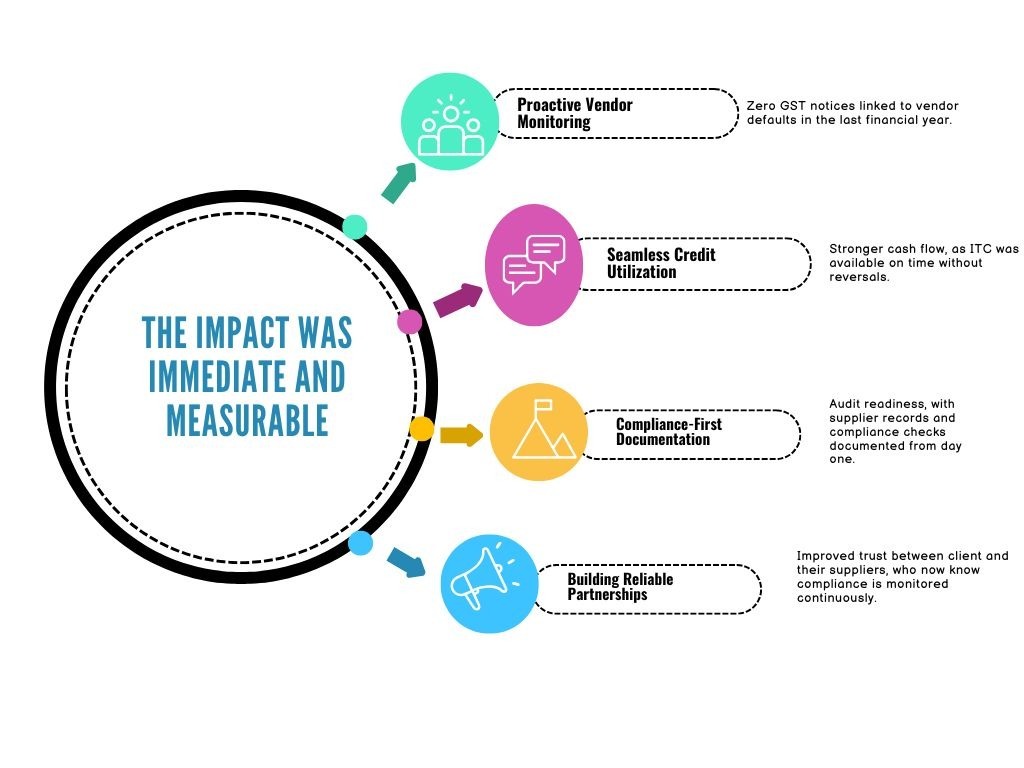
The Results Speak for Themselves:

Most importantly, the client expressed genuine relief. Instead of reacting to compliance failures after they occurred, they now operate with certainty and peace of mind.

A Model for Every Business:

  • While this success story began with an Indian client, the principle is universal:   supplier non-compliance creates real business risk, regardless of jurisdiction. Our compliance framework is adaptable for:Indian clients needing robust GST and TDS oversight.
  • US clients seek vendor diligence in areas like sales tax reporting, 1099 compliance, and reconciliation.
  • By embedding due diligence into everyday operations, we help businesses avoid penalties, protect working capital, and build stronger supplier relationships.

Conclusion

At Kariwala & Company LLP, compliance management isn’t a back-office exercise—it is a strategic advantage. By proactively safeguarding vendor compliance, we have already delivered tangible results for our client, Kariwala Industries Limited.


Read more

Understanding Fundamental Accounting: The Core of Sound Financial Decision-Making

Financial statements are not just numbers—they’re a language. A language that communicates the financial health, stability, and future potential of a business. To speak this language effectively, one must understand the foundational principles that govern financial reporting.

Whether you’re a startup founder, a manager at a growing enterprise, or a CPA advising clients, these fundamental concepts form the bedrock of all financial decision-making.

Why Financial Reporting Matters

Financial statements are prepared according to established guidelines to ensure consistency, transparency, and comparability. As outlined by the Financial Accounting Standards Board (FASB) in its Statement of Financial Accounting Concepts No. 1, the main objective of financial reporting is:

“To provide information that helps existing and potential investors, creditors, and other users assess the amounts, timing, and uncertainty of prospective net cash inflows to the enterprise.”

Core Accounting Concepts

To prepare financial statements accurately, certain key accounting principles must be followed:

ConceptExplanation
Going ConcernAssumes the business will continue operating for the foreseeable future.
Accruals & MatchingRevenues and related expenses should be recorded in the same accounting period.
PrudenceWhen in doubt, understate rather than overstate profits or asset values.
ConsistencySimilar items must be treated consistently across periods.
Entity ConceptThe business is distinct from its owners or stakeholders.
Money MeasurementOnly transactions measurable in monetary terms are recorded.
Separate ValuationEach asset or liability must be valued individually.
MaterialityOnly items significant enough to influence decisions are considered.
Historical CostTransactions are recorded at their original cost.
RealizationRevenue is recorded only when it is earned or realized.
DualityEvery transaction has two equal and opposite effects (debit and credit).

Components of Fundamental Accounting

At Kariwala & Co. LLP, we view fundamental accounting as more than just record-keeping—it’s a powerful tool that enables clarity and confidence in business decisions.

ComponentDescription
Double-Entry SystemEvery transaction affects two accounts, ensuring books stay balanced.
Journal EntriesRecords all day-to-day transactions in chronological order.
Ledger AccountsGroups transactions under specific categories like Sales, Cash, Expenses, etc.
Trial BalanceA summary to verify that total debits equal total credits.
Financial StatementsIncludes the Balance Sheet, Income Statement, and Cash Flow Statement.
ReconciliationEnsures internal records match external sources like bank statements.

Why It Matters: Different Stakeholder Perspectives

For Business Owners & Managers

  • Make informed strategic decisions
  • Monitor profitability and growth
  • Maintain control over budgets

    Insight: A clear understanding of your numbers reduces surprises and builds investor trust.

For Investors & Financial Institutions

  • Evaluate financial health before investing or lending
  • Assess risk and return
  • Demand transparency and consistency

    Insight: Sound accounting attracts funding and strengthens relationships with banks and VCs.

For Government & Regulators

  • Ensure tax compliance
  • Adhere to GAAP or IFRS standards
  • Create auditable financial trails

    Insight: Accurate reporting avoids fines and legal complications.

Conclusion: Accounting is More Than Compliance

Fundamental accounting isn’t just a regulatory requirement—it’s a strategic advantage. When done right, it empowers business leaders, satisfies stakeholders, and secures the financial future of your enterprise.
At Kariwala & Co. LLP, we help U.S.-based CPA firms and their clients stay grounded in these principles—ensuring accuracy, clarity, and confidence every step of the way.
Let your books tell a story you can stand behind.


Have questions about implementing these principles in your business? Contact our team to learn more about how Kariwala LLP supports your accounting journey.

Read more

EU VAT CHANGES FOR 2015

There are two new directives, first for the fast reaction mechanism aimed towards preventing VAT fraud. Second one is for the optional and temporary application of the reverse charge mechanism in relation to supplies of certain goods and services. Quick Reaction mechanism provides the legal basis to the countries that are members of the EU to integrate an emergency measure in they are in position to serious case of sudden and massive VAT fraud.

Read more

SAVE ON TAXES

Value Added Tax (VAT) is a tax on consumption levied in the United Kingdom by the National Government. It was introduced in 1973 and is the third largest source of government revenue after Income Tax and National Insurance. It is administered and collected by HM revenue and customs, primarily through the Value Added Tax Act 1994. VAT is levied on most goods and services provided by registered businesses in the UK and some goods and services imported from outside the European Union.

Read more

PROPER INVOICE INFO

Financial statements are prepared according to agreed upon guidelines. In order to understand these guidelines, it helps to understand the objectives of financial reporting. The objectives of financial reporting, as discussed in the Financial Accounting standards Board (FASB) Statement of Financial Accounting Concepts No. 1, are to provide information that

Read more