
Skip to main content Skip to search

Archives for November 2025

Non-GAAP Measures & Disclosures – Growing Scrutiny

Numerical metrics known as Non-GAAP financial measures are used to modify GAAP results by adding or removing specific factors, such as restructuring charges, stock-based compensation, acquisition-related expenditures, or FX impacts. They can be found in:

  • Earnings releases and investor presentations
  • MD&A and analyst decks
  • Debt covenant reporting and management scorecards

Why Growing Scrutiny-The Regulatory & Market Context

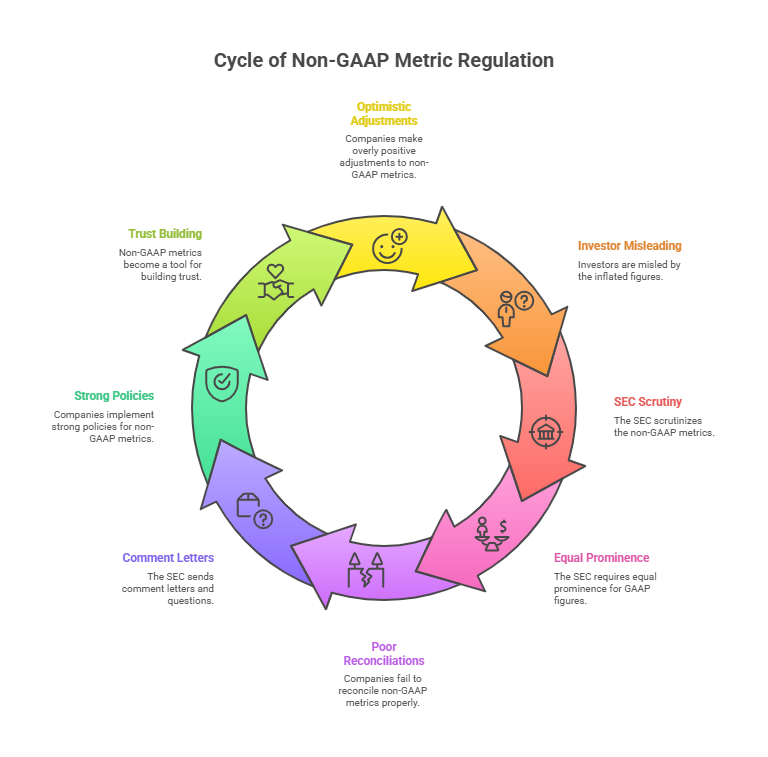
The SEC has recently focused on Non-GAAP abuses, requiring these measures to be transparent, reconciled with GAAP, and not presented more prominently than GAAP figures, as per regulations like Regulation G, Item 10(e) of Regulation S-K, and updated C&DIs.

Recent SEC actions and staff speeches highlight specific areas of concern:

  • “Individually tailored” accounting that effectively rewrites GAAP (for example, recognizing revenue on a basis inconsistent with ASC 606 in a Non-GAAP metric).
  • Cherry-picking adjustments – excluding recurring expenses while keeping recurring income.
  • Undue prominence –putting GAAP in the footnotes and a Non-GAAP number in the headlines or tables.

When Non-GAAP Measures Add Value – and When They Don’t

Non-GAAP measures tend to be most valuable when they are:

  • Well-defined and consistently applied over time
  • Symmetrical (they modify not just “bad news,” but also income and expenses as necessary)
  • Anchored in the economics of the business (e.g., removing clearly non-recurring items to focus on core operations)
  • Clearly reconciled to GAAP, with each adjustment’s justification provided in simple terms

They become problematic when they are:

  • Used to mask deteriorating GAAP performance
  • Constantly changing definitions, making period-to-period comparisons impossible
  • Filled with modifications that eliminate regular, ongoing expenses like payroll, marketing, or stock-based compensation 

Key Regulatory Expectations (U.S. Perspective)

Under Regulation G and Item 10(e) of Regulation S-K, the SEC expects public companies that present non-GAAP measures to:

  • Present GAAP measures with equal or greater prominence (e.g., GAAP EPS should not be overshadowed by Adjusted EPS).
  • Provide a clear reconciliation from GAAP to Non-GAAP figures, with all material adjustments listed.
  • Avoid misleading adjustments, such as:
    • Reversing normal, recurring operating expenses to increase “adjusted” income.
  • Creating revenue metrics that ignore GAAP’s timing principles (individually-tailored revenue recognition).
The Role of CPA Firms and Outsourced Accounting Partners

For U.S. businesses especially growing companies, startups, and mid-market entities outsourced accounting and advisory teams play a critical role in Non-GAAP governance:

  • Designing appropriate metrics
    Assisting management in identifying which modifications are appropriate and which Non-GAAP measures accurately reflect business drivers.
  • Implementing controls over calculations
    Ensuring that each Non-GAAP metric is calculated consistently, using documented logic and system-driven routines where possible.
  • Preparing reconciliations and narratives
    Drafting reconciliations and MD&A-style explanations that are clear, accurate, and regulator-ready.
  • Monitoring regulatory updates
    Ensuring that disclosures remain up to date by keeping the reporting team informed about new SEC C&DIs, comment-letter trends, and enforcement topics.

For U.S. CPA firms, having an offshore partner who understands both technical rules and practical reporting pressures can materially strengthen their clients financial communication.

Governance, Controls and Documentation

Non-GAAP measurements can no longer be regarded as “marketing numbers” produced outside of the finance control environment due to increased scrutiny. Among the best practices are:

  • Written guidelines and definitions outlining the objective of each non-GAAP statistic as well as any permitted modifications
  • Internal controls over data, calculations and disclosure, aligned with SOX-style control frameworks for public companies
  • The audit committee is in charge of determining which Non-GAAP metrics are used externally, how they are computed, and how they are shown.
  • Periodic back-testing: comparing Non-GAAP and GAAP trends to ensure that adjustments continue to make sense and don’t obscure risk or volatility

Strong governance helps companies withstand SEC comment letters, investor questions, and due diligence in transactions or capital raising.

 How Kariwala & Co. LLP Adds Value

At Kariwala & Co. LLP, we assist American accounting firms and companies who use Non-GAAP metrics to present a more transparent performance narrative without going over regulatory red lines.

Our teams support you by:

  • Standardising non-GAAP definitions and policies, aligned with SEC expectations and investor best practices.
  • Building robust reconciliation templates that ensure every Non-GAAP measure is traceable back to GAAP figures.
  • Running period-end Non-GAAP calculations and quality checks, so numbers are consistent across earnings releases, internal decks, and lender packages.

Keeping your finance team informed of emerging SEC focus areas around Non-GAAP so you can stay ahead of scrutiny not react to it.

We assist American companies and CPA firms in using Non-GAAP measurements as a reliable analytical tool rather than a compliance concern by fusing technical precision with transparent communication.

References:

U.S. Securities and Exchange Commission – Non-GAAP Financial Measures (Regulation G and related guidance).

Read more

Internal-Use Software Costs — Financial Accounting Standards Board (FASB) ASU

Software is indispensable to contemporary business functions, encompassing everything from enterprise resource planning  systems to customer support interfaces and internal data analysis tools. For accounting, bookkeeping, and finance professionals in the United States, including those involved in outsourced or shared service arrangements, grasping the new guidelines is paramount. These guidelines impact the timing and classification of capitalizable costs, the methods for assessing development risks, and the disclosures required for software-related expenditures. This article delves into the key areas that must be understood to successfully implement ASU 2025-06.

What Is Internal-Use Software?

Internal-use software, as defined by FASB’s guidelines, encompasses any software that is purchased, created, or altered exclusively for a company’s internal business activities rather than for external sale, leasing, or marketing purposes.

For Example:

  • Payroll processing systems
  • Accounting and financial reporting applications
  • Customized enterprise resource planning (ERP) systems

Internal use software is distinct from software developed for sale (covered under ASC 985-20) or hosted arrangements provided to customers (ASC 350-40).

Capitalization Guidelines and Illustrations

Capitalization begins when:

  1. Preliminary stage is complete,
  2. Management authorizes funding and
  3. It’s probable the project will be completed and used internally.

Capitalizable costs include:

  1. Direct labor of employees developing the software
  2. Costs of materials and services
  3. Interest costs incurred during development (if material)

Non-capitalizable costs include:

  1. General overhead
  2. Training or maintenance costs
  3. Data conversion and re-engineering expenses

Cloud Computing and SaaS Arrangements

ASU 2025-06 introduces changes to how organizations handle cloud computing and Software-as-a-Service (SaaS) agreements.

  • When a client possesses the right to manage software via a license, it is categorized as software intended for internal use and is therefore subject to capitalization according to ASC 350-40.
  • If it is  not a pure SaaS model, you can still record the costs of setting it up as prepaid assets and spread them out over the contract period following the rules in ASU 2018-15.

Amortization and Impairment

Once the software is ready for use the capitalized cost is amortized over its estimated useful life (typically 3–7 years).

  • The method should reflect the pattern of expected benefit; straight line is used if no better estimate is available.
  • Software undergoes impairment testing when alterations in its usage, capabilities, or underlying technology suggest that its recorded value might not be recoverable in accordance with ASC 360 principles.

 Disclosure Requirements under ASU 2025-06

Enhanced disclosures aim to improve transparency for investors and stakeholders. Entities must disclose:

  • Total capitalized internal-use software costs
  • Amortization expense for each period
  • Impairment losses recognized
  • Description of software types and useful lives

These disclosures provide insight into the technological investment and operational efficiency of a company.

Comparison with Previous Guidance (Pre-ASU 2025-06)


Area

Before (ASC 350-40)

After (ASU 2025-06)

Capitalization trigger

Ambiguous between preliminary and application stages

Clear criteria for capitalization authorization and completion probability

Cloud/SaaS treatment

Limited clarity

Specific treatment aligning with ASU 2018-15

Disclosure

Minimal

Expanded and standardized

Transition

N/A

Prospective adoption from FY 2025-26

 Relevance for U.S. Businesses

Internal software development investments will be handled more uniformly and openly thanks to the modification.

  • Companies with significant IT spending (financial institutions, manufacturers, healthcare, etc.) will see a clearer impact on their balance sheet.
  • It boosts industry comparability and boosts investor trust.

How Kariwala & Co. LLP Helps U.S. Businesses

At Kariwala & Co. LLP, we help U.S. firms understand and implement ASU 2025-06 by:

  • Evaluating which internal-use software costs qualify for capitalization.
  • Assisting in documentation and disclosure preparation as per FASB standards.

Ensuring that your financial reporting reflects technological investments accurately.

Conclusion

The FASB ASU 2025-06 ensures more accurate and transparent reporting by streamlining and updating how businesses account for internal-use software costs. It unifies financial statements with today’s technology-driven company models and clarifies capitalization regulations. At Kariwala & Co. LLP, we help U.S. businesses navigate these new standards with precision and compliance confidence.

References:

Financial Accounting Standards Board – Accounting Standards Update 2025-06, Intangibles—Goodwill and Other—Internal-Use Software (Subtopic 350-40): Targeted Improvements to the Accounting for Internal-Use Software (September 18, 2025). 

Read more

 Crypto Assets Accounting – ASU 2023‑08 (FASB)

The financial landscape is undergoing swift advancements, with cryptocurrency spearheading this evolution. However  many American enterprises and Certified Public Accountant (CPA) firms continue to experience ambiguity regarding the proper methods for recording and reporting their digital asset portfolios.

What Is “Cryptocurrency” vs “Crypto assets Accounting”?

Cryptocurrency
A digital token that is fungible and protected by cryptography, recorded on a decentralized system like Bitcoin or Ethereum. From an accounting perspective, it is classified as an intangible asset that is not considered money.

Cryptoassets
This signifies the accounting standards, such as Ind AS or U.S. GAAP, that dictate the procedures for recognizing, valuing, displaying, and reporting these tokens.

  • Under U.S. GAAP, crypto guidance is now codified in ASC 350-60 (ASU 2023-08).
  • Under Indian GAAP (Ind AS) entities apply Ind AS 38 (Intangible Assets) or Ind AS 2 (Inventories)   there’s no dedicated crypto standard yet.

 Accounting Treatments: India vs United States

A. India (Ind AS)

Classification

  • Most entities: Record crypto holdings as intangible assets (Ind AS 38).
  • Broker-traders: Treat them as inventory (Ind AS 2) if held for trading.

Measurement & Subsequent Accounting

  • Ind AS 38: Typically the cost model is applied, which involves deducting any impairment losses. Revaluation is only allowed when there is an active market.
  • Ind AS 2: Broker traders can measure holdings at fair value less costs to sell with changes recognised in profit or loss.
  • Presentation & Disclosures
  • Disclose as per Ind AS 38/36/113 and Schedule III requirements:
  • Profit/loss on crypto transactions.
  • Advances or deposits related to crypto investments.

B. United States (U.S. GAAP)

Before ASU 2023-08
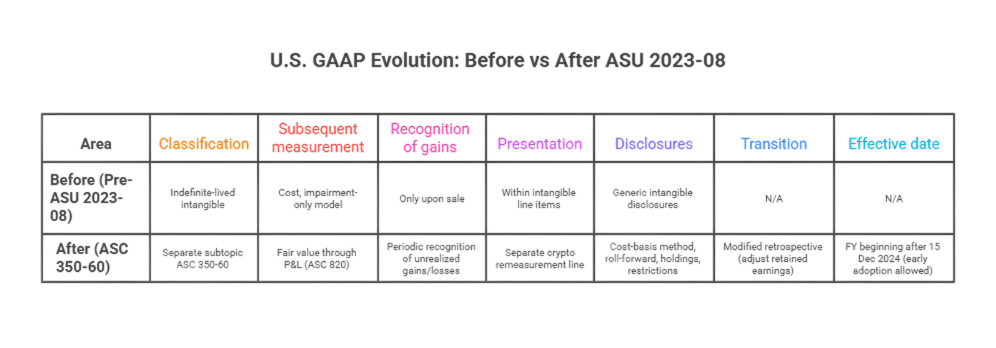
Under ASC 350, cryptoassets were classified as indefinite-lived intangibles recorded at their cost minus any impairment. This accounting treatment prohibited upward revaluations, resulting in a “down-only” approach where value could only decrease.

After ASU 2023-08 → ASC 350-60 (Crypto Assets)
This new update  effective for fiscal years beginning after December 15, 2024, introduces a fair-value model.

  • Scope: Applies to fungible, cryptography secured digital tokens on a blockchain that are not issued by the entity and don’t provide enforceable rights.
  • Measurement: Must be reported at fair value through net income (FVTNI) each period.
  • Presentation: You’ll see crypto gains and losses listed separately from the usual amortization or impairment of other intangible assets.
  • Disclosures: Entities must disclose cost basis methods, roll forward reconciliations, significant holdings, and restrictions on sale or transfer.

 Illustrative Accounting Entries

Example Scenario:
A company holds 10 BTC purchased at $420,000. At year-end 2024, fair value = $500,000.

On adoption (Jan 1 2025):

  • Dr Crypto Assets $80,000
  • Cr Retained Earnings $80,000

Quarterly remeasurement (to $560,000):

  • Dr Crypto Assets $60,000
  • Cr Unrealized Gain (P&L) $60,000

Sale of 2 BTC at $124,000 total:

  • Dr Cash $124,000
  • Cr Crypto Assets $100,000
  • Cr Realized Gain on Crypto $24,000

This demonstrates the fair value through the earnings model replacing the previous impairment only model.

Short-Term vs Long Term Gains on Cryptoassets

From an accounting not tax perspective:

Short Term Gains/Losses:

  • Occur from frequent trading and fair value fluctuations recognized in net income.
  • Affect P&L volatility and financial ratios.

Long Term Holdings:

  • Impact balance sheet valuations and earnings per share due to cumulative fair value adjustments.
  • Require consistent impairment testing and disclosure in Indian GAAP and periodic revaluation in U.S. GAAP.

Why These Differences Matter for U.S. Businesses

For U.S. CPA firms and financial controllers, these changes mean:

  • Reporting that is more open and accurately reflects the economic situation.
  • Volatility directly visible in earnings  influencing performance metrics and valuation.
  • There is a requirement for enhanced controls over asset valuation  reconciliation of custodial assets and preparedness for audits.

For outsourced bookkeeping and accounting partners  understanding both frameworks ensures seamless consolidation  compliance  and advisory for multinational clients holding crypto.

Kariwala & Co. LLP’s Expertise

At Kariwala & Co. LLP, we specialize in helping U.S. CPA firms and businesses understand and apply these complex accounting changes.

  • We differentiate between Indian and U.S. standards to help clients maintain clarity in cross-border reporting.
  • Our team sets up cryptoasset ledgers, ensures accurate fair-value measurement, and builds disclosure-ready reports aligned with ASU 2023-08.
  • We train in-house finance teams on reconciling blockchain records with accounting systems, ensuring data integrity and transparency.

Conclusion

The FASB’s ASU 2023-08 marks a turning point in the accounting for digital assets replacing outdated impairment models with a fair-value approach that reflects true economic performance. While the U.S. has taken a clear step toward modernization, India’s accounting treatment remains principles-based  relying on existing Ind AS guidance.

For businesses operating across both frameworks, clarity is essential. Kariwala & Co. LLP stands ready to simplify that complexity  ensuring that your cryptoasset reporting remains accurate, compliant, and forward-looking in this evolving financial era.

Reference:

FASB — Projects page for “Accounting for and Disclosure of Crypto Assets”: fasb.org

Read more