

Global conflict is now a direct financial risk to businesses, not just a distant geopolitical concern. Supply chains in 2026 face ongoing disruption from geopolitical tensions, tariffs, climate events, and economic instability.
Rising supply chain pressures are fueling inflation, cost volatility, and U.S. economic uncertainty. While operations teams focus on rerouting and securing suppliers, a crucial area is often neglected.
The Real Shift: From Cost Stability to Cost Volatility
Historically, businesses operated with relatively stable:
- Supplier pricing
- Freight costs
- Lead times
Today, those assumptions are no longer valid.
Costs are dynamic, unpredictable, and often retroactive forcing accounting teams to rethink how financial data is recorded, adjusted, and reported.
Critical Accounting Questions Businesses Overlook
Are Contract Terms Still Financially Relevant?
Supply disruptions often lead to:
- Renegotiated supplier contracts
- Changed delivery terms
- Volume commitments not being met
But accounting teams often continue applying old contract assumptions.
What gets missed:
- Revised cost obligations
- Penalty clauses or waivers
- Changes in payment timelines
Key Question:
Are contract modifications being reflected accurately in financial reporting and accruals?
Are We Properly Accounting for Price Variance and Volatility?
Frequent price changes create:
- Purchase price variances
- Budget vs. actual mismatches
- Margin unpredictability
Without proper tracking, these variances get buried in overall expenses.
Key Question:
Are we isolating and analyzing price variances to understand their real impact on profitability?
Are Our Accruals Still Reliable?
In a disrupted supply chain:
- Invoices are delayed
- Goods are received without billing
- Services are partially completed
This makes accruals significantly more complex.
Many companies either:
- Under-accrue (understating liabilities)
- Or over accrue (distorting profitability)
Key Question:
Are accrual estimates aligned with actual supply chain delays and uncertainties?
How Are Currency Fluctuations Impacting Our Books?
Global conflict often triggers:
- Currency volatility
- Exchange rate fluctuations
- Increased hedging activity
If not tracked properly, this impacts:
- Payables and receivables
- Imported inventory costs
- Financial reporting accuracy
Key Question:
Are foreign exchange impacts being consistently measured and recorded across transactions?
Are We Overlooking Impairment Risks?
Disruptions can lead to:
- Obsolete or slow moving inventory
- Supplier failures
- Idle or underutilized assets
Yet many businesses delay recognizing impairments.
This leads to:
- Overstated asset values
- Misleading balance sheets
Key Question:
Do we need to reassess inventory, receivables, or asset impairment due to ongoing disruptions?
Is Our Budgeting and Forecasting Model Still Valid?
Traditional budgets assume:
- Predictable supply
- Stable costs
- Consistent timelines
But in today’s environment, those assumptions break down quickly.
Static budgets become irrelevant within months.
Key Question:
Are we using flexible, scenario based forecasting models that reflect supply chain uncertainty?
Are We Capturing the Financial Impact of Strategic Decisions?
To mitigate disruption, businesses often:
- Shift to local suppliers
- Increase inventory buffers
- Diversify sourcing
While operationally necessary, these decisions have financial consequences:
- Higher working capital requirements
- Reduced margins
- Increased carrying costs
Key Question:
Are strategic supply chain decisions being evaluated through a financial lens?
Do Our Financial Reports Reflect Reality or Lag Behind It?
One of the biggest risks today is timing gaps in financial reporting.
By the time reports are generated:
- Costs may have already changed
- Inventory positions may be outdated
- Margins may have shifted
Key Question:
How close is our financial reporting to real time operational reality?
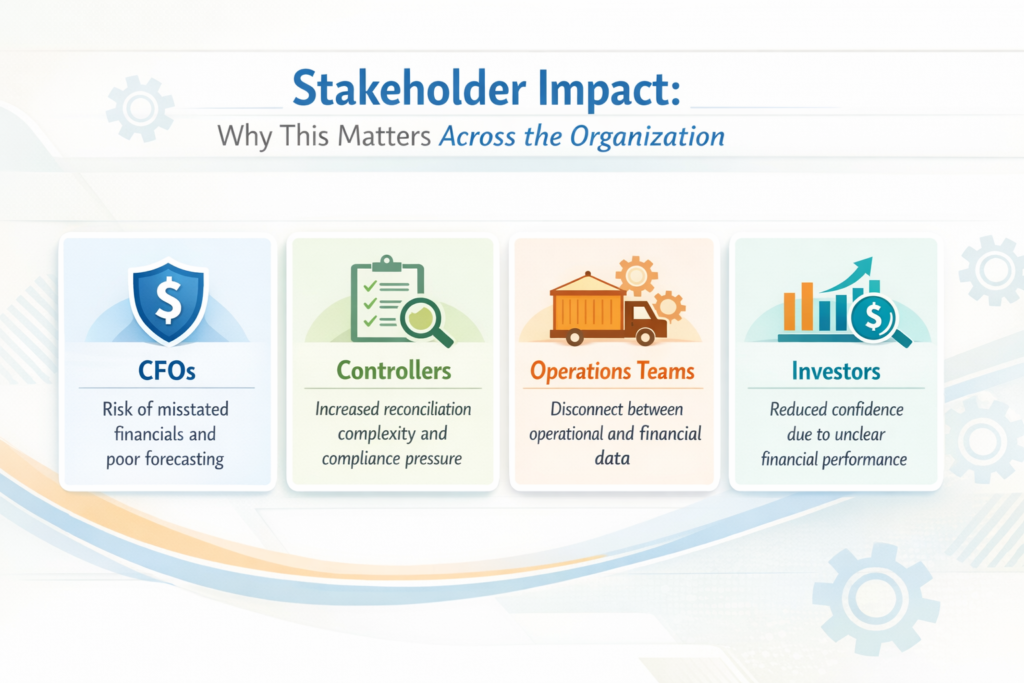
Stakeholder Impact: Why This Matters Across the Organization
Forward Thinking Companies Are Doing
Leading businesses are adapting their accounting approach to match the new reality:
- Implementing dynamic accrual and estimation models
- Integrating FX risk tracking into daily accounting
- Moving to rolling forecasts instead of annual budgets
- Enhancing inventory and asset impairment reviews
- Aligning finance teams closely with supply chain operations
Why This Matters: The Risk of Financial Lag
In a volatile environment, the biggest danger is not disruption itself, it is delayed financial awareness.
If accounting does not evolve:
- Risks remain hidden
- Decisions become reactive
- Financial statements lose reliability
Conclusion: Accounting Must Evolve with Disruption
Global conflict has altered supply chains and accounting’s role. Today, financial reporting needs constant adaptation to cost fluctuations, operational uncertainty, and changing strategies, not static assumptions or delayed data. Companies not aligning accounting with these realities risk poor decisions. Proactive businesses improving financial processes, visibility, and real-time data integration will better handle disruption. In an unpredictable world, accurate, adaptive accounting is key to resilience and success.