
Skip to main content Skip to search

Archives for September 2025

Difference Between Accounts Payable and Accounts Receivable

How Digital Payroll Tools and Automation Are Changing the Payroll Game

For decades, payroll meant long spreadsheets, late-night reconciliations, and endless compliance headaches. HR managers worried about accuracy, CFOs worried about costs, and employees worried about errors in their paychecks. In short, payroll was seen as a necessary burden, not as a business enabler.

Payroll Before Automation: A Manual Burden

For several decades, payroll administration constituted a highly labor-intensive operational procedure. Human resources personnel were required to maintain extensive spreadsheet databases, verify attendance documentation, and perform tax computations through manual processes. Each payroll cycle presented inherent risks including computational errors, processing delays, and regulatory compliance deficiencies. Consequently, payroll functions were perceived as burdensome administrative obligations rather than strategic, value-added organizational activities.

Payroll After Automation: A Strategic Advantage

Cloud-based digital payroll solutions, enhanced by automated technologies, have transformed payroll administration into an efficient, transparent, and regulatory-compliant operation. Through automated computational processes, dynamically updated taxation protocols, and self-managed employee service interfaces, payroll management has achieved unprecedented speed and accuracy. Organizations now recognize payroll systems as strategic organizational assets that foster stakeholder confidence, optimize operational expenditures, and maintain regulatory adherence.

Comparison: Payroll Before vs After Automation

AspectBefore Automation (Manual Payroll)After Automation (Digital Payroll)
Data ManagementSpreadsheets, paper files, prone to duplication & errorsCloud-based systems with centralized, real-time data
AccuracyHigh chance of human error in calculations & deductionsAutomated validation ensures error-free payroll
Time ConsumptionHours or days to process each cycleProcessing completed in minutes
ComplianceDependent on staff keeping up with changing lawsSystems auto-update with federal & state tax rules
Employee ExperienceEmployees relied on HR for pay slips & queriesSelf-service portals for pay slips, benefits & tax info
ScalabilityDifficult to handle when workforce growsEasily scalable for small, mid-sized, or global teams
Cost EfficiencyMore staff needed for manual checksReduced overhead through automation & streamlined processes
Reporting & InsightsLimited reporting, mostly reactiveReal-time dashboards & predictive insights

Why This Transformation Matters

Payroll is more than just paying employees on time — it affects compliance, trust, and business sustainability. Moving from manual payroll to digital automation matters most because:

  • Reduces Risk of Costly Errors
    Automated tax filing reduces errors and prevents costly fines and reputation harm.
  • Strengthens Compliance & Audit Readiness
    U.S. payroll laws are complex and change often. Automated systems maintain compliance with tax regulations, minimizing legal risks and simplifying audits.
  • Boosts Employee Satisfaction & Retention
    Employees expect timely, transparent payroll. When salaries are accurate, benefits are clear, and self-service portals are available, employees feel valued — directly improving retention.
  • Frees HR & Finance for Strategic Work
    Instead of spending hours on repetitive payroll tasks, HR and finance teams can focus on higher-value functions like workforce planning, cost optimization, and employee engagement.
  • Improves Decision-Making Through Insights
    Payroll automation offers instant analytics on labor expenses, overtime, and benefits, enabling data-driven decisions that control costs and boost profits.
  • Builds Trust With Stakeholders
    From employees to investors, accurate and transparent payroll builds confidence in the company’s governance and operational strength.

Payroll Automation Enhances Compliance

Compliance is one of the most challenging aspects of payroll management. Laws and tax codes in the U.S. frequently change, and even a small mistake can lead to significant financial penalties and reputational harm. Payroll automation ensures businesses stay ahead of these challenges by:

  • Automatic Tax Code Updates: Digital payroll systems automatically update with regulatory changes, eliminating manual tracking and reducing compliance errors for HR teams.
  • Error-Free Reporting & Filing: Automated systems create compliant tax forms, W-2s, and e-filings, reducing errors and ensuring prompt submissions.
  • Audit-Ready Documentation: All transactions and adjustments are logged for transparency. Businesses can instantly provide records when regulators request them.
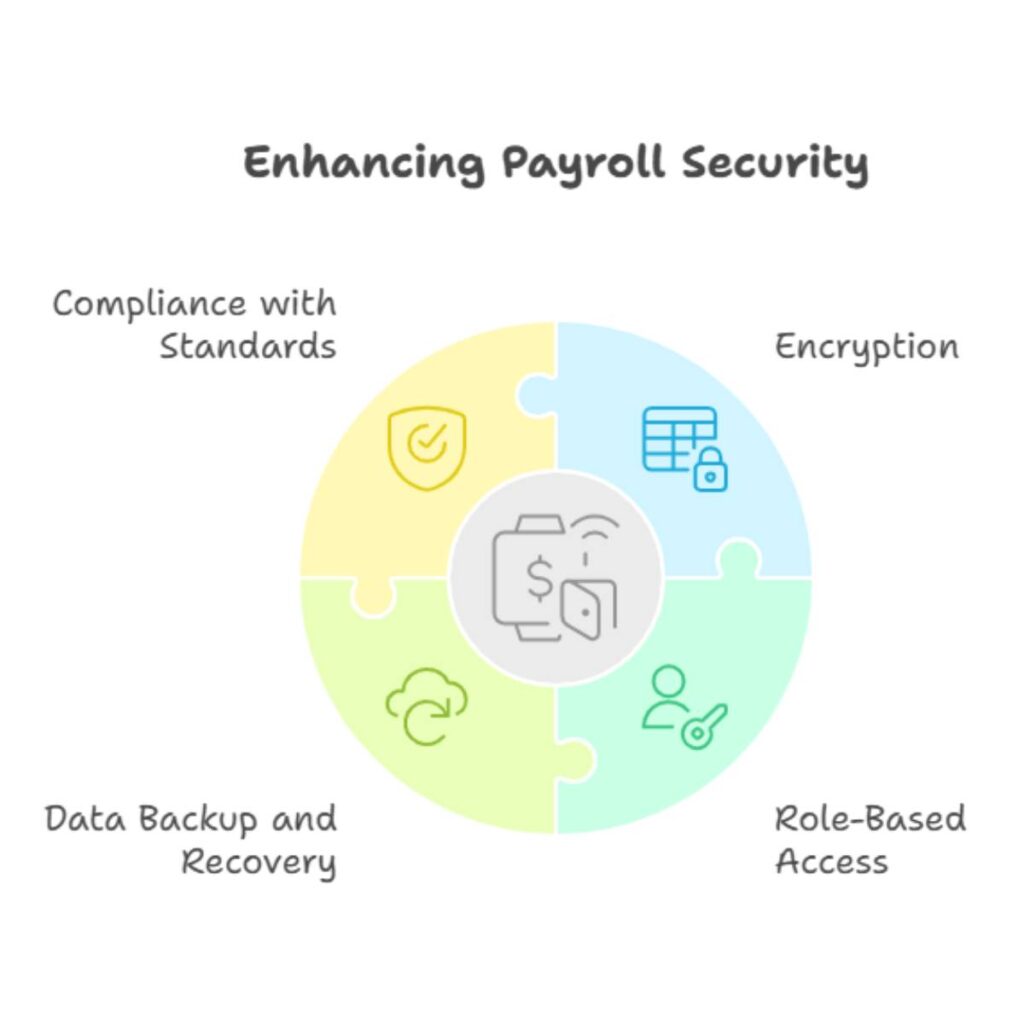
Payroll contains sensitive employee information like SSNs, tax IDs, and bank details. Manual systems risk data theft or loss. Automated payroll reduces these risks by:

  • Payroll data is encrypted during storage and transmission to prevent unauthorized access and breaches.
  • Automated systems enable role-based access, restricting sensitive data viewing to authorized personnel like payroll managers or CFOs.
  • Digital payroll systems automatically backup data and use recovery systems to prevent data loss from hardware failures or cyberattacks.
  • Leading payroll software providers comply with GDPR and SOC standards to protect employer and employee data.

The Global Payroll Challenge

In today’s interconnected economy, many companies are no longer limited to one location or even one country. Remote hiring, cross-border teams, and international expansions are now the norm. But this global workforce brings with it a new and complex payroll challenge.

Key Complexities in Global Payroll:

  • Multiple Jurisdictions
    Every nation and U.S. state has unique tax, labor, and compliance laws. Manual management raises error risks and costs.
  • Currency Fluctuations
    When employees are paid in different currencies, exchange rate volatility can create financial discrepancies and budgeting challenges.
  • Diverse Employee Benefits
    Payroll teams must track varying regional health insurance, retirement, and statutory benefit requirements for compliance.
  • Data Privacy Regulations
    Laws like GDPR in Europe and state-level privacy laws in the U.S. require payroll teams to ensure secure handling of sensitive employee data across borders.


Kariwala & Co. LLP: Enabling the Payroll Shift

At Kariwala & Co. LLP, we help U.S. businesses transition from manual payroll struggles to automated, efficient systems. Our expertise ensures:

  • Easy digital payroll setup.
  • Strict adherence to U.S. payroll regulations.
  • Secure, scalable solutions that grow with your workforce.

    With the right automation, payroll is no longer a back-office burden — it’s a driver of growth and trust.

    Resources:
    Payroll Best Practices — Steven M. Bragg

Read more

How to Spot Sneaky Bookkeeping Mistakes via Ratio Analysis

Accounting inaccuracies frequently remain undetected until they precipitate significant fiscal disturbances. Minor discrepancies in expenditure documentation, revenue inflation, or improper account categorization may obscure an organization’s authentic financial status. It is in this context that ratio analysis emerges as an invaluable instrument. Through the systematic examination of financial ratios, enterprise proprietors, accounting professionals, and stakeholders can expeditiously identify anomalies, uncover concealed inaccuracies, and verify that the financial records accurately represent the organization’s operational performance.

What is Ratio Analysis?

Ratio analysis constitutes a systematic methodology for assessing an organization’s financial documentation through the computation of proportional relationships among critical figures within the balance sheet, income statement, and cash flow statement. This analytical approach facilitates the transformation of unprocessed financial information into substantive and actionable intelligence.

The Significance of Ratio Analysis for Corporate Entities

Ratio analysis plays a critical role in corporate decision-making because:

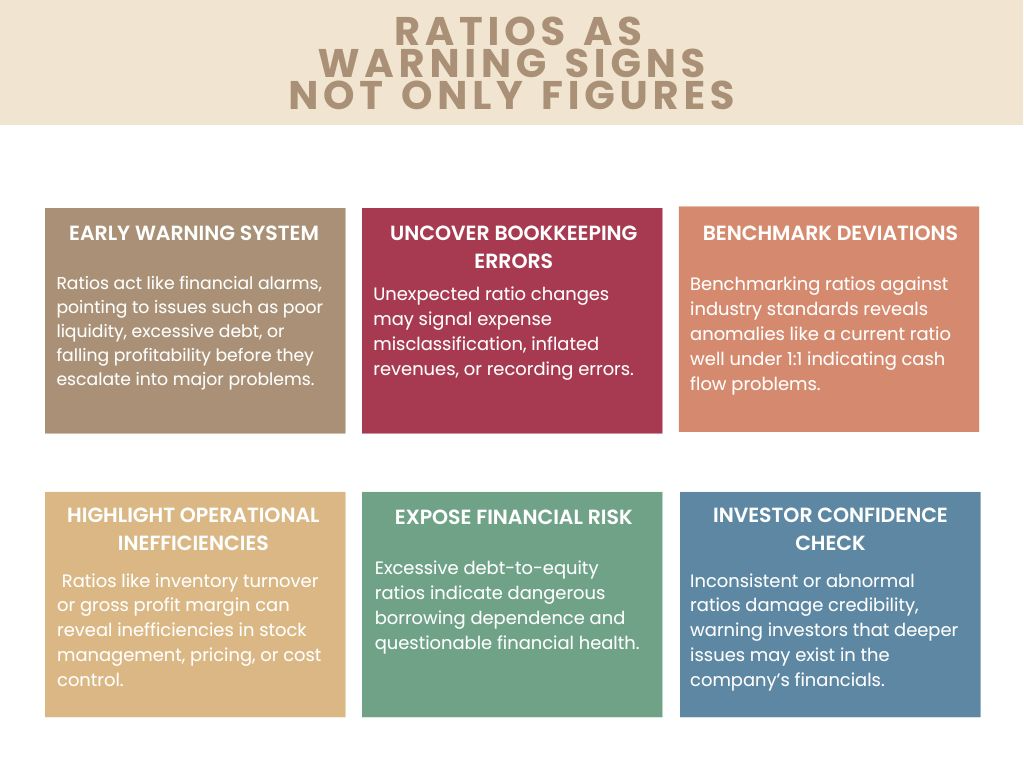
  • It detects errors: Unexpected fluctuations in ratios may signal mistakes in bookkeeping entries.
  • It ensures accuracy: Consistent ratios over time confirm reliable financial reporting.
  • It supports decision-making: Management can use ratios to track performance and identify problem areas.


How Ratio Analysis Links with Bookkeeping

Bookkeeping forms the foundation of ratio analysis. If transactions are recorded incorrectly, ratios will be misleading. For instance:

  • When expenditures are reported below their actual values, financial performance metrics demonstrate artificially enhanced profitability that does not accurately reflect the organization’s true economic position.
  • Excluding liabilities distorts solvency ratios, creating misleading financial stability indicators. Regular ratio analysis helps companies identify discrepancies quickly and fix accounting errors before they escalate into compliance problems or damage investor confidence.

Why Bookkeeping is the Backbone of Ratio Analysis

Accuracy of Data

Ratios are only as good as the numbers behind them. If sales, expenses, or liabilities are wrongly entered, every ratio becomes misleading, and decisions based on them turn risky.

Consistency Over Time

Proper bookkeeping ensures transactions are recorded in the same way each period. This makes ratio trends reliable and helps companies compare performance year over year.

Early Error Detection

Small bookkeeping mistakes — like duplicate entries or missed invoices — get exposed through ratios. Clean records make these errors visible sooner, before they snowball into compliance or cash flow problems.

Investor and Lender Confidence

Well-maintained books keep ratios trustworthy, which reassures investors, auditors, and banks. Without accurate bookkeeping, even strong ratios lose credibility in the eyes of stakeholders.

Strategic Decision Support

When bookkeeping is precise, ratios truly reflect business health. This allows management to plan expansion, manage debt, or adjust pricing with confidence that their numbers aren’t distorted.

The Principal Categories of Financial Ratios:

There are several financial ratios, but companies primarily rely on five key ratios to assess health and detect hidden errors.

1. Current Ratio (Liquidity)

Formula: Current Assets ÷ Current Liabilities

Ideal Benchmark: 2:1

The current ratio tells us if a company can pay its short-term debts with short-term assets like cash, receivables, and inventory. A ratio below 2:1 suggests tight liquidity and possible trouble meeting obligations. A ratio well above 2:1 can mean assets are lying idle without being invested productively.

From a bookkeeping standpoint, minor inaccuracies such as undocumented vendor invoices or omitted accounts receivable can render this ratio deceptive. Preserving precise record-keeping guarantees that this ratio accurately represents the organization’s genuine financial stability, upon which creditors and stakeholders place considerable emphasis when evaluating fiscal soundness.

2. Debt-to-Equity Ratio (Leverage)

Formula: Total Debt ÷ Shareholders’ Equity

Benchmark: < 1:1 conservative; 1–2:1 moderate; > 2:1 risky

This metric demonstrates the extent to which an organization relies upon external financing relative to equity capital. An elevated ratio indicates substantial leverage, thereby increasing the organization’s susceptibility to liquidity challenges should borrowing costs escalate. Conversely, a diminished ratio signifies fiscal prudence and stability, though it may concurrently indicate foregone expansion prospects.

From a bookkeeping perspective, misclassification of loans (short-term vs. long-term) or missing accrued interest can distort this ratio. Proper recording ensures clarity on how much of the company’s operations are financed through external borrowing versus internal funds.

3. Gross Profit Margin (Profitability)

Formula: (Revenue − COGS) ÷ Revenue × 100

Benchmark: 20%–40% for many industries (varies by sector)

The gross margin demonstrates the effectiveness with which an organization converts direct expenses into income. An abrupt increase in margin may indicate inflated revenue figures or inadequately reported expenditures. A significant decline might reflect escalating expenses that have not been comprehensively documented.

Accurate bookkeeping of both sales and direct costs is essential here. For businesses, this ratio is the first checkpoint of financial health — a distorted margin gives management the wrong impression of profitability and can lead to poor pricing, budgeting, and investment decisions.

4. Inventory Turnover (Efficiency)

Formula: COGS ÷ Average Inventory

Benchmark: Retail 5–10×/year; Manufacturing 3–6×/year

This ratio reveals how quickly inventory is sold and replaced. A very high turnover could mean inventory is undervalued in the books. A very low turnover might suggest overstocking, obsolete items, or inflated inventory balances.

Because inventory entries involve valuation, timing, and adjustments, bookkeeping accuracy is crucial. Errors here don’t just distort this ratio — they ripple across profit margins, cash flow, and working capital. Companies use this ratio to plan procurement, avoid dead stock, and manage cash efficiently.

5. Return on Equity (ROE — Shareholder Returns)

Formula: Net Income ÷ Shareholders’ Equity × 100

Benchmark: 10–20% is healthy; >20% strong (but often linked to high leverage)

Return on Equity serves as an indicator of an organization’s proficiency in utilizing shareholder capital to produce earnings. When net earnings are artificially elevated or shareholder equity is inadequately represented, the ROE metric may present a more favorable appearance than the actual financial performance, thereby creating potential misrepresentation for both executive leadership and stakeholders.

Accurate bookkeeping ensures the “bottom line” reflects true earnings. For investors, ROE is a key performance indicator; for management, it confirms whether strategies are yielding value or draining resources.

Spotting Mistakes Through Ratios

Here’s how ratio analysis helps catch “sneaky” bookkeeping issues:

  • Inflated revenues → Gross Profit Margin spikes without matching sales growth.
  • Missing liabilities → Current Ratio appears healthier than reality.
  • Inventory errors → Turnover ratio shows unrealistic efficiency or sluggishness.
  • Debt misreporting → Debt-to-Equity ratio doesn’t align with industry averages.

How Small Businesses Can Use Ratios Effectively

  1. Keep it Simple – Focus on 4–5 key ratios rather than trying to calculate everything.
  2. Integrate with Month-End Closing – Make ratio checks part of the monthly closing checklist.
  3. Leverage Dashboards – Many accounting systems now provide real-time ratio insights.
  4. Seek Expert Review – A CPA or outsourced accounting partner can interpret ratios with more depth.

Conclusion

Ratio analysis transcends its fundamental role as a financial assessment methodology, serving as a critical protective mechanism against concealed accounting irregularities. Through systematic examination of financial ratios and their comparison to established industry standards, organizations can maintain precision in their financial reporting, preserve stakeholder confidence, and enhance the quality of their strategic financial decision-making processes. At Kariwala & Company LLP, we help small businesses and CPA firms leverage ratio analysis to uncover financial red flags early, strengthen compliance, and maintain confidence in their numbers. With the right ratios, your books tell the real story, not a distorted one.

Read more

Outsourcing Accounting for Small Businesses & CPA Firms: Key Benefits and Common Mistakes to Avoid

Introduction

For both small businesses and U.S. CPA firms, managing bookkeeping and accounting in-house can be time-consuming, costly, and overwhelming. As financial operations become more complex, outsourcing accounting services has emerged as a smart, strategic solution. From reducing costs to accessing skilled professionals, outsourcing offers significant advantages. However, many firms make common mistakes when outsourcing, which can limit the benefits and create unnecessary challenges. By understanding these pitfalls and knowing how to avoid them, businesses can turn outsourcing into a powerful tool for growth.

The Hidden Pressures Small Businesses and CPA Firms Face

Small businesses face budget constraints, poor bookkeeping, and limited expertise, while U.S. CPA firms deal with talent shortages, seasonal demands, and real-time reporting needs. Both require flexible solutions for accurate finances and growth focus. Outsourcing provides essential support to address these challenges.

What Makes Outsourcing Work Successfully

Successful outsourcing requires a collaborative approach rather than simply delegating tasks. The foundation lies in establishing clear role definitions where both the company and service provider understand their specific responsibilities and expectations. Technology integration, particularly through cloud accounting tools, facilitates seamless collaboration and maintains transparency between parties. Regular communication through consistent check-ins helps prevent misunderstandings while building trust in the partnership. Additionally, ensuring compliance and confidentiality measures are in place is crucial, as a dependable outsourcing partner must safeguard sensitive financial information throughout the collaboration.

Errors That Diminish Outsourcing Effectiveness

Outsourcing can fail if approached casually. Some common missteps include:

  • Assuming One-Size-Fits-All – Every business has unique needs; generic outsourcing rarely works.
  • Insufficient Training – If processes aren’t explained upfront, errors are more likely.
  • Disregarding Cultural Fit – A mismatch in work culture or business practices can slow progress.
  • Relying on Manual Updates – Without automation, delays and errors creep into reporting.
  • Unrealistic Expectations – Poor onboarding causes disappointment when expecting quick results.

Essential Compliance and Data Security

One of the biggest fears small businesses and CPA firms have about outsourcing is data security. A reliable outsourcing partner ensures:

  • Compliance with international data protection laws.
  • Use of secure file transfer protocols and encrypted platforms.
  • Strict access controls with multi-level authentication.
  • Regular audits to ensure zero data leaks.

This emphasis on compliance not only protects the business but also builds long-term trust with clients.

Conclusion

Outsourcing accounting functions is a smart strategy for small businesses and CPA firms. It frees up resources, improves compliance, and supports growth. Success depends on choosing the right provider and avoiding common mistakes like poor onboarding and communication gaps. Partnering with established firms like Kariwala & Co. LLP transforms accounting outsourcing from a cost-saving measure into a strategic advantage that ensures financial integrity and drives business success.

Read more

Vendor Due Diligence and GST Compliance in India: How Kariwala & Company LLP Safeguards Your Business

Introduction

At Kariwala & Company LLP, we believe compliance is not a burden—it is a shield that safeguards a business’s credibility and financial strength. Our role goes beyond processing invoices and returns; we help companies build secure, transparent supplier networks where every transaction stands the test of regulatory scrutiny.

Recently, we introduced a structured compliance management framework for one of our long-standing Indian clients, Kariwala Industries Limited. The results were striking: reduced notices, smoother audits, timely Input Tax Credit availability, and a newfound sense of confidence in their vendor ecosystem. This experience has become a blueprint we now extend to other clients, including international partners.

Turning Pain Points Into Strengths, Before we stepped in, the client often faced issues such as:

  • Blocked ITC because suppliers delayed GST filings.
  • Incorrect TDS deductions due to inactive PANs.
  • Unwanted notices during annual GST reconciliations.

These challenges disrupted cash flow and created avoidable compliance risks. 

What we have Changed With Our Framework:

  • We rolled out a proactive supplier verification and monitoring process that now forms the backbone of their GST compliance.
  • Every new supplier is checked for active PAN and valid GST registration.
  • Historical GST filings are reviewed before onboarding, reducing exposure to non-compliant vendors.
  • Suppliers crossing turnover thresholds are monitored for e-invoicing obligations.
  • Monthly reconciliations ensure purchase registers match GSTR-2B, with ITC claims suspended where invoices are absent.
  • Payments are tracked against the 180-day rule, preventing reversals and interest liabilities.
  • This framework is no longer a back-office formality—it is an assurance system that protects the client every month.

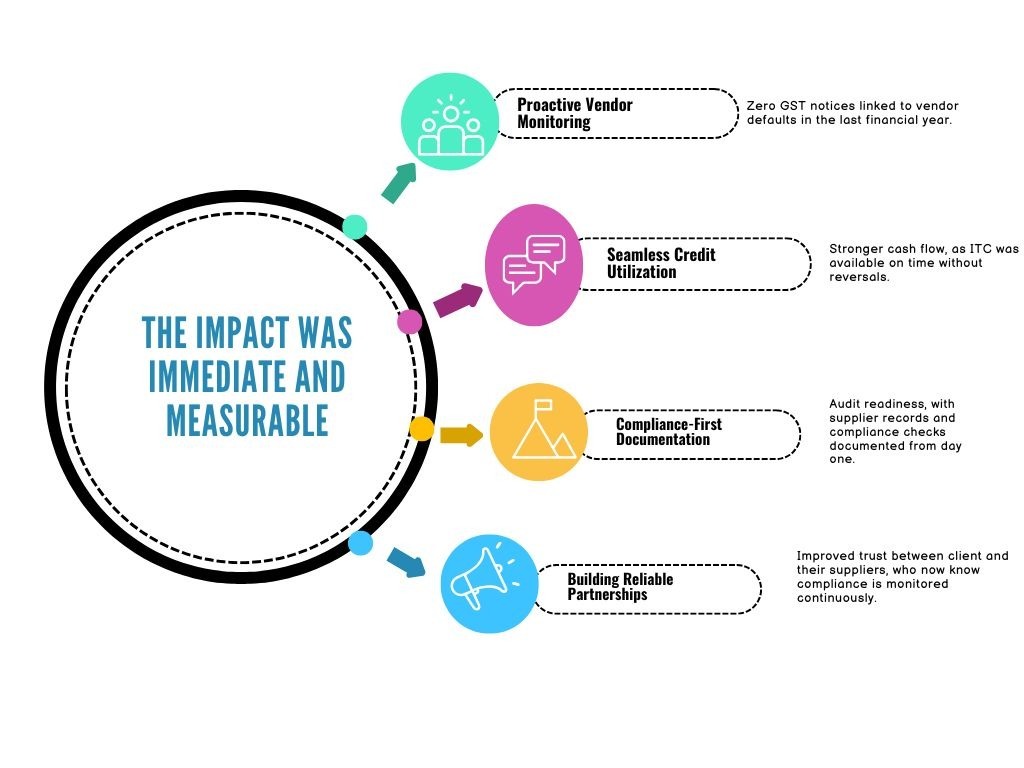
The Results Speak for Themselves:

Most importantly, the client expressed genuine relief. Instead of reacting to compliance failures after they occurred, they now operate with certainty and peace of mind.

A Model for Every Business:

  • While this success story began with an Indian client, the principle is universal:   supplier non-compliance creates real business risk, regardless of jurisdiction. Our compliance framework is adaptable for:Indian clients needing robust GST and TDS oversight.
  • US clients seek vendor diligence in areas like sales tax reporting, 1099 compliance, and reconciliation.
  • By embedding due diligence into everyday operations, we help businesses avoid penalties, protect working capital, and build stronger supplier relationships.

Conclusion

At Kariwala & Company LLP, compliance management isn’t a back-office exercise—it is a strategic advantage. By proactively safeguarding vendor compliance, we have already delivered tangible results for our client, Kariwala Industries Limited.


Read more