
Skip to main content Skip to search

Archives for February 2026

Lease Accounting Reform Under US GAAP and Its Balance Sheet Effects

Why Lease Accounting Matters Today

For a considerable period, companies rented office spaces, storage facilities, cars, and machinery without reflecting these financial commitments on their balance sheets. Information about operating leases was confined to footnotes, thereby obscuring financial responsibilities from lenders, investors, and internal management. This situation was altered by the implementation of revised lease accounting standards under US GAAP. Currently, the majority of leases are required to be recorded directly on the balance sheet. 

Consequently, lease accounting now impacts reported assets, liabilities, financial metrics, and the evaluation of business risk. Comprehending these modifications is crucial for maintaining precise financial statements and making sound business decisions.

How Lease Accounting Evolved

Previously, under existing GAAP rules, only finance leases were recorded on the balance sheet. Operating leases were not shown, despite involving long term, mandatory payment obligations. This lack of transparency hindered comparisons between companies that leased assets and those that bought them. To resolve this, accounting standard setters implemented ASC 842, aiming to more accurately portray economic realities by acknowledging the rights and responsibilities associated with lease agreements.

Under the new guidance nearly all leases now result in balance sheet recognition.

What Changed Under ASC 842

The most important change is that operating leases are no longer off the balance sheet.

Under ASC 842:

  • Both operating and finance leases create a right-of-use (ROU) asset and a lease liability
  • Lease classification still matters, but mainly for expense presentation
  • Lease obligations are now clearly visible to financial statement users

This shift improves transparency and consistency across financial reporting.

Understanding the ROU Asset and Lease Liability

At lease commencement  two items are recorded:

Right-of-Use (ROU) Asset
The ROU asset represents the company’s right to use the leased asset during the lease term. It is measured based on the lease liability, adjusted for prepaid rent, lease incentives, and certain initial costs.

Lease Liability
The lease liability represents the present value of future lease payments. It is discounted using the lessee’s incremental borrowing rate or the rate implicit in the lease if available.

Both balances are adjusted over the life of the lease as payments are made and interest is recognized.

How Lease Accounting Works in Practice

The accounting process typically follows these steps:

  1. Identify the lease term, including reasonably certain renewal options
  2. Determine lease payments subject to capitalization
  3. Discount future payments to calculate the lease liability
  4. Record the ROU asset and lease liability at commencement
  5. Recognize ongoing lease expense, interest, and amortization

While the calculations can be complex, the result is a clearer picture of long term obligations
Financial Statement Presentation

Lease accounting affects all three primary statements:

  • Balance Sheet: ROU assets and lease liabilities
  • Income Statement: Single lease expense for operating leases, interest and amortization for finance leases
  • Cash Flow Statement: Principal payments in financing activities; interest typically in operating activities

Cash flows do not change but their classification does.

Broader Business Implications

Lease accounting reform is more than a technical change. It influences:

  • Lease-versus-buy decisions
  • Contract negotiation strategies
  • Debt covenant discussions
  • Financial planning and performance measurement

Treating lease accounting as a strategic issue helps organizations manage its impact effectively.

Conclusion

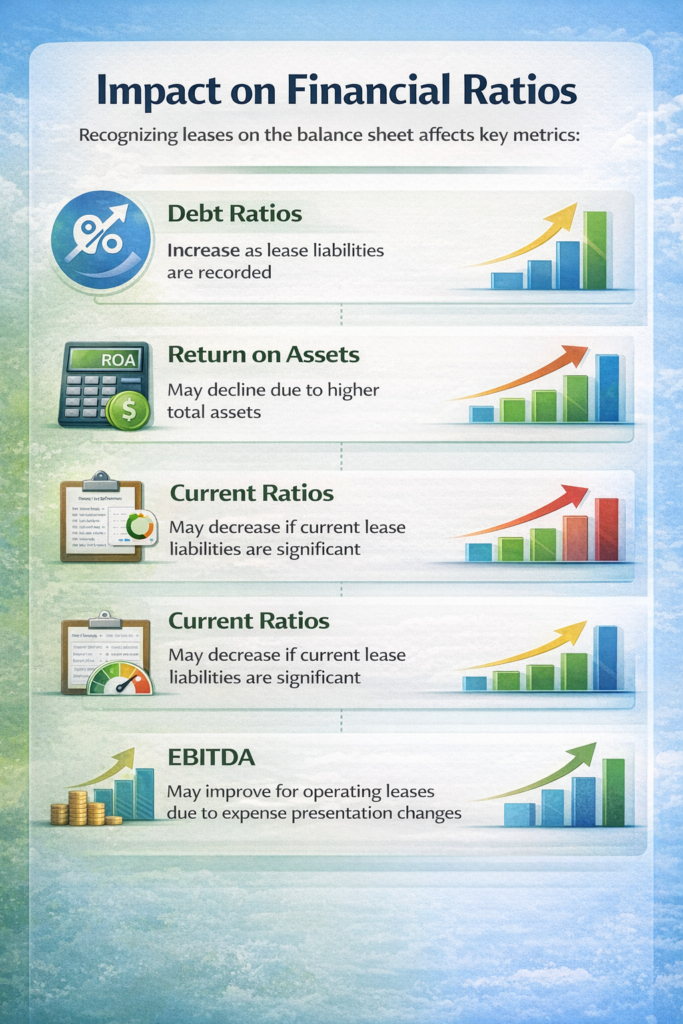
US GAAP now mandates that most leases be recorded as right-of-use assets and lease liabilities. This enhances transparency but alters financial metrics. Companies must accurately identify, measure, and disclose leases for correct financial reporting. 

A systematic approach to lease accounting ensures financial statements accurately represent the economic effects of leasing choices.
Reference

Read more
Difference Between Accounts Payable and Accounts Receivable

QuickBooks Online vs QuickBooks Desktop Cleanup: A Structured Guide to Restoring Accurate Financial Records

Why QuickBooks Cleanup Becomes Necessary

As companies grow, change accountants, or outsource bookkeeping, their QuickBooks files can develop errors like duplicate entries, incorrect balances, uncleared transactions, and automation issues. These inaccuracies hinder financial accuracy, complicating tax preparation, audits, and financial statement generation. A structured QuickBooks cleanup process identifies and corrects these issues, ensuring the system accurately reflects financial health. Both QuickBooks Online and Desktop require this cleanup, though methods differ due to their distinct designs and automation handling.

QuickBooks Cleanup Process: Step-by-Step Framework

A structured cleanup process typically follows these steps:

  1. File assessment and backup
  2. Review of chart of accounts
  3. Verification of opening balances
  4. Cleanup of duplicate and incorrect transactions
  5. Correction of automation rules (Online)
  6. Structural corrections and rebuild (Desktop)
  7. Sequential bank reconciliation
  8. Financial report verification

This systematic approach ensures complete restoration of accounting accuracy.

 Accessibility and Remote Working Capability

This subtopic explains how easily users can access QuickBooks and work remotely.

QuickBooks Online:
QuickBooks Online is a cloud-based accounting software accessible via a web browser from any location, supporting remote teams, external accountants, and businesses with multiple branches without requiring local software installation.

QuickBooks Desktop:
QuickBooks Desktop is installed on a local system. Access is limited to the computer where it is installed unless remote access tools or hosting services are used. This makes it less flexible for remote teams.

Why this matters:
Businesses with remote employees, outsourced accounting firms, or multiple locations benefit more from QuickBooks Online due to its accessibility.

Bank Reconciliation Cleanup and Correction Process

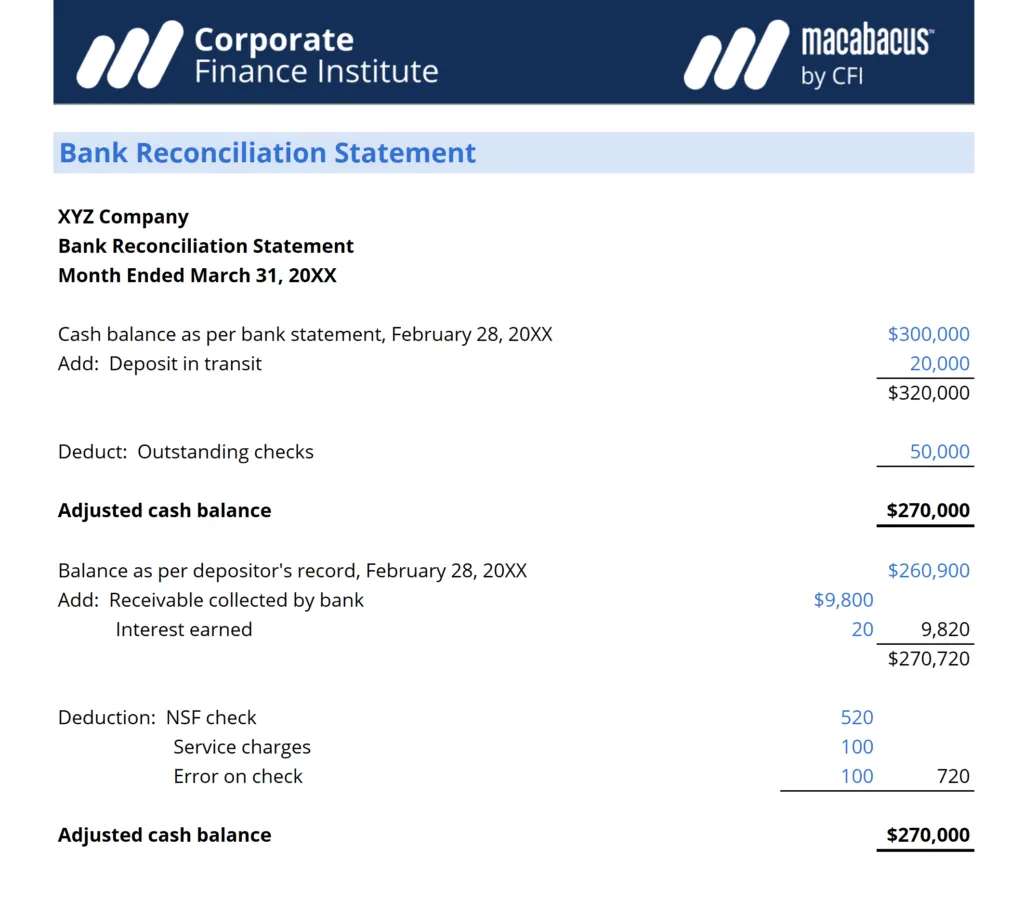
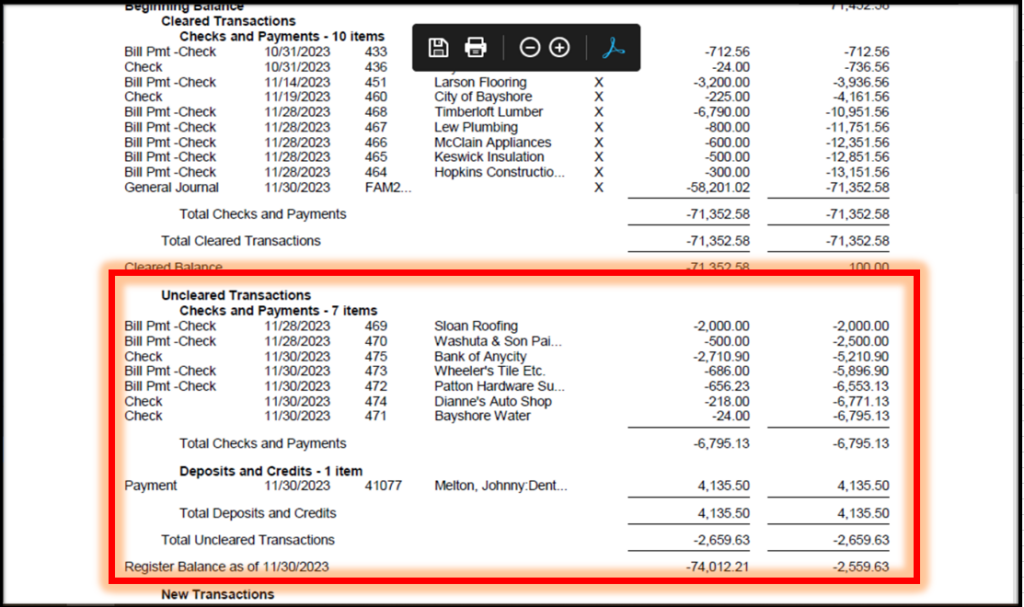
Bank reconciliation is the foundation of accurate accounting.

Cleanup involves:

  • Identifying missing transactions
  • Removing duplicate entries
  • Correcting incorrect postings
  • Ensuring balances match bank statements

Reconciled transactions must never be deleted. Corrections should always address the original error rather than forcing adjustments.

Proper reconciliation ensures accurate financial reporting and audit readiness.

Data Backup, Security, and Risk Protection

This subtopic explains how financial data is protected in both versions.

QuickBooks Online:
QuickBooks Online automatically backs up data in secure cloud servers. It uses encryption, secure login, and advanced security layers. There is no risk of losing data due to system failure or hardware damage.

QuickBooks Desktop:
QuickBooks Desktop requires manual backups or scheduled backups. If backups are not maintained properly, there is a risk of data loss due to system crashes, hardware failure, or viruses.

Why this matters:
Automatic backups in QuickBooks Online provide better protection and reduce risk, while Desktop requires more manual responsibility.

Common Problems Identified During QuickBooks Cleanup

The most frequent issues found during cleanup include:

  1. Duplicate transactions from bank feeds
  2. Incorrect automation rules
  3. Unreconciled bank accounts
  4. Incorrect opening balances
  5. Payroll liability discrepancies
  6. Inventory valuation errors
  7. Improper use of undeposited funds
  8. Incorrect journal entries

These issues accumulate over time and reduce financial reliability.

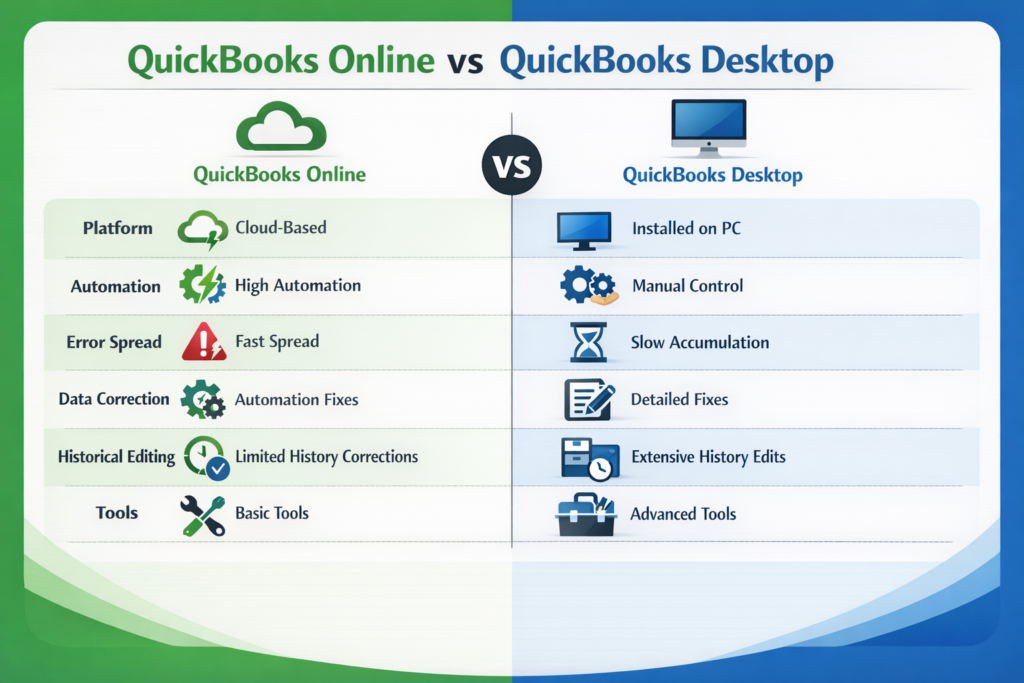
Key Differences: QuickBooks Online vs Desktop Cleanup

Business Benefits of Proper QuickBooks Cleanup

Proper cleanup provides significant benefits:

  • Accurate financial reporting
  • Reliable tax filing
  • Audit readiness
  • Better business decision-making
  • Smooth outsourcing transition
  • Improved financial transparency

Clean books improve operational confidence and financial control.

When Professional Cleanup Support Is Recommended

Professional cleanup is necessary when:

  • Multiple years require correction
  • Reconciliations are incomplete
  • Financial reports are unreliable
  • Business is preparing for audit
  • Business is transitioning to outsourced accounting

Conclusion: 

QuickBooks cleanup ensures financial accuracy, reliable reporting, and readiness for compliance, audits, and growth. QuickBooks Online and Desktop need distinct cleanup methods due to their differing operations. Proper assessment, automation control, reconciliation maintenance, and error correction restore confidence in financial data, resolving current issues and building a foundation for sustainable financial management.

Reference:

Bank reconciliation and bookkeeping best practices

Read more

Advance Interest and Principal Repayment: Accounting Treatment with Year-End and Next-Year Impact

Scenario Overview

In December 2025, a business obtained a loan of ₹10,00,000 at 10% annual interest. In January 2026, the business made a combined payment of ₹1,20,000, which included:

  • ₹10,000 for current interest (expense of FY 2025-26)
  • ₹10,000 for advance interest (benefit of next financial year)
  • ₹1,00,000 towards principal repayment (reduction of liability)

This single transaction affects three different accounting elements:

  • Expense recognition (Interest Expense)
  • Asset creation (Prepaid Interest)
  • Liability reduction (Loan Principal)

Proper classification ensures that profit, assets, and liabilities are presented accurately in the financial statements.

Why Proper Accounting Treatment is Important

If the full ₹20,000 interest is treated as expense immediately:

  • Profit will be understated
  • Assets will be understated
  • Financial statements will not reflect future benefits

Correct accounting ensures:

  • Only current period interest is treated as expense
  • Advance interest is recorded as a current asset
  • Loan balance reflects actual outstanding liability
  • Financial statements present a true and fair view

This treatment follows the Accrual Concept and Matching Principle, where expenses are recorded in the period to which they relate.

Complete Accounting Treatment and Financial Position as on 31 March 2026

Component
Amount (₹)

Accounting Treatment
Effect on Financial StatementsExplanation
Loan Taken (Dec 2025)10,00,000Loan A/c creditedLiability increasesCreates legal repayment obligation
Principal Repaid (Jan 2026)1,00,000
Loan A/c debited
Loan reduces to ₹9,00,000Improves financial position
Interest Paid (Current period)10,000Interest Expense debitedExpense recorded in P&LReduces profit of FY 2025-26
Interest Paid in Advance10,000Prepaid Interest debitedRecorded as Current AssetFuture benefit available
Total Bank Payment1,20,000Bank creditedBank balance decreasesCash outflow occurred

Closing Financial Position as on 31 March 2026

Financial ElementAmount (₹)Financial StatementPosition
Loan Outstanding9,00,000Balance SheetLiability
Prepaid Interest10,000Balance SheetCurrent Asset
Interest Expense10,000Profit & Loss AccountExpense
Bank BalanceReduced by ₹1,20,000Balance SheetAsset reduced

Key Interpretation as on 31 March 2026

As of the financial year-end, the business has correctly recognized only ₹10,000 as interest expense because it relates to the current accounting period. The advance interest of ₹10,000 remains classified as a prepaid asset, representing future economic benefit.

The loan balance has been reduced from ₹10,00,000 to ₹9,00,000 due to principal repayment. This improves the company’s financial stability by lowering its outstanding obligations.

This treatment ensures that profit is not understated, assets are correctly presented, and liabilities reflect the true financial obligation.

Result in April 2026

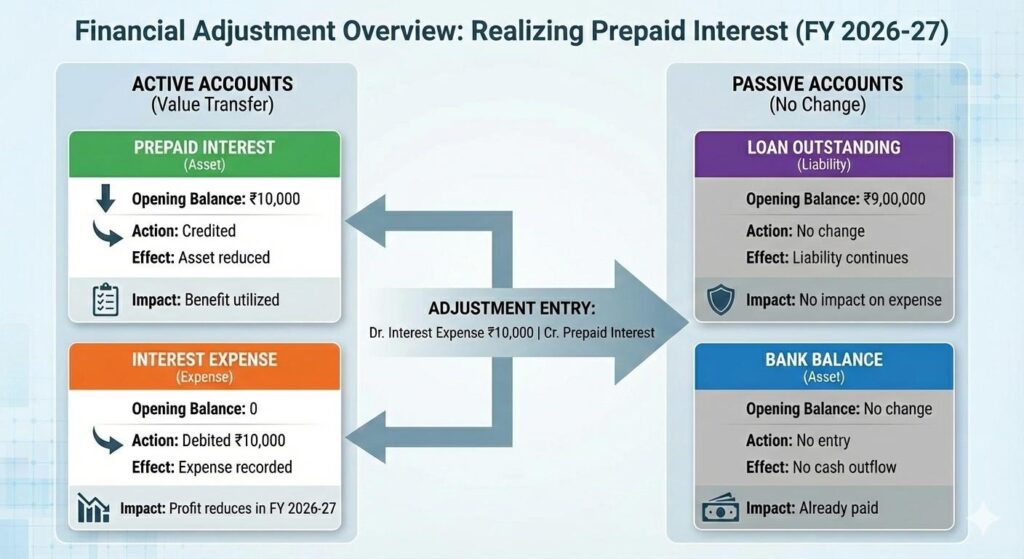
In April 2026, the prepaid interest is converted into interest expense because the benefit now relates to the current accounting period. This adjustment ensures proper matching of expense with the relevant period.

No additional cash payment occurs because the interest was already paid earlier. This ensures proper expense recognition without affecting cash flow again.

Overall Accounting Impact Summary

ComponentTreatmentFinancial Effect
Current InterestExpenseReduces current year profit
Advance InterestCurrent AssetFuture benefit
Principal RepaymentLiability ReductionImproves financial strength
Bank PaymentCash OutflowReduces bank balance

Final Financial Position Interpretation

As of March 31, 2026, the financial statements reflect the correct position of the business. The loan liability stands at ₹9,00,000, prepaid interest of ₹10,000 is recorded as an asset, and only ₹10,000 is recorded as expense in the Profit & Loss Account.

This ensures that profit, assets, and liabilities are accurately reported and financial statements present a true and fair view.

Additional Professional Subtopics 

Impact on Profitability and Financial Performance

Proper treatment ensures that only the relevant interest expense is recorded in the current financial year. If advance interest is incorrectly recorded as expense, profit will appear lower than actual, which can mislead management and stakeholders. Correct classification helps in accurate performance evaluation and decision making.

Impact on Balance Sheet Accuracy and Financial Position

Recording advance interest as a prepaid asset ensures that assets reflect future economic benefits. Similarly, principal repayment reduces liabilities, improving the company’s debt position. This ensures the Balance Sheet presents the true financial strength of the business.

Importance for Audit, Compliance, and Financial Transparency

Auditors verify whether expenses, assets, and liabilities are correctly classified. Proper accounting treatment ensures compliance with accounting standards and prevents financial misstatement. This improves transparency, builds investor confidence, and ensures reliable financial reporting.

Conclusion

When a business pays interest in advance along with principal repayment, each component must be accounted for separately. Current interest is treated as expense, advance interest is recorded as a prepaid asset, and principal repayment reduces loan liability. This ensures proper expense recognition, accurate financial reporting, and correct presentation of financial position. Such treatment supports reliable decision-making, ensures compliance with accounting principles, and maintains the integrity of financial statements.

Reference:

IFRS framework issued by the International Accounting Standards Board (IASB)

Read more