
Skip to main content Skip to search

Archives for Uncategorized

A Comprehensive Guide to Real Estate Financial Statements and Performance Analysis

Financial statements are essential for assessing the financial well being and operational success of businesses centered on property. In contrast to industries driven by individual transactions, the performance of these businesses is shaped by enduring assets, consistent revenue generation, the way they are financed, and continuous operating expenditures. Consequently, financial reporting serves not merely as a regulatory obligation but as a fundamental pillar for strategic choices, future planning, and expansion initiatives. 

For stakeholders to derive genuine benefit from financial statements, they need to grasp the organization of the figures, their operational implications, and their relationship to overall business outcomes. This guide aims to elucidate these aspects in a clear and applicable manner, empowering readers to interpret financial information with assurance and a defined objective.

The Financial Statements That Define Real Estate Performance

Real estate financial performance is evaluated through three primary statements, each serving a distinct purpose:

  • The Income Statement highlights operating performance over a specific period.
  • The Balance Sheet presents financial position at a point in time.
  • The Cash Flow Statement explains how cash moves through the business.

Together, these statements provide a complete financial picture. Reviewing one without the others often leads to incomplete or misleading conclusions.

Income Statement: Understanding Property Level Profitability

To interpret a real estate income statement effectively, readers should focus on the flow of profitability rather than just the final net income figure:

  1. Revenue Generation – Primarily rental income and property-related fees.
  2. Operating Expenses – Costs required to maintain and operate the property.
  3. Operating Results – Profitability before financing and non-operational items.

This structure helps distinguish between property performance and financing decisions, which is a critical distinction in real estate analysis.

 Understanding Financial Position Through Structure

ComponentFinancial Meaning
AssetsResources controlled by the business
LiabilitiesFinancial obligations and commitment
EquityResidual value after obligations

This structure explains how resources are funded and how value is distributed over time.

Profit vs Cash: Why the Numbers Do not Always Match

It is common for a business to appear profitable on paper while experiencing cash constraints. This disconnect arises from timing differences, loan repayments, and capital expenditures that do not immediately affect reported income.

Understanding cash movement is essential for evaluating sustainability, not just profitability.

 Performance Indicators Used in Real Estate Financial Analysis

Certain metrics are widely used to evaluate real estate performance:

  • Net Operating Income (NOI): Reflects operational profitability before financing.
  • Operating Expense Ratio: Measures cost efficiency.
  • Cash Flow from Operations: Indicates liquidity strength.

These indicators help stakeholders compare performance across properties and time periods.

 Balance Sheet Perspective: Properties, Liabilities, and Equity

AreaWhat It Represents in Real Estate
AssetsProperties, improvements, cash
LiabilitiesLoans, mortgages, payables
EquityOwner’s interest over time

Cash Flow Realities in Real Estate Operations

Profitability does not always align with cash availability in real estate. A property may show strong income while experiencing cash constraints due to loan repayments, capital expenditures, or timing differences in collections.

This is why the cash flow statement plays a vital role in performance analysis. It highlights whether operations generate sufficient cash to support ongoing obligations and future investments, independent of accounting profits.

Turning Financial Data Into Strategic Insight

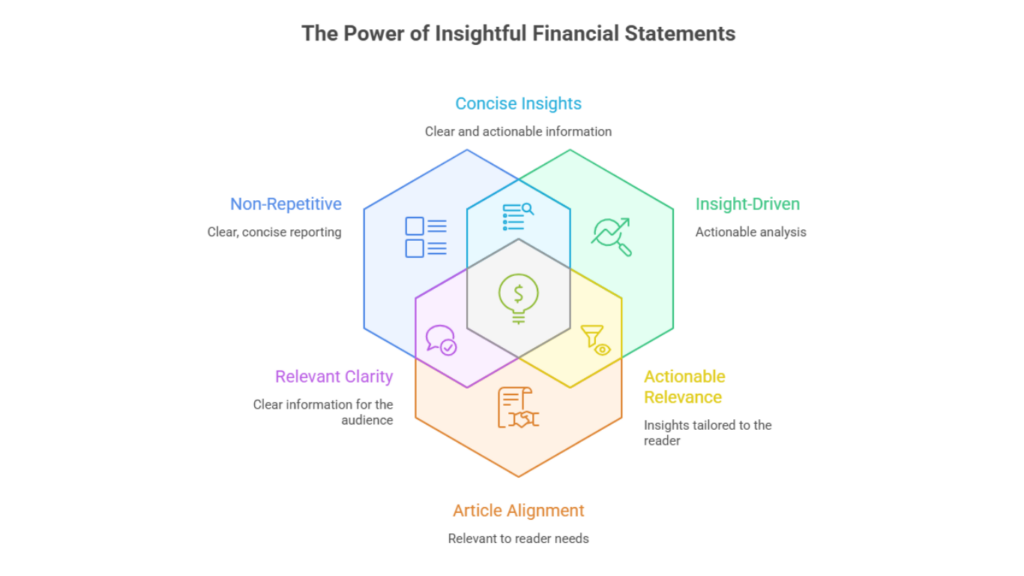
Financial statements offer the greatest worth when they function as instruments for understanding rather than mere records. Properly organized and carefully analyzed, they illuminate performance, identify potential dangers, and aid in strategic development. 

A consistent method of financial reporting leads to improved decision-making, enhanced monitoring, and sustained assurance in financial results.

Why Accurate Bookkeeping Is the Backbone of Real Estate Statements

Explain:

  • How poor bookkeeping affects reports
  • Why clean books lead to better decisions
  • How consistency supports scalability

How Accountants Add Value Beyond Report Preparation

Discuss:

  • Interpretation
  • Compliance support
  • Investor-ready reporting

This positions your firm as more than data processors.

Conclusion:

Real estate financial statements are not fixed documents but rather dynamic instruments that showcase operational rigor, financial well being, and prospective opportunities. When they are produced with accuracy and interpreted properly, they offer understanding, aid in strategic planning, and facilitate assured choices. A systematic method for financial reporting converts data into valuable understanding, empowering real estate ventures to function with enhanced oversight, openness, and financial certainty.

Reference:

Financial Accounting Standards Board (FASB)

Accounting Standards Codification – Financial Statement Presentation

https://www.kariwala.pro/services/accounting/

Read more

How the 2025 Federal Government Shutdown Affected Employment Data and Business Forecasting

Introduction: Why This Shutdown Mattered Beyond Politics

The 2025 federal government shutdown was not just a political event, it created a temporary breakdown in the U.S. economic information system. When large parts of the federal government stopped functioning, the impact went far beyond unpaid federal employees. One of the most critical consequences was the disruption of employment data and economic indicators that businesses, CPA firms, investors, and policymakers rely on for forecasting and decision-making.

What Triggered the 2025 Federal Government Shutdown? 

Congress’s failure to pass funding bills caused a government shutdown. Disputes over budget priorities led to a funding lapse, suspending non-essential operations and furloughing federal workers. Many agencies ceased operations or reduced staff significantly.

 Immediate Halt in Employment Data Collection 

Labor statistics agencies, including the BLS, faced disruptions to their regular survey operations during the shutdown. Crucial data from household employment, establishment payroll, and job openings surveys were impacted, leading to delays, incomplete surveys, or outright suspension, which hindered labor market insight.

 Employment Reports Most Affected 

The shutdown directly impacted several high impact labor indicators, including:

  • Monthly nonfarm payroll reports
  • Unemployment rate calculations
  • Initial and continuing jobless claims
  • Job Openings and Labor Turnover Survey (JOLTS)
  • Wage growth and labor participation metrics

These reports are typically released on fixed schedules, and delays or omissions disrupted normal market and business planning cycles.

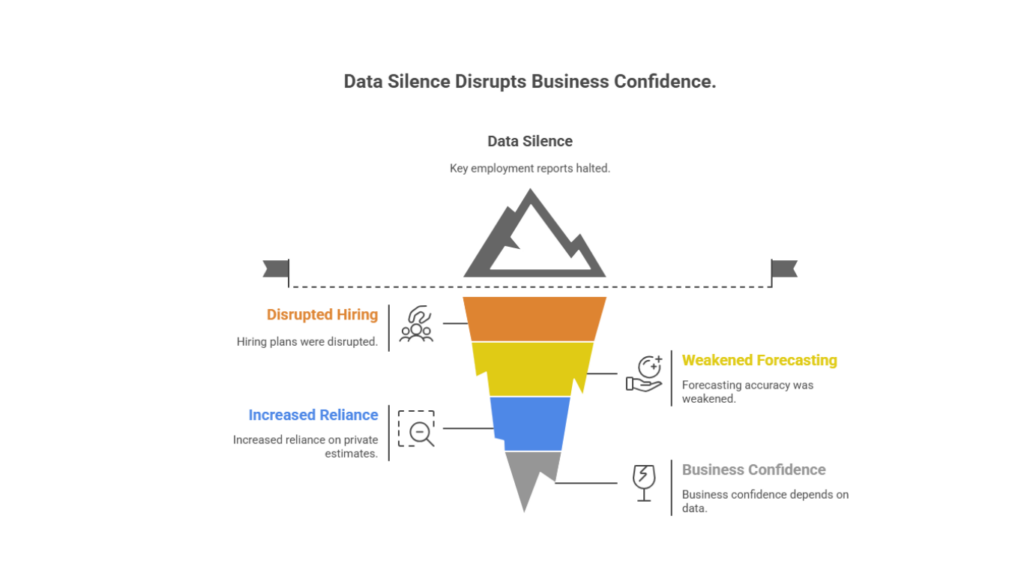
How the Data Blackout Affected Business Forecasting 

Businesses depend on labor data to anticipate demand, hiring needs, and wage pressure. The shutdown affected forecasting in several ways:

  1. Workforce planning became reactive rather than data-driven
  2. Hiring freezes or delays were implemented due to uncertainty
  3. Budget forecasts for labor costs became less accurate
  4. Demand projections tied to employment trends lost reliability

This uncertainty was especially challenging for companies preparing year-end budgets and forward-looking financial plans,

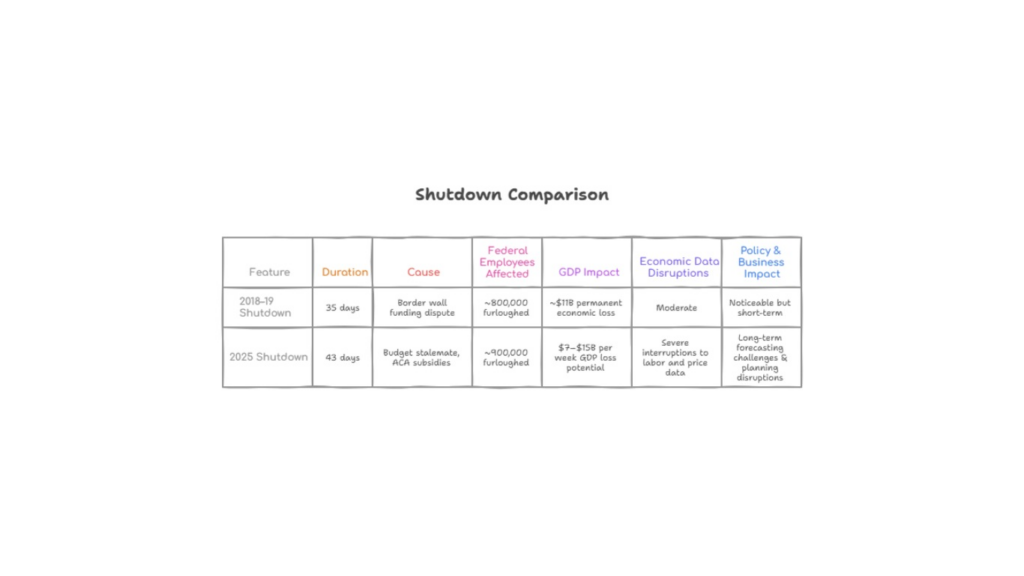
Impact on CPA Firms, Accounting & Financial Professionals: 2018–19 vs. 2025 Shutdown

Government shutdowns disrupt the essential economic data, financial reporting, compliance, forecasting, and corporate planning relied upon by accountants and CPAs. The impact escalates with the shutdown’s length and severity.

1. Data Disruption and Quality Challenges  Primary Difference

The 35-day government shutdown in 2018-2019 caused delays in labor market, GDP, CPI, and business output reports. However, the impact was brief, with skeleton crews completing some data releases.

By contrast, the 2025 shutdown (43 days) triggered wider data blackout effects, blocking routine monthly employment data, labor force participation reports, price indexes, and retail or production statistics for longer periods. This created a noticeable “information gap” in official economic releases, complicating:

  • Trend analysis
  • Comparative period reporting
  • Audit risk assessments

Because financial professionals use these datasets to adjust forecasts, calculate expected performance, and analyze economic conditions, missing data forces reliance on private or partial sources, increasing uncertainty and risk in advising clients especially for planning labor costs and projections.

2. Forecasting and Business Planning Uncertainty

2018–19 Shutdown:
Businesses experienced short term planning disruption as economic confidence dipped and temporary furloughs slowed consumer spending. Many firms delayed investment decisions due to incomplete data, but the impact generally resolved soon after operations resumed.

2025 Shutdown:
Because it occurred at a more fragile point in the economy  with slowing job growth, rising unemployment, and inflation concerns  the shutdown’s effect on forecasting was more pronounced:

  • Delayed employment and CPI releases made Q4 forecasts less reliable
  • Companies hesitated to update sales and hiring plans
  • Economic models lacked recent benchmark inputs
  • Financial professionals had to use alternate datasets (private sector payroll data, industry surveys) instead of official reports, leading to higher variance in forecasts and greater sensitivity in decision-making.

In both cases, CPAs needed to adjust projections with scenario planning and caution, but the 2025 data vacuum was deeper, creating more forecasting uncertainty.

3. Accounting Treatments and Reporting Challenges

Both shutdowns affected accounting workflows but the 2025 shutdown had more complications due to length and data issues:

Revenue Recognition & Performance Obligations

Government contract revenue recognition became complex during shutdowns due to delayed client payments and approvals. While this was a challenge in 2018-19, it was usually resolved later. In 2025, data reporting delays further complicated financial closing by impacting GAAP/US GAAP comparatives and estimates.

Estimates, Disclosures, and Going Concern

Extended shutdowns increased uncertainty in estimates, affecting bad debt and inventory valuations due to reduced consumer spending, leading to more cautious disclosures. CPA firms advised clients to improve disclosures and bolster audit documentation on assumptions.

 4. Financial Stability and Market Confidence

Market reactions differ significantly between a short shutdown and a long shutdown:

  • During 2018–19, markets shrugged off much of the uncertainty within weeks, and economic statistics largely rebounded after reopening.
  • In 2025, extended uncertainty and missing data added volatility in employment figures, consumer sentiment, and inflation data, causing institutions like the Federal Reserve to delay or complicate policy decisions.

Because CPAs interpret policy implications for clients (e.g., on capital budgeting, cost of borrowing, wage cost assumptions), the 2025 shutdown impeded strategic financial planning more, particularly in prolonged inflationary or slow-growth environments. 

Shift Toward Alternative and Private Data Sources 

In the absence of official data, businesses and analysts increasingly turned to:

  • Private payroll processors’ employment estimates
  • Internal HR and payroll trend analysis
  • Industry-specific labor benchmarks
  • Regional employment indicators

While useful, these alternatives lack the breadth, standardization, and authority of federal data.

 Key Lessons for Businesses Going Forward 

The 2025 shutdown highlighted several structural lessons:

  • Over-dependence on a single data source increases risk
  • Forecasting models need contingency scenarios
  • Businesses must prepare for data interruptions, not just economic downturns

This event reinforced the importance of resilience in financial planning.

Conclusion

The 2025 government shutdown highlighted the importance of employment data for business forecasting and economic decisions. Disruptions to this data flow caused widespread uncertainty across various sectors. The shutdown underscored the critical need for continuous data availability, alongside accuracy, for organizations dependent on economic insights.

Reference:

Associated Press (AP News) – Coverage on employment data disruptions

Read more

Inventory Accounting Problems in Manufacturing Companies

Inventory in manufacturing is essentially frozen cash, often comprising 40-60% or more of a company’s assets, including raw materials, work-in-progress, finished goods, and spare parts. Errors in inventory accounting negatively impact cost of goods sold, gross margin, pricing, tax calculations, loan agreements, and management decisions. This article explores common manufacturing inventory accounting issues, their causes, and solutions through disciplined processes and expert outsourcing.

Wrong Categorisation of Inventory (Raw Material, WIP, Finished Goods)

One of the most common problems in manufacturing is misclassification:

  1. Raw materials booked as WIP or finished goods still shown as WIP.
  2. Items issued to production physically but not recorded in the system.
  3. Returned goods from customers wrongly treated as fresh finished goods.

This leads to overstated or understated inventory and incorrect COGS.
How it’s resolved:

  1. Clear definitions and policies for each category (RM, WIP, FG).
  2. Standard issue and return procedures linked to production orders.
  3. Periodic reconciliation between production reports and inventory ledger.

Weak Controls over Cutting, Issuance & Fabric Utilization

Cutting departments often operate without robust real-time tracking of marker efficiency, fabric yield, or residual scraps. Decisions taken manually on the production floor translate into losses that are not recorded in books. Weak controls cause invisible waste, inaccurate standard cost benchmarking, and poor cost recovery during costing and pricing.

Inaccurate Bills of Material and Routing Data


Issue

Operational Impact

Financial Consequence

Missing components

Production stoppage

Urgent purchase premiums

Incorrect quantities

Excess scrap

Higher COGS

Outdated routing times

Incorrect labor costing

Margin compression

Engineering changes untracked

Frequent rework

Write-offs

Accurate BOM and routing data are foundational for stable costing, scheduling, and inventory valuation.

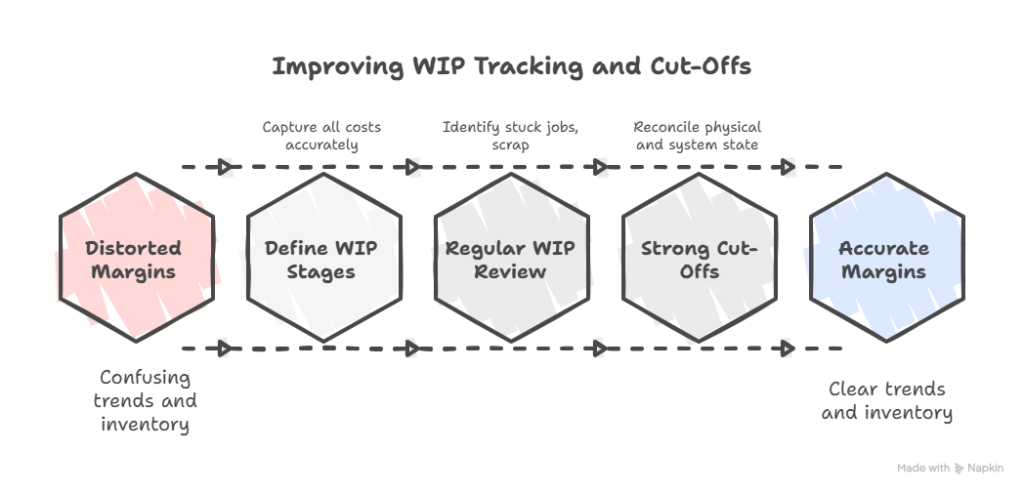
Weak WIP Tracking and Cut-Off Errors

 Standard Costing vs Actual Costing Confusion

Many manufacturing plants use standard costing, but do not track actual variances properly, which leads to:

  • Large, unexplained purchase price variances (PPV).
  • Usage variances (materials consumed more than standard) not analysed.
  • Overhead variances ignored, leading to wrong product profitability.
                                               

This makes management believe some products are profitable when they aren’t.

Resolution:

  • Clear policy on whether the plant primarily uses standard cost or moving average/actual cost.
  • Detailed variance analysis each month: material, labor, overhead, mix, yield.
  • Feeding variance insights back into BOMs, routings, and purchasing strategy.

 Excess and Obsolete Inventory Accumulation

  • Scenario: A workwear manufacturer maintains 6 months of fabric inventory due to MOQ contracts.
  • Outcome: Customer specification change renders ₹38 lakhs of stock obsolete.
  • Result: Write-off of raw material + additional cost to procure new grade fabric.
  • Lesson: Buffer stocks reduce risk, but without demand alignment, they destroy capital.

 Inventory Shrinkage Due to Theft, Damage or Errors

To reduce shrinkage, manufacturers must implement:

  1. Serialized material identification
  2. Controlled access to storage
  3. Mandatory scrap reporting
  4. CCTV monitoring of warehouses
  5. Periodic cycle counts

Without controls, shrinkage silently drains profitability.

Cost Allocation Issues: Overhead, Labor, and Machine Time

Manufacturing costing isn’t just material  it also includes:

  • Direct labor (wages, overtime, incentives).
  • Manufacturing overheads (power, maintenance, depreciation, factory rent).
  • Machine hours or setup time for complex jobs.

When overheads are allocated using vague or outdated bases, high volume products may appear less profitable while low-volume, complex products look better than they truly are.

Resolution steps:

  • Selecting rational overhead allocation bases (machine hours, labor hours, etc.)
  • Periodic review of standard rates vs actual cost pool.

Using activity based costing (ABC) where complexity is high.

Compliance, Audit Readiness, and Management Reporting

Inventory is a key area in financial audits and internal control reviews. Common findings include:

  • Weak documentation of standard costing assumptions.
  • Inconsistent application of inventory valuation methods (FIFO, weighted average).
  • Incomplete inventory disclosures for financial statements.

Without a strong inventory accounting framework, audits become time-consuming, and management gets delayed or unreliable MIS.

How structured processes help:

  • Standardised inventory accounting policy and clear documentation.
  • Tight linkage between inventory sub-ledgers and GL.
  • Dashboards showing inventory days, ageing, variance trends, and margin impact.

How Kariwala & Co. LLP Supports US Manufacturing Companies

At Kariwala & Co. LLP, we work with US-based manufacturing businesses to:

  1. Diagnose inventory accounting pain points across raw materials, WIP, and finished goods.
  2. Clean up BOMs, WIP tracking, and standard costing so reported margins match operational reality.
  3. Design and run robust reconciliation routines between physical stock, production reports, and ERP ledgers.
  4. Build practical variance analysis and inventory dashboards that management can act upon.

We help finance leaders clarify and control inventory by merging US GAAP accounting knowledge with manufacturing operational insight.

Reference:

The Hidden Costs of Inventory Management — supply management trade article that explains how data inaccuracy, poor forecasting and outdated systems result in excess or obsolete stock and inefficiencies. ISM World


Read more