

Introduction: Why This Shutdown Mattered Beyond Politics
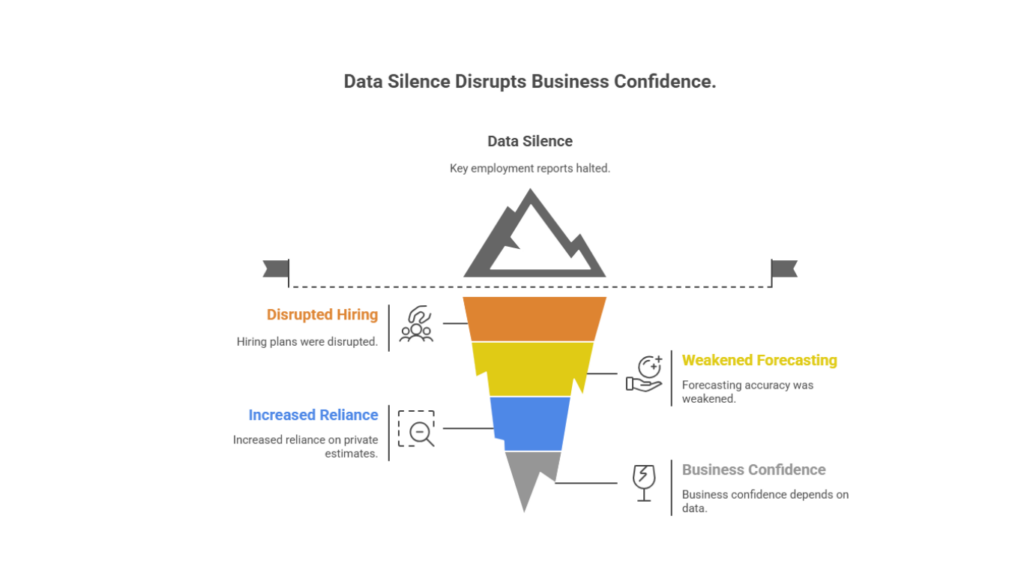
The 2025 federal government shutdown was not just a political event, it created a temporary breakdown in the U.S. economic information system. When large parts of the federal government stopped functioning, the impact went far beyond unpaid federal employees. One of the most critical consequences was the disruption of employment data and economic indicators that businesses, CPA firms, investors, and policymakers rely on for forecasting and decision-making.
What Triggered the 2025 Federal Government Shutdown?
Congress’s failure to pass funding bills caused a government shutdown. Disputes over budget priorities led to a funding lapse, suspending non-essential operations and furloughing federal workers. Many agencies ceased operations or reduced staff significantly.
Immediate Halt in Employment Data Collection
Labor statistics agencies, including the BLS, faced disruptions to their regular survey operations during the shutdown. Crucial data from household employment, establishment payroll, and job openings surveys were impacted, leading to delays, incomplete surveys, or outright suspension, which hindered labor market insight.
Employment Reports Most Affected
The shutdown directly impacted several high impact labor indicators, including:
- Monthly nonfarm payroll reports
- Unemployment rate calculations
- Initial and continuing jobless claims
- Job Openings and Labor Turnover Survey (JOLTS)
- Wage growth and labor participation metrics
These reports are typically released on fixed schedules, and delays or omissions disrupted normal market and business planning cycles.
How the Data Blackout Affected Business Forecasting
Businesses depend on labor data to anticipate demand, hiring needs, and wage pressure. The shutdown affected forecasting in several ways:
- Workforce planning became reactive rather than data-driven
- Hiring freezes or delays were implemented due to uncertainty
- Budget forecasts for labor costs became less accurate
- Demand projections tied to employment trends lost reliability
This uncertainty was especially challenging for companies preparing year-end budgets and forward-looking financial plans,
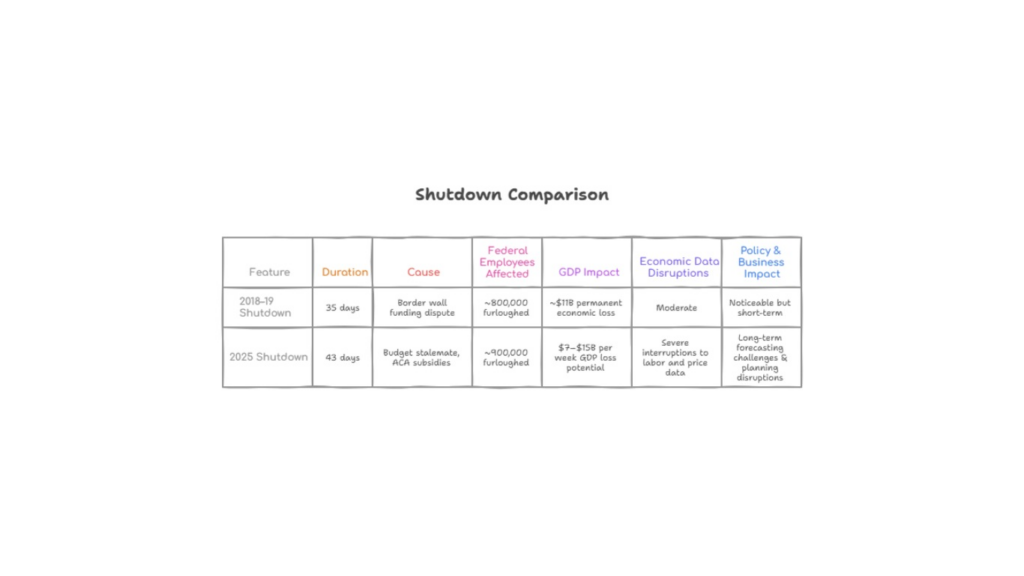
Impact on CPA Firms, Accounting & Financial Professionals: 2018–19 vs. 2025 Shutdown
Government shutdowns disrupt the essential economic data, financial reporting, compliance, forecasting, and corporate planning relied upon by accountants and CPAs. The impact escalates with the shutdown’s length and severity.
1. Data Disruption and Quality Challenges Primary Difference
The 35-day government shutdown in 2018-2019 caused delays in labor market, GDP, CPI, and business output reports. However, the impact was brief, with skeleton crews completing some data releases.
By contrast, the 2025 shutdown (43 days) triggered wider data blackout effects, blocking routine monthly employment data, labor force participation reports, price indexes, and retail or production statistics for longer periods. This created a noticeable “information gap” in official economic releases, complicating:
- Trend analysis
- Comparative period reporting
- Audit risk assessments
Because financial professionals use these datasets to adjust forecasts, calculate expected performance, and analyze economic conditions, missing data forces reliance on private or partial sources, increasing uncertainty and risk in advising clients especially for planning labor costs and projections.
2. Forecasting and Business Planning Uncertainty
2018–19 Shutdown:
Businesses experienced short term planning disruption as economic confidence dipped and temporary furloughs slowed consumer spending. Many firms delayed investment decisions due to incomplete data, but the impact generally resolved soon after operations resumed.
2025 Shutdown:
Because it occurred at a more fragile point in the economy with slowing job growth, rising unemployment, and inflation concerns the shutdown’s effect on forecasting was more pronounced:
- Delayed employment and CPI releases made Q4 forecasts less reliable
- Companies hesitated to update sales and hiring plans
- Economic models lacked recent benchmark inputs
- Financial professionals had to use alternate datasets (private sector payroll data, industry surveys) instead of official reports, leading to higher variance in forecasts and greater sensitivity in decision-making.
In both cases, CPAs needed to adjust projections with scenario planning and caution, but the 2025 data vacuum was deeper, creating more forecasting uncertainty.
3. Accounting Treatments and Reporting Challenges
Both shutdowns affected accounting workflows but the 2025 shutdown had more complications due to length and data issues:
Revenue Recognition & Performance Obligations
Government contract revenue recognition became complex during shutdowns due to delayed client payments and approvals. While this was a challenge in 2018-19, it was usually resolved later. In 2025, data reporting delays further complicated financial closing by impacting GAAP/US GAAP comparatives and estimates.
Estimates, Disclosures, and Going Concern
Extended shutdowns increased uncertainty in estimates, affecting bad debt and inventory valuations due to reduced consumer spending, leading to more cautious disclosures. CPA firms advised clients to improve disclosures and bolster audit documentation on assumptions.
4. Financial Stability and Market Confidence
Market reactions differ significantly between a short shutdown and a long shutdown:
- During 2018–19, markets shrugged off much of the uncertainty within weeks, and economic statistics largely rebounded after reopening.
- In 2025, extended uncertainty and missing data added volatility in employment figures, consumer sentiment, and inflation data, causing institutions like the Federal Reserve to delay or complicate policy decisions.
Because CPAs interpret policy implications for clients (e.g., on capital budgeting, cost of borrowing, wage cost assumptions), the 2025 shutdown impeded strategic financial planning more, particularly in prolonged inflationary or slow-growth environments.
Shift Toward Alternative and Private Data Sources
In the absence of official data, businesses and analysts increasingly turned to:
- Private payroll processors’ employment estimates
- Internal HR and payroll trend analysis
- Industry-specific labor benchmarks
- Regional employment indicators
While useful, these alternatives lack the breadth, standardization, and authority of federal data.
Key Lessons for Businesses Going Forward
The 2025 shutdown highlighted several structural lessons:
- Over-dependence on a single data source increases risk
- Forecasting models need contingency scenarios
- Businesses must prepare for data interruptions, not just economic downturns
This event reinforced the importance of resilience in financial planning.
Conclusion
The 2025 government shutdown highlighted the importance of employment data for business forecasting and economic decisions. Disruptions to this data flow caused widespread uncertainty across various sectors. The shutdown underscored the critical need for continuous data availability, alongside accuracy, for organizations dependent on economic insights.
Reference:
Associated Press (AP News) – Coverage on employment data disruptions