
Skip to main content Skip to search

Archives for April 2026

U.S. Inflation Uncertainty in 2026: What It Means for Financial Planning, Audits, and Business Stability

By 2026, inflation has transitioned from a temporary economic blip to a persistent structural issue that impacts how businesses operate, how they plan their finances, and their choices for the future. Increasing expenses, volatile interest rates, and unpredictable consumer demand are compelling companies to reconsider their established approaches.

For companies operating in dynamic environments, especially in the U.S. market, the key question is no longer “How does inflation impact us?” but rather “How do we adapt and remain stable despite inflation?”

Understanding the Real Impact of Inflation

Inflation’s impact on businesses differs, especially between manufacturing and services. It affects production costs, cash flow, and investment. Businesses unaware of these effects face profitability and sustainability issues.

Manufacturing Sector: Direct Exposure to Inflation

Manufacturing businesses are among the most affected during inflationary periods due to their dependency on physical inputs and supply chains.

Key Impact Areas:

  1. Rising raw material and energy costs directly increase production expenses
  2. Labor cost pressures due to wage adjustments
  3. Supply chain disruptions leading to inconsistent pricing
  4. Reduced profit margins due to inability to fully pass on costs

Unlike other sectors, manufacturing companies face immediate cost pressure, making inflation a critical operational risk.

Working Capital Stress: The Hidden Challenge

Inflation significantly impacts working capital management, often creating liquidity challenges even when revenues grow.

ComponentInflation ImpactBusiness Outcome
InventoryHigher procurement costsIncreased capital blockage
ReceivablesSlower customer paymentsCash flow strain
PayablesSupplier price hikesReduced negotiation flexibility
Cash ReservesLower purchasing powerLiquidity pressure

Why it matters

A business may appear profitable on paper but still face cash shortages, making working capital management critical during inflation.

Pros and Cons of Inflation: A Balanced Perspective

Advantages (Short-Term Gains)

Inflation can occasionally lead to short-term financial advantages. Companies might see increased income because of higher prices, and goods bought at earlier, lower prices can appreciate in worth. In some instances, reported profits might seem more robust.

Challenges (Long-Term Risks)

However, these benefits are often outweighed by long-term risks. Rising costs compress margins, borrowing becomes expensive, and demand becomes unpredictable. Strategic planning becomes more complex, increasing overall business uncertainty.

Impact on Investment and Expansion Decisions

Inflation and rising interest rates often work together to slow down business growth.

  • Cost of borrowing increases
  • Capital expenditure becomes expensive
  • Expansion plans are delayed or restructured

Strategic Shift

Businesses move from aggressive expansion to cost control and efficiency optimization.

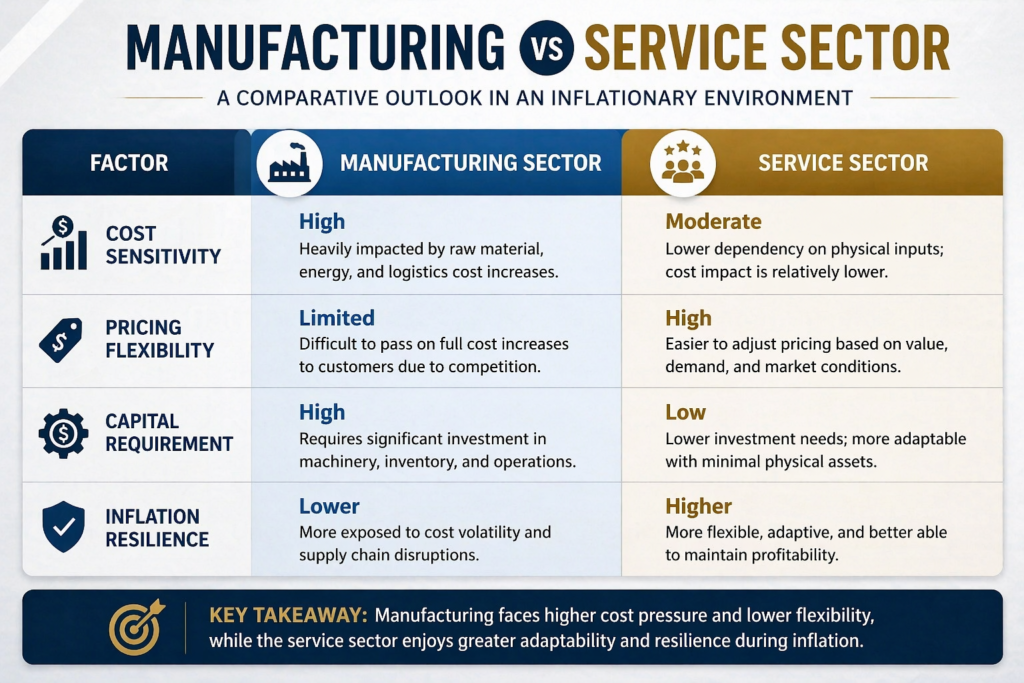
Manufacturing vs Service Sector: Comparative Outlook

Risk Management: A Critical Priority

Inflation introduces multiple financial and operational risks:

  1. Profitability Risk due to rising costs
  2. Liquidity Risk due to working capital pressure
  3. Financing Risk due to high interest rates
  4. Operational Risk due to supply disruptions

Kariwala Insight

Businesses that actively monitor and manage these risks are better positioned to maintain stability and avoid financial shocks.

How Service Businesses Survive

✔ Adjust pricing dynamically
✔ Shift to remote or hybrid models
✔ Automate repetitive processes
✔ Focus on high-margin services
✔ Reduce dependency on fixed costs

Outcome: Better control over profitability

Strategic Shift: From Growth to Sustainability

In inflationary environments, the focus shifts from aggressive growth to:

  • Cost efficiency
  • Cash flow stability
  • Risk control

Businesses that prioritize sustainability over expansion tend to perform better in uncertain conditions.

Conclusion

In 2026, inflation presents businesses with a strategic shift. Manufacturers face rising costs and reduced profits, while service firms gain from their agility. Success hinges on forward looking financial plans, strict cost control, and robust risk management. Prioritizing long term viability over immediate profits will help companies manage inflation and sustain financial health.

Final Thought (Kariwala Perspective)

Kariwala & Co. LLP posits that during periods of uncertainty, a distinct advantage in the competitive landscape is achieved through financial data clarity and strategic foresight. Enterprises that prioritize organized accounting practices, precise reporting, and proactive analysis are positioned for prosperity, transcending mere survival.

Read more

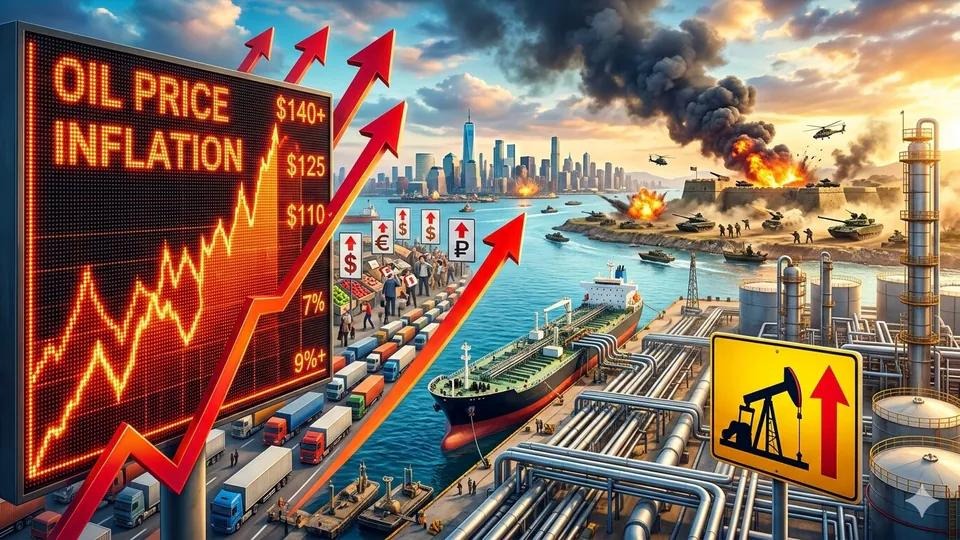
Impact of Global Oil Price: What It Means for U.S. Businesses and Their Accountants

A Crisis That is Rewriting the Rules for CPA Firms

The ongoing geopolitical tensions involving the U.S. and the Middle East are not just global headlines, they are actively reshaping the financial ecosystem.For U.S. CPA firms, this is not a distant macro issue. It is a day to day operational challenge.Clients are uncertain. Costs are volatile. Regulations are tightening.

And in the middle of all this, CPA firms are expected to deliver more accuracy, faster insights, and stronger guidance than ever before.

The Shift: From Compliance Providers to Crisis Advisors

Traditionally, CPA firms focused on:

  1. Bookkeeping
  2. Tax compliance
  3. Audit support

But in today’s environment, clients expect:

  1. Real time financial insights
  2. Planning is based on scenario
  3. Decision support is based on risk

CPA firms are being pushed into a new role:
Financial crisis managers

How the Current Crisis Is Impacting U.S. CPA Firms

1. Increased Client Uncertainty and Delayed Decision-Making

During geopolitical instability:

  • Businesses delay investments
  • Expansion plans are paused
  • Financial decisions become conservative

Impact on CPA firms:

  • Slower advisory engagements
  • Reduced consulting revenue
  • Clients favor cautious approaches.

2. Rising Complexity in Financial Reporting

Conflict driven volatility affects:

  • Oil prices
  • Exchange rate of currency
  • Supply chain costs

 This leads to:

  • Frequent changes in financial assumptions
  • Increased need for adjustments, estimates, and disclosures
  • Higher risk of misstatements

CPA firms now spend more time ensuring:
✔ Accurate valuations
✔ Proper disclosures
✔ Compliance under uncertain conditions

3. Pressure on Audit and Compliance Work

In uncertain environments:

  • Regulators increase scrutiny
  • Auditors demand stronger documentation
  • Risk assessments become more detailed

CPA firms face:

  • Longer audit cycles
  • Higher workload without proportional fee increases
  • Increased liability risks

4. Client Cash Flow Stress and Fee Pressure

As businesses face:

  • Rising costs (fuel, logistics, imports)
  • Reduced margins
  • Tight liquidity

They push back on:

  • Professional fees
  • Billing timelines
  • Scope of services

CPA firms are forced to:

  • Do more work
  • With tighter margins
  • Under higher expectations

5. Surge in Demand for Advisory Services (But With Challenges)

While traditional services face pressure, demand increases for:

  • Risk advisory
  • Scenario planning
  • Cash flow forecasting
  • Cost optimization

 However:

  • Clients expect faster turnaround
  • Require real time insights
  • Demand deeper analysis

This creates a capacity challenge for CPA firms.

The Core Problem: The Traditional CPA Model Is Under Stress

The current environment exposes a structural issue:

 CPA firms are built for stability
But are now operating in constant disruption

This mismatch creates:

  • Delivery not in time
  • Reduced service quality
  • Limited scalability

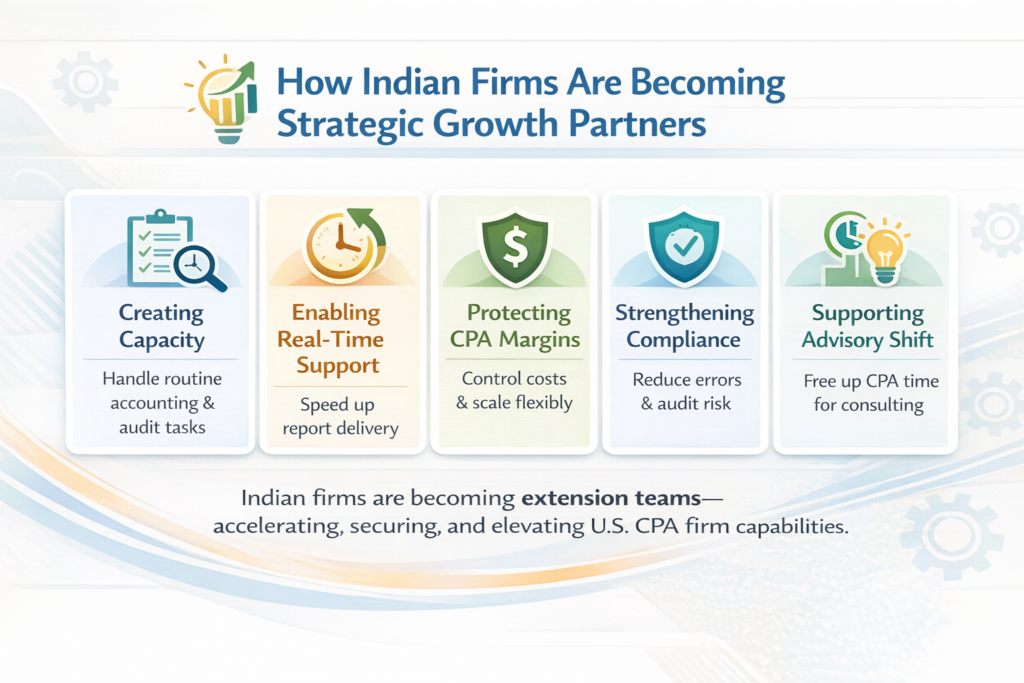
How Indian Firms Are Becoming Strategic Growth Partners

Why This Trend Is Accelerating Now

The current geopolitical crisis is acting as a catalyst.

It is forcing CPA firms to:

  1. Rethink their operating models
  2. Increase efficiency
  3. Build resilience

And offshore collaboration is becoming a core strategy not a backup option

The Bigger Picture: From Cost Saving to Value Creation

Earlier the outsourcing was about:
✔ Reducing costs

Now, it is about:
✔ Increasing capacity
✔ Improving turnaround time
✔ Enhancing service quality
✔ Enabling strategic growth

Conclusion: A Structural Shift in How CPA Firms Operate

The ongoing global conflict is speeding up long term changes for the U.S. CPA firms. With increasing financial complexity and changing client demands, firms can not just use old methods relying on internal resources. Agility, scalability, and quick responses are now essential. Indian accounting firms are becoming vital partners, assisting U.S. CPAs with workload, accuracy, and better services without sacrificing efficiency. What used to be outsourcing is now a core operational strategy. 

Firms adapting to this change will be better prepared for uncertainty, profitability, and leadership in a complex world.

Read more

When Global Conflict Disrupts Supply Chains: Accounting Questions Businesses Forget to Ask

Global conflict is now a direct financial risk to businesses, not just a distant geopolitical concern. Supply chains in 2026 face ongoing disruption from geopolitical tensions, tariffs, climate events, and economic instability. 

Rising supply chain pressures are fueling inflation, cost volatility, and U.S. economic uncertainty. While operations teams focus on rerouting and securing suppliers, a crucial area is often neglected.

The Real Shift: From Cost Stability to Cost Volatility

Historically, businesses operated with relatively stable:

  • Supplier pricing
  • Freight costs
  • Lead times

Today, those assumptions are no longer valid.

Costs are dynamic, unpredictable, and often retroactive forcing accounting teams to rethink how financial data is recorded, adjusted, and reported.

Critical Accounting Questions Businesses Overlook

Are Contract Terms Still Financially Relevant?

Supply disruptions often lead to:

  1. Renegotiated supplier contracts
  2. Changed delivery terms
  3. Volume commitments not being met

But accounting teams often continue applying old contract assumptions.

What gets missed:

  • Revised cost obligations
  • Penalty clauses or waivers
  • Changes in payment timelines

Key Question:
Are contract modifications being reflected accurately in financial reporting and accruals?

Are We Properly Accounting for Price Variance and Volatility?

Frequent price changes create:

  1. Purchase price variances
  2. Budget vs. actual mismatches
  3. Margin unpredictability

Without proper tracking, these variances get buried in overall expenses.

Key Question:
Are we isolating and analyzing price variances to understand their real impact on profitability?

Are Our Accruals Still Reliable?

In a disrupted supply chain:

  1. Invoices are delayed
  2. Goods are received without billing
  3. Services are partially completed

This makes accruals significantly more complex.

 Many companies either:

  • Under-accrue (understating liabilities)
  • Or over accrue (distorting profitability)

Key Question:
Are accrual estimates aligned with actual supply chain delays and uncertainties?

How Are Currency Fluctuations Impacting Our Books?

Global conflict often triggers:

  1. Currency volatility
  2. Exchange rate fluctuations
  3. Increased hedging activity

If not tracked properly, this impacts:

  • Payables and receivables
  • Imported inventory costs
  • Financial reporting accuracy

Key Question:
Are foreign exchange impacts being consistently measured and recorded across transactions?

Are We Overlooking Impairment Risks?

Disruptions can lead to:

  1. Obsolete or slow moving inventory
  2. Supplier failures
  3. Idle or underutilized assets

Yet many businesses delay recognizing impairments.

This leads to:

  • Overstated asset values
  • Misleading balance sheets

 Key Question:
Do we need to reassess inventory, receivables, or asset impairment due to ongoing disruptions?

Is Our Budgeting and Forecasting Model Still Valid?

Traditional budgets assume:

  • Predictable supply
  • Stable costs
  • Consistent timelines

But in today’s environment, those assumptions break down quickly.

 Static budgets become irrelevant within months.

Key Question:
Are we using flexible, scenario based forecasting models that reflect supply chain uncertainty?

Are We Capturing the Financial Impact of Strategic Decisions?

To mitigate disruption, businesses often:

  1. Shift to local suppliers
  2. Increase inventory buffers
  3. Diversify sourcing

While operationally necessary, these decisions have financial consequences:

  1. Higher working capital requirements
  2. Reduced margins
  3. Increased carrying costs

 Key Question:
Are strategic supply chain decisions being evaluated through a financial lens?

Do Our Financial Reports Reflect Reality or Lag Behind It?

One of the biggest risks today is timing gaps in financial reporting.

By the time reports are generated:

  1. Costs may have already changed
  2. Inventory positions may be outdated
  3. Margins may have shifted

 Key Question:
How close is our financial reporting to real time operational reality?

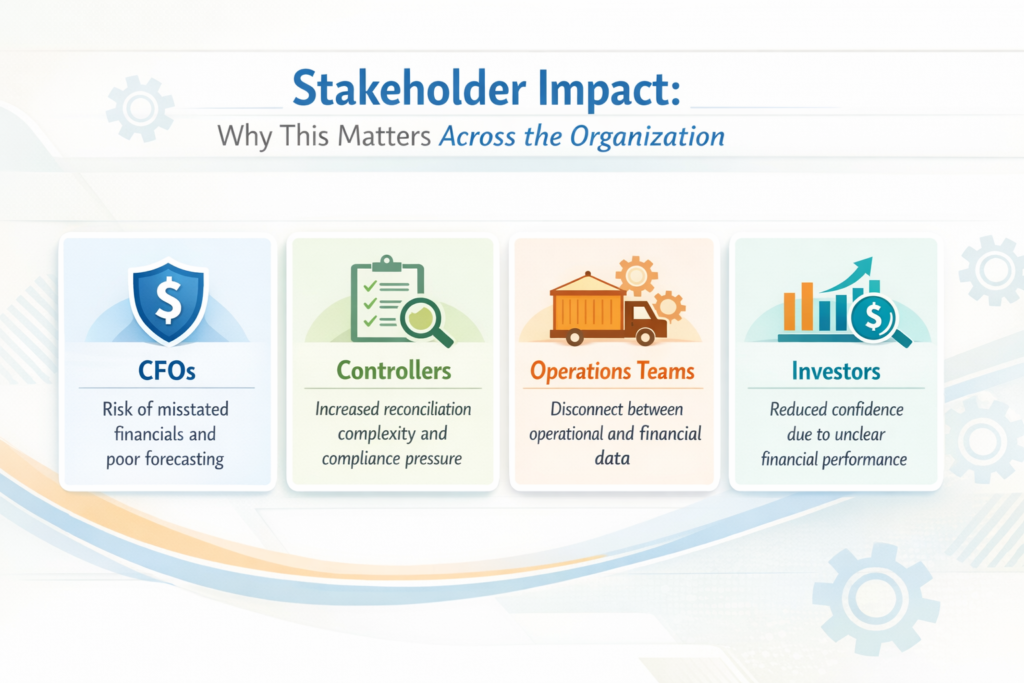
Stakeholder Impact: Why This Matters Across the Organization

Forward Thinking Companies Are Doing

Leading businesses are adapting their accounting approach to match the new reality:

  • Implementing dynamic accrual and estimation models
  • Integrating FX risk tracking into daily accounting
  • Moving to rolling forecasts instead of annual budgets
  • Enhancing inventory and asset impairment reviews
  • Aligning finance teams closely with supply chain operations

Why This Matters: The Risk of Financial Lag

In a volatile environment, the biggest danger is not disruption itself, it is delayed financial awareness.

If accounting does not evolve:

  • Risks remain hidden
  • Decisions become reactive
  • Financial statements lose reliability

Conclusion: Accounting Must Evolve with Disruption

Global conflict has altered supply chains and accounting’s role. Today, financial reporting needs constant adaptation to cost fluctuations, operational uncertainty, and changing strategies, not static assumptions or delayed data. Companies not aligning accounting with these realities risk poor decisions. Proactive businesses improving financial processes, visibility, and real-time data integration will better handle disruption. In an unpredictable world, accurate, adaptive accounting is key to resilience and success.

Read more