
Skip to main content Skip to search

Archives for March 2026

Difference Between Accounts Payable and Accounts Receivable

Financial Reporting Risks from Improper Revenue Recognition

Revenue is a key performance metric in U.S. businesses, directly impacting profitability, valuation, investor confidence, and regulatory compliance.Errors in revenue recognition, whether intentional or procedural, present significant risks to financial reporting.

Under U.S. GAAP (ASC 606), revenue must be recognized when performance obligations are satisfied and control is transferred, not merely when cash is received. Noncompliance can result in misstated financial statements, regulatory scrutiny, audit findings, and diminished valuation.

What This Topic Really Means

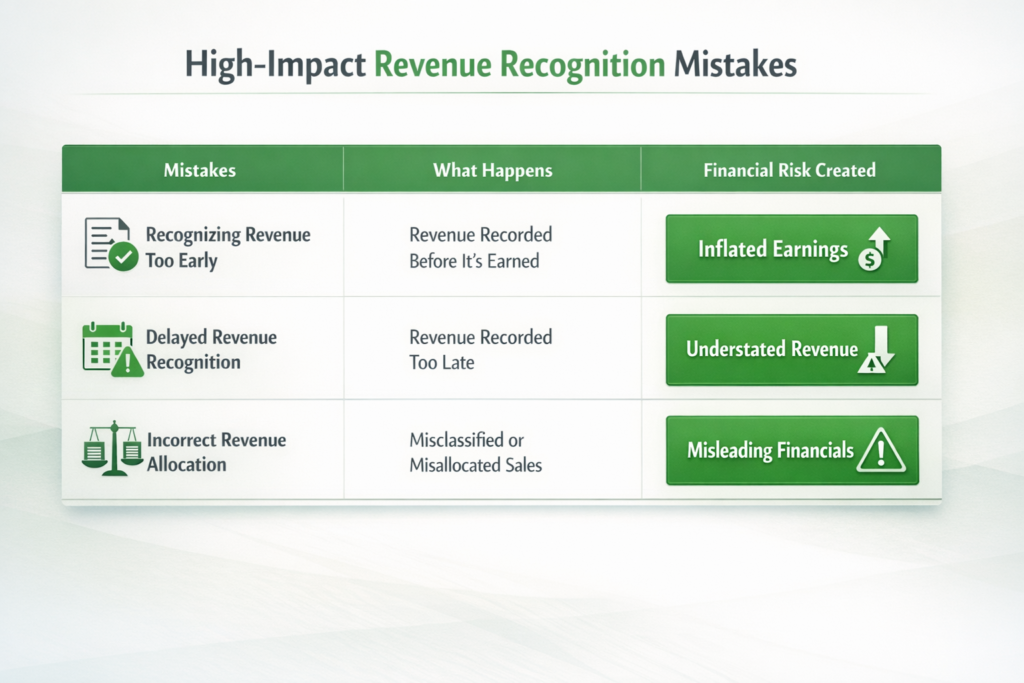
Improper revenue recognition includes:

  • Recording revenue prematurely
  • Delaying revenue recognition
  • Misclassifying revenue streams
  • Recognizing revenue without fulfilling performance obligations
  • These practices result in financial statements that do not accurately reflect the economic reality of the business.

Behavioral Red Flags Inside Organizations

Improper revenue recognition is often driven not only by technical gaps but also by behavioral factors.

Common internal patterns include:

  • Pressure to meet quarterly financial targets
  • Lack of coordination between sales and accounting teams
  • Overreliance on manual adjustments
  • Weak internal control review processes
  • These behaviors increase the likelihood of both intentional and unintentional misstatements.

The Real Problem: Timing vs. Economic Reality

At its core, improper revenue recognition is a timing issue:

  • Early billing
    • Business practice: Recognize immediately
    • U.S. GAAP requirement: Recognize when earned
  • Advance payments
    • Business practice: Treat as revenue
    • U.S. GAAP requirement: Record as liability
  • Long-term contracts
    • Business practice: Recognize upfront
    • U.S. GAAP requirement: Recognize over time
  • Bundled services
    • Business practice: Lump sum recognition
    • U.S. GAAP requirement: Allocate across obligations
  • The disconnect between cash flow and revenue recognition is the underlying cause of most reporting risks.

The 5 Step Revenue Recognition Model (U.S. GAAP – ASC 606)

Businesses are required to follow a structured framework:

  1. Identify the contract with a customer
  2. Identify performance obligations in the contract
  3. Determine the transaction price
  4. Allocate the transaction price to performance obligations
  5. Recognize revenue when performance obligations are satisfied

Stakeholder Impact Breakdown

1. Business Owners

  • Improper revenue recognition creates a misleading view of growth
  • Leads to flawed strategic decisions
  • Results in potential future corrections

2. Investors and Buyers

  • Increases perceived risk
  • Often results in:
    • Lower valuation multiples
    • Extended due diligence timelines
    • Deal renegotiations

3. CPA Firms and Auditors

  • Increases audit complexity
  • Requires:
    • Additional testing procedures
    • Revenue restatements
    • Enhanced compliance reporting

High Impact Revenue Recognition Mistakes
Advanced Risk Scenarios

  1. Multi-Element Arrangements
    Bundled service offerings often create challenges in properly allocating revenue across performance obligations.
  2. Variable Consideration
    Discounts, incentives, and rebates are frequently overlooked, resulting in overstated revenue.
  3. Contract Modifications
    Contract changes are not consistently updated in accounting systems, leading to reporting inconsistencies.
  4. Cutoff Errors
    Revenue recognized in the incorrect period remains one of the most common audit findings in the United States.

How to Fix and Prevent Revenue Recognition Errors (Step-by-Step)

Step 1: Standardize Contracts
Ensure all contracts clearly define deliverables and payment terms.

Step 2: Apply ASC 606 Consistently
Train teams to rigorously follow the five-step revenue recognition model.

Step 3: Automate Revenue Tracking
Implement accounting systems that align revenue recognition with performance obligations.

Step 4: Perform Monthly Reviews
Conduct regular reviews of revenue entries and reconciliations.

Step 5: Maintain Documentation
Retain complete audit trails for all revenue transactions.

Case Insight

A U.S.-based SaaS company recognized annual subscription revenue upfront instead of over the subscription period.

Issue:
Revenue was overstated by 25%

Action Taken:
Revenue was restated in accordance with ASC 606
Financial statements were corrected

Result

Initial valuation declined
Transaction was delayed but ultimately completed after correction

Why This Matters for Business Valuation
Revenue serves as the foundation for EBITDA and valuation multiples. When revenue is overstated:

1.EBITDA (Earnings Before Interest, Taxes, Depreciation, and Amortization) becomes     unreliable

2.Buyers apply valuation discounts
3.Transactions may fail during due diligence

In many U.S. transactions, revenue-related adjustments are among the primary drivers of valuation reductions.

Conclusion

Accurate revenue recognition reflects true business performance. Improper practices introduce hidden risks that impact financial reporting, investor confidence, and valuation. A disciplined, GAAP compliant approach to revenue recognition builds a strong financial foundation for sustainable growth.

References:

Financial Accounting Standards Board (FASB)
ASC 606: Revenue from Contracts with Customers
Core framework for revenue recognition in the United States

Link:

Read more

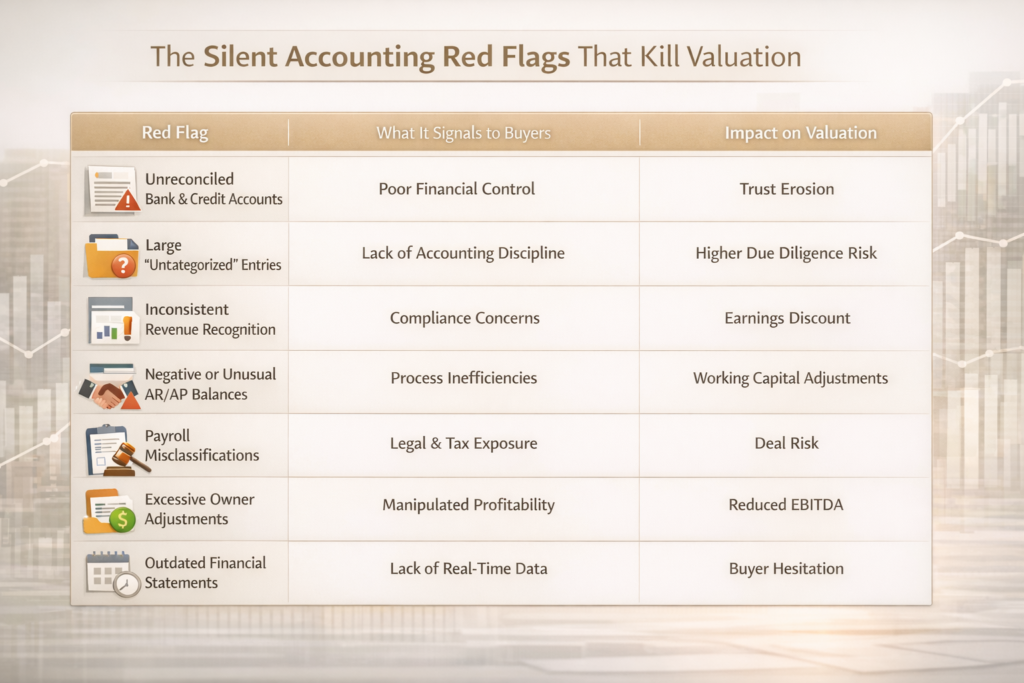
Exit-Ready Books: The Accounting Red Flags That Quietly Destroy Your Business Valuation

Business owners aim for a successful exit at maximum valuation, not just profit. Financial records are key to trust, whether via acquisition, private equity, or merger. Many businesses have hidden accounting issues that are not apparent in daily work but can detail deals during due diligence. Exit ready books are crucial.

These are accurate, transparent, and audit ready, meeting valuation expectations. Without them, profitable businesses risk valuation discounts, delays, or failed deals.

What Are Exit Ready Books?

Exit ready books are financial records that are:

  1. Fully reconciled and accurate
  2. Compliant with US GAAP principles
  3. Free from inconsistencies and unexplained balances

They ensure that when a buyer reviews your financials, they see confidence not confusion.

Why Exit Readiness Matters More Than You Think

Most business owners prepare for an exit too late but often when a buyer is already involved.

By then, issues like:

  1. Unreconciled accounts
  2. Revenue inconsistencies
  3. Poor documentation

Key Impact:

  1. Lower valuation multiples
  2. Increased due diligence timelines
  3. Higher risk perception for buyers

In competitive deals, clean books can increase valuation by 10–30%, while messy books can reduce it just as quickly.

Deep Dive: How These Red Flags Destroy Value

1. Unreconciled Accounts

When accounts do not match bank statements, buyers assume:

  • Transaction is missing
  • Potential fraud happened
  • Controls of internal system is weak

This leads to immediate valuation skepticism.

2. Revenue Recognition Issues

Incorrect revenue timing violates US GAAP principles.

Buyers often:

  • Recalculate revenue
  • Adjust EBITDA downward

This directly reduces your valuation multiple.

3. Poor Accounts Receivable Management

Unclear AR aging or unapplied cash signals:

  • Weak collections
  • Inflated revenue

Result: Buyers apply bad debt discounts.

4. Payroll & Compliance Risks

Misclassifying employees vs contractors can trigger:

  • IRS penalties
  • Legal exposure

Buyers may pause or restructure the deal.

Stakeholder Impact Analysis

For Business Owners

Messy books mean:

  • Lower exit price
  • Longer deal cycles
  • Lost negotiation power

For Buyers & Investors

Red flags increase:

  • Risk perception
  • Audit effort
  • Need for price adjustments

For CPA Firms & Advisors

Poor bookkeeping:

  • Increases cleanup workload
  • Damages credibility during due diligence

Exit Readiness Checklist

To make your books exit ready, focus on the following:

Core Financial Hygiene

  • Monthly bank and credit card reconciliations
  • Clean general ledger with zero suspense balances
  • Accurate chart of accounts

Revenue & Expense Accuracy

  • GAAP compliant revenue recognition
  • Clear expense categorization
  • Removal of duplicate or personal expenses

Working Capital Clarity

  • Clean Accounts Receivables aging (no unapplied cash)
  • Accurate Accounts payable tracking
  • Inventory reconciliation

Compliance & Documentation

  • Payroll properly classified
  • Tax filings aligned with books
  • Supporting documentation for all entries

Before vs After: The Valuation Difference

ScenarioBefore CleanupAfter Exit-Ready Books
Financial AccuracyQuestionableVerified & reliable
Buyer ConfidenceLowHigh
Due Diligence TimeExtendedStreamlined
Valuation MultipleDiscountedOptimized
Deal Closure ProbabilityUncertainStrong

Case Insight

A mid-sized US service business approached a buyer with:

  • $5M reported revenue
  • Unreconciled accounts
  • $300K in unclear adjustments

After cleanup:

  • Revenue was restated to $4.6M
  • EBITDA became more credible
  • Buyer confidence increased

Final Result:

  1. Deal closed successfully
  2. Valuation improved due to transparency not inflated numbers

Why It Matters for Growing Businesses

Exit readiness is not just for companies planning to sell.

It helps in:

  1. Raising capital
  2. Securing loans
  3. Attracting investors
  4. Scaling operations confidently

In short, exit-ready books are equal to business ready books.

Conclusion

Financial credibility drives business valuation. Hidden accounting issues, even in profitable firms, can reduce offers due to buyer uncertainty during due diligence. Exit-ready financial records, ensuring accuracy and transparency, expedite deals, enhance negotiation, and boost valuation. Buyers assess your number’s integrity, not just growth. Well-organized financials build credibility for a better exit and higher value.

References:

  1. Financial Accounting Standards Board (FASB)
  2. American Institute of Certified Public Accountants (AICPA)

Read more

Chart of Accounts Optimization: The Foundation of Accurate Financial Reporting

A robust Chart of Accounts serves as the fundamental framework for any accounting system, dictating the classification, aggregation, and presentation of financial transactions within financial statements. Inadequate or antiquated COA designs can lead to erroneous reporting, reduced operational efficiency, and challenges in conducting financial analysis. 

Streamlining the Chart of Accounts facilitates the systematic organization of financial data, thereby enhancing reporting precision, accelerating decision-making processes, and improving the efficacy of financial oversight.

 Why Chart of Accounts Optimization Becomes Necessary

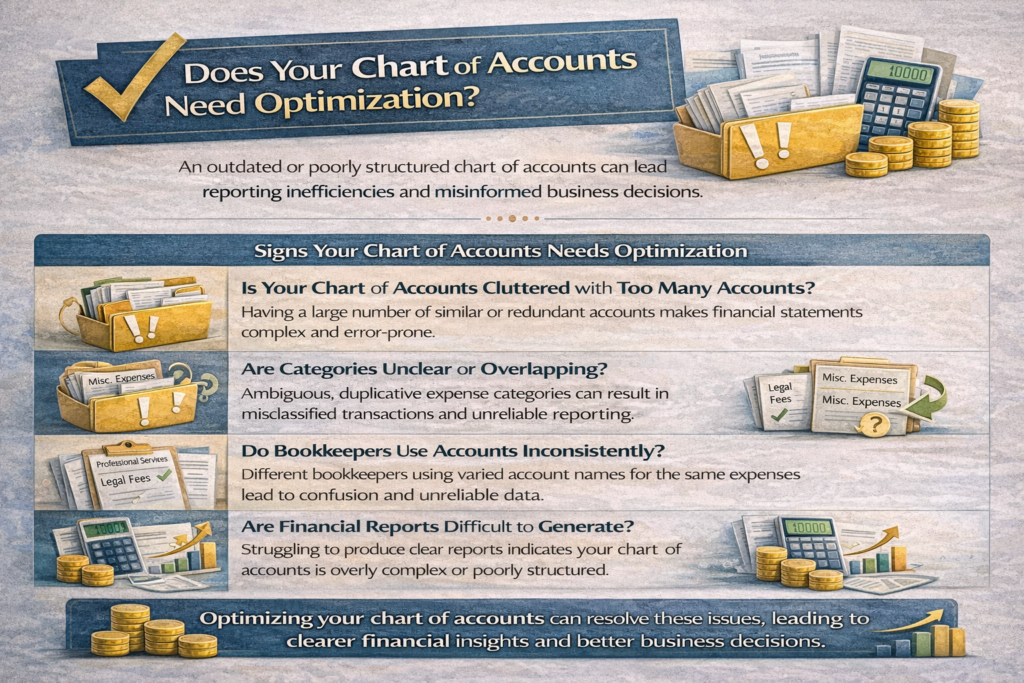
Small companies often begin with a basic chart of accounts, but as they grow, adding accounts haphazardly leads to complexity and confusion.

Common issues that signal the need for COA optimization include:

  • Number of accounts are excessive
  • Descriptions of accounts are unclear
  • Duplicate expense categories
  • Inconsistent account usage

Optimization ensures that the accounting structure matches the company’s operational reality.

The Relationship Between COA Design and Financial Reporting Accuracy

A well-designed Chart of Accounts is crucial for accurate financial reporting. Poorly structured accounts can lead to transaction misrecording and skewed financial outcomes, such as inaccurate profit margins from misclassified expenses or an inaccurate balance sheet from incorrect asset categorization.

An optimized chart of accounts ensures that:

  • Financial data is properly categorized
  • Reports are easier to interpret
  • Financial analysis becomes more reliable

Ultimately, the quality of financial reporting depends heavily on the quality of the COA structure.

Key Principles of an Optimized Chart of Accounts

A well designed chart of accounts follows several fundamental principles that support both operational efficiency and financial transparency.

Essential Design Principles

PrincipleExplanation
SimplicityAvoid unnecessary or duplicate accounts
ConsistencyUse standardized naming conventions
ScalabilityAllow room for future business expansion
Logical GroupingOrganize accounts by financial category
Reporting AlignmentEnsure accounts support financial reporting needs

These principles help create a COA that is both efficient and adaptable.

The Impact of COA Optimization on Business Decision Making

Financial reports are only useful if they provide clear insights into business performance.

Optimized account structures allow businesses are as follows:

  1. Analyze cost behavior
  2. Track department level performance
  3. Compare financial results across periods
  4. Financial forecasts generate more accurate data

This improves the quality of strategic decision-making.

Relationship Between COA Structure and Financial Reporting

Financial reporting quality heavily depends on how accounts are structured.

For example:

  1. Sales performance is gauged by revenue accounts.
  2. Expense classifications influence profitability analysis
  3. Asset accounts affect balance sheet accuracy

An optimized COA ensures that every transaction flows logically into financial statements, reducing the need for manual adjustments.

Industry-Specific Chart of Accounts Design

Different industries require different account structures to reflect their operational characteristics.

For example:

Manufacturers track inventory; service firms track labor and project costs.

Example-1

IndustryTypical COA Focus
ManufacturingInventory, production costs
RetailCost of goods sold, sales categories
Professional ServicesLabor, project expenses
Technology CompaniesR&D expenses, subscription revenue

Tailoring the COA to industry requirements improves reporting clarity.

Retailers need a Chart of Accounts optimized for inventory, sales, and COGS, differing from service businesses by requiring close monitoring of stock, supplier costs, and product margins.

Example 2:

Typical Retail Chart of Accounts Structure

Account CategoryExample AccountsPurpose
AssetsCash, Bank Account, Inventory, Store EquipmentManages inventory and asset data.
LiabilitiesAccounts Payable, Credit Card PayableRecords supplier obligations
RevenueProduct Sales, Online Sales Revenue, Discount SalesTracks income from different sales channels
Cost of Goods Sold (COGS)Purchase Cost, Freight-In, Inventory ShrinkageMeasures the direct cost of products sold
Operating ExpensesStore Rent, Advertising exp etc.Operational costs are tracked daily

Practical Example of COA Simplification

Before Optimization

 Office Supplies
Office Stationery
Office Expenses – Supplies
Office Materials

After Optimization

Office Supplies Expense

Consolidating categories simplifies accounting system maintenance and analysis.

Conclusion

Optimizing the Chart of Accounts is key for accurate financial reporting. Simplified, standardized, and business-aligned structures improve financial performance visibility. A good COA boosts reporting efficiency, strengthens controls, aids decision-making, and supports growth.

Reference:

Kieso, Donald E., Jerry J. Weygandt, and Terry D. Warfield – Intermediate Accounting (Widely used accounting textbook explaining financial reporting structures including the Chart of Accounts.)

Read more

Cash Flow vs Profit: Why Profitable Businesses Still Run Out of Cash

 The Profit Illusion in Modern Businesses

Profitability does not always mean financial stability. While profits suggest a healthy company, many profitable businesses face cash shortages or even bankruptcy. This is because profit measures accounting performance, whereas cash flow indicates the actual money available for operations. This difference is crucial for business leaders, as a company can appear profitable yet struggle with payments.

Understanding Profit in Accounting

Profit is the business’s financial outcome that comes after subtracting expenses from revenue, calculated by accounting rules. Under Accrual accounting, revenue is recorded when earned and expenses when incurred, irrespective of cash transactions.

ComponentExplanation
RevenueIncome generated from sales of goods or services
Cost of Goods SoldDirect costs associated with production
Gross ProfitRevenue minus cost of goods sold
Operating ExpensesAdministrative, marketing, and operational costs
Net ProfitFinal profit after deducting all expenses and taxes

Because of this accounting approach, profit often reflects economic performance rather than cash position.

The Hidden Gap Between Profit and Cash Availability

Reported profit and available cash can differ due to accounting and operational elements. Revenue recorded before payment boosts profit but not cash. Expenses like depreciation reduce profit without cash outflow, while loan principal payments decrease cash but aren’t expensed. These timing mismatches can lead profitable companies to experience cash shortages.

Real Business Scenario: Profit Without Cash

Suppose, a manufacturing company that sells goods worth ₹10,00,000 in January.

The company records the revenue immediately in its income statement because the goods have been delivered. However, customers are allowed a 90-day credit period, meaning the cash will only be received in April.

Meanwhile, the company must pay for:

  • employee salaries
  • supplier invoices
  • rent and utilities
  • loan installments

Although the income statement shows a profit, the business may struggle to meet these payments because the actual cash has not yet been collected.

Profit vs Cash Flow: A Practical Comparison

The difference between profit and cash flow becomes clearer when comparing their financial meaning and reporting structure.

Basis of ComparisonProfitCash Flow
Financial StatementIncome StatementCash Flow Statement
Accounting MethodAccrual AccountingCash Based Movement
RecognitionRevenue and expenses recorded when incurredCash recorded when received or paid
PurposeMeasures business performanceMeasures liquidity and financial stability
Impact on SurvivalIndicates profitabilityDetermines ability to operate daily

This distinction explains why profitability does not always translate into available cash.

Major Reasons Profitable Businesses Experience Cash Shortages

The following operational factors commonly lead to liquidity problems even when profits 

are strong.

Business FactorImpact on Cash Flow
Slow customer paymentsCash remains stuck in receivables
Excess inventoryMoney tied up in unsold stock
Capital expenditureLarge cash payments for equipment or assets
Loan principal repaymentsExpenses is not reflected as cash outflows
Rapid business growthIncreased need for working capital

Financial Statements and Their Role in Liquidity Analysis

Understanding the relationship between financial statements helps explain how profit and cash flow differ.

The income statement shows profitability during a period.
The balance sheet reflects assets, liabilities, and equity at a specific point in time.
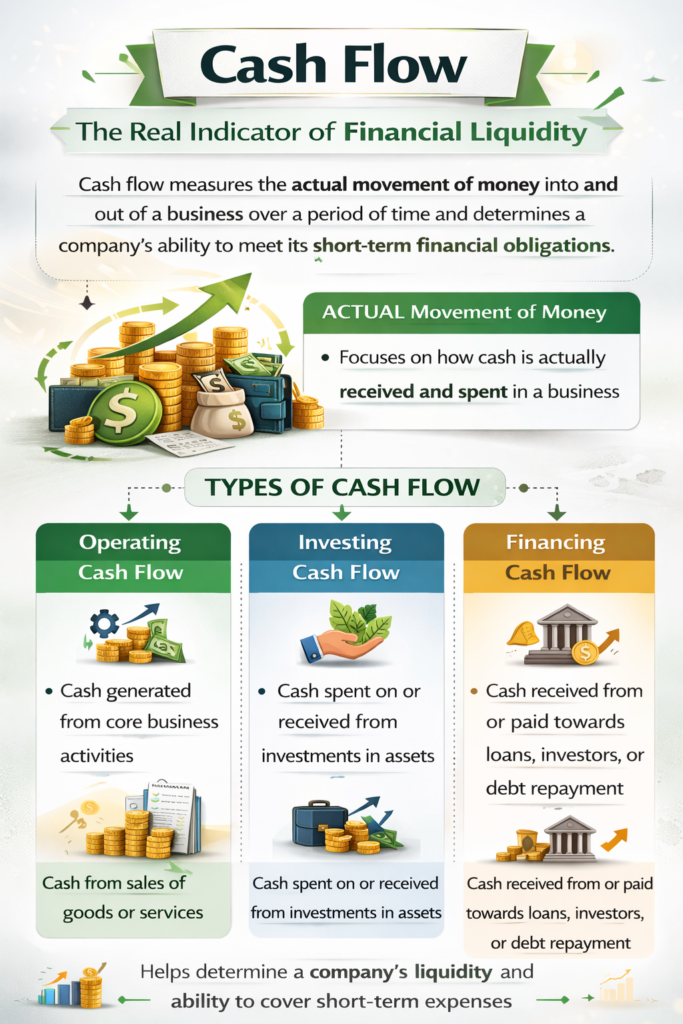
The cash flow statement tracks the actual movement of cash between these periods.

Early Warning Indicators of Cash Flow Problems

Financial analysts often rely on specific ratios and indicators to detect potential liquidity issues before they become critical.

IndicatorPurpose
Operating Cash FlowMeasures cash generated from core operations
Current RatioEvaluates short term financial strength
Quick RatioMeasures ability to meet obligations without inventory
Cash Conversion CycleShows how quickly sales convert into cash

Practical Strategies to Improve Cash Flow Management

Companies can strengthen their financial stability by implementing structured cash management practices.

Effective strategies include improving receivable collection systems, negotiating better credit terms with suppliers, maintaining optimal inventory levels, and preparing accurate cash flow forecasts.

Businesses should also maintain a liquidity buffer to handle unexpected financial obligations.

Working Capital: The Core Driver of Cash Flow

Working capital represents the funds required to operate daily business activities. It directly influences how quickly a company converts sales into cash.

Working capital consists of three primary elements:

ComponentRole in Cash Flow
Accounts ReceivableMoney customers still owe to the business for credit sales.
InventoryA business keeps goods in stock to sell or use in production.
Accounts PayableMoney the business still owes to suppliers for credit purchases.

Efficient management of these components helps businesses maintain healthy liquidity.

Conclusion

Profit shows operational success, but cash flow dictates survival and effective operation. A company can seem profitable yet struggle with immediate payments if cash is scarce. Therefore, businesses need to assess both profitability and liquidity. Recognizing the distinction between profit and cash flow, and managing working capital efficiently, ensures lasting financial health and growth.

Reference

https://www.kariwala.pro/services/accounting/

Read more