
Skip to main content Skip to search

Archives for October 2025

Integrating ERP Systems with Accounting for Seamless Operations

In today’s rapidly evolving business landscape, integration is not just a trend it’s a necessity. The days of operating multiple, disconnected systems for accounting, sales, inventory, payroll, and procurement are fading fast. For modern U.S. companies and CPA firms, connecting Enterprise Resource Planning (ERP) systems with accounting has become the cornerstone of achieving operational efficiency, transparency, and real-time insight. When financial data seamlessly flows across departments, businesses gain not only speed and accuracy but also the strategic advantage of making faster, smarter decisions.

The Power of Integration

The integration of ERP systems with accounting processes revolutionizes routine financial management. By connecting all divisions from sales through purchasing via a unified information platform, organizations encounter reduced mistakes and accelerated operational flow. Rather than depending on hand-processed reconciliations, financial transactions are updated instantaneously and automatically, providing immediate insight into the company’s fiscal status.

The Core Idea: Unifying Operations and Finance

ERP systems function as the backbone of an organization, connecting various operations such as order processing, supply chain management, inventory control, human resources, and manufacturing. When combined with accounting functions, this integrated framework guarantees that all business activities are immediately captured in the financial documentation.

To illustrate, when a purchase order is approved, it simultaneously updates stock levels, creates accounts payable entries, documents expenditures, and generates accounting entries instantaneously. This process removes the need for manual input, minimizes mistakes, and maintains alignment between financial records and actual business operations. The result is a harmonized enterprise where the finance department doesn’t merely track figures but actively steers the organization using precise, up-to-date information.

Why Integration Matters to Businesses and CPA Firms

Enterprise Resource Planning and accounting system integration enables American corporations to transition from a reactive financial management approach to a proactive strategic methodology. Instead of deferring reconciliation processes until the conclusion of monthly reporting periods, financial professionals and departmental supervisors can conduct real-time monitoring of transactional activities, thereby facilitating immediate identification of emerging patterns, potential risks, and strategic opportunities. For certified public accounting firms servicing diverse client portfolios, such integration provides enhanced access to refined, contemporaneous data, expedited financial closing procedures, and superior accuracy in financial reporting documentation. This technological advancement empowers these professional service organizations to transcend traditional compliance-focused services and evolve toward comprehensive advisory consulting, thereby assisting clients in optimizing cash flow management, working capital efficiency, and overall organizational profitability.

Operational and Financial Benefits

Before IntegrationAfter ERP-Accounting Integration
Manual data entry & duplicationAutomated data flow between systems
High risk of errors & delayed closesReal-time updates & quicker closing cycles
Departmental silosUnified operational and financial data
Time-consuming reconciliationsInstant reconciliation and automated matching
Reactive decision-makingReal-time dashboards and proactive insights

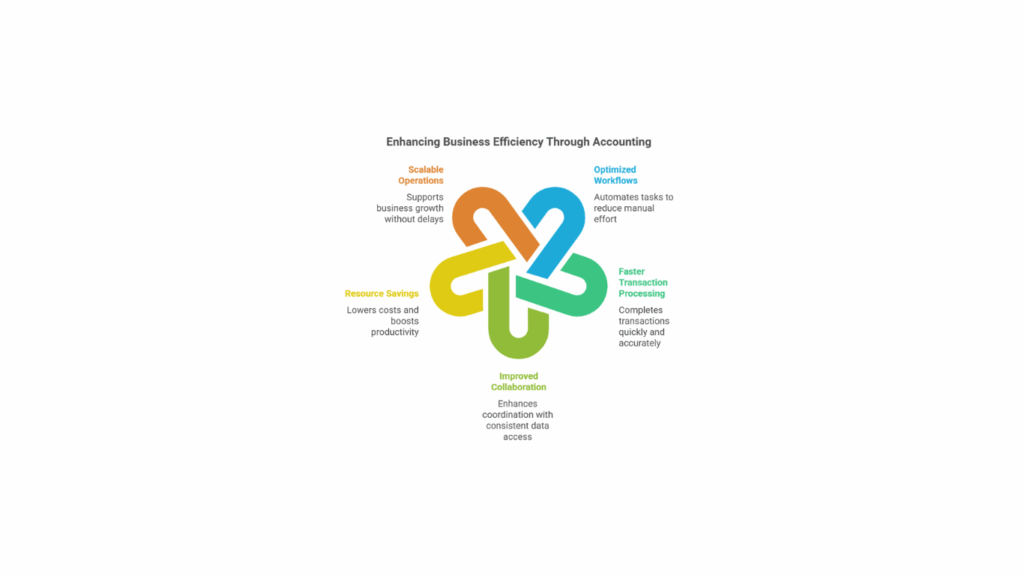
This transformation isn’t just technological it’s strategic. By merging financial and operational visibility, companies eliminate delays, gain control, and build the foundation for scalability.

Strategic Implications for U.S. CPA Firms

Accounting firms across the United States are progressively implementing comprehensive solutions for their clientele to enhance operational effectiveness and precision. Through ERP system integration, accounting professionals eliminate the need to solicit numerous reports or await reconciliation processes, as they gain direct access to live data streams from their clients’ operational systems.This transformation minimizes reliance on manual processes, expedites monthly closing procedures, and enables firms to concentrate on consultative services including financial projections, budget planning, and strategic guidance instead of data correction activities. Essentially, ERP integration transforms the accountant’s function from a data recorder to a strategic business consultant.

Automating Workflows and Reducing Manual Overhead

Traditional manual procedures for data input, record alignment, journal entries, and account reconciliation present considerable challenges in terms of time consumption and susceptibility to errors. Through systematic integration, these operational workflows undergo automation: commercial transactions automatically generate corresponding financial records, stock movements seamlessly update both cost accounting and financial ledgers, and inter-organizational transactions achieve autonomous reconciliation. Comprehensive industry analyses demonstrate that Enterprise Resource Planning integrations substantially diminish manual data input requirements, thereby enhancing operational efficiency and minimizing error frequencies.

Through the elimination of repetitive tasks from finance personnel responsibilities, organizations can strategically reallocate human capital toward analytical functions, strategic consultation, and organizational enhancement initiatives. Within the context of Certified Public Accounting practices, this transformation enables more efficient portfolio management while delivering enhanced value propositions to clientele.

Expected Obstacles and Solutions for Managing Them

Naturally, integration does not occur automatically and is accompanied by inherent risks. Prevalent obstacles encompass: disparate master data elements (including customer records, vendor information, and accounting structures), incongruent process frameworks across organizational divisions (encompassing sales, finance, and operations), and organizational resistance from personnel accustomed to established operational procedures. Achievement depends upon meticulous master data remediation, comprehensive process documentation across business units, and systematic implementation progressing from fundamental modules to comprehensive deployment. Initial accomplishments establish organizational confidence; structured governance mechanisms ensure institutional responsibility.

Strengthening Compliance, Auditability and Internal Control

In the U.S., accounting teams face increasing regulatory scrutiny, audits, and governance expectations. An integrated ERP accounting environment enhances internal controls automatically: transactions are logged end-to-end, audit trails are comprehensive, and systemic deviations can be flagged via standardized workflows. 

For auditors or internal compliance teams, this unified architecture simplifies review the documentation is built in, the chain of events is traceable, and reconciliation is timely. The risk of non-compliance, adjustments, or manual errors is markedly reduced, thus elevating the credibility of financial reporting.

Future-Ready Finance: Scalable and Adaptive Systems

The integration of ERP and accounting systems establishes a crucial groundwork for emerging technologies such as artificial intelligence-powered forecasting, automated process robotics, and analytical prediction tools. When American companies expand their operations, these unified systems guarantee that financial procedures can accommodate growth while preserving precision, efficiency, and data protection throughout the entire process.

Integration Solutions: Key Insights

While the benefits are clear, successful integration demands disciplined execution. Key considerations include:

  • Ensuring data master-cleanliness: unified customer/vendor/ chart of accounts across systems  inconsistent masters lead to chaos.
  • Defining business process alignment: finance, operations and IT must agree on workflows, timing of postings, responsibilities and exceptions.
  • Phasing rollout smartly: start with core modules (finance + procurement + sales) then expand to advanced modules such as HR, manufacturing, CRM.
  • Monitoring metrics: track close-cycle time, reconciliation time, manual entry volume, error-rate these signal progress and areas for refinement.
  • Building change management and training: users must trust the integrated environment and abandon old work-arounds for maximum effect.
Conclusion

The incorporation of Enterprise Resource Planning systems with accounting functions transcends mere technological advancement, representing a strategic transformation toward more intelligent, expeditious, and transparent organizational operations. For United States enterprises, this integration facilitates immediate financial reconciliation, automated data precision, and perpetual fiscal oversight. For Certified Public Accounting practices, it delivers enhanced operational efficiency, instantaneous reporting capabilities, and the capacity to provide comprehensive analytical insights to clientele.

Kariwala & Co. LLP assists U.S. businesses and CPA firms with ERP-accounting integrations to streamline financial operations, boost efficiency, and enable better decision-making. We align technology with financial accuracy for real-time business insights.

Reference:

Management Accounting: Information for Decision-Making and Strategy Execution — Anthony A. Atkinson and Robert S. Kaplan

Read more

Strategies to Reduce Accounts Receivable Delays

In today’s fast-paced business environment, money locked in outstanding invoices represents more than just an annoyance; it creates obstacles to expansion. When accounts receivable payments are delayed, companies lose their capacity to make investments, compensate vendors, and capitalize on new prospects. Both American businesses and accounting firms can benefit from minimizing Accounts Receivable delays, converting their collections process from a passive liability into a competitive advantage. This piece presents professionally backed strategies to accelerate payment timelines, enhance customer relations, and establish robust cash flow stability consolidated in a single resource.

The Cost of Every Day Late

Every extra day an invoice remains unpaid adds hidden cost. It eats into working capital, increases reliance on credit lines, and creates ripple effects through vendor terms, operational flexibility, and profitability. It may seem routine, but delayed receivables often hide deeper issues: inconsistent billing, weak client onboarding, or neglected credit terms. Recognizing that each outstanding invoice is a small yet significant drag on financial momentum is the first step toward change.

Establishing Clear Credit and Collection Policies

Establishing clear credit policies stands as one of the most powerful approaches for avoiding payment delays. By outlining terms, payment requirements, and collection processes from the beginning of business partnerships, companies can avoid conflicts later on. Credit limits ought to be determined through analytical risk evaluations instead of guesswork. Conducting periodic assessments of client financial stability enables organizations to modify terms when market circumstances or customer situations change. An organized credit policy converts accounts receivable management from a responsive approach into a preventive control system.

Transform Billing into an Immediate, Clear-Cut Procedure

Payment delays often originate from billing-related issues such as confusing invoice layouts, absent reference information, or sluggish problem resolution. Contemporary accounts receivable methods eliminate these obstacles by automatically creating invoices immediately upon delivery completion or service fulfillment. However, automation by itself is insufficient: invoices need to be clear and comprehensive, including purchase order details, service explanations, payment deadlines, and convenient payment options. When billing occurs promptly and invoices are user-friendly, payment processing accelerates accordingly.

Personalize Communication & Build Payment Culture

Prompt receivables are not automatic occurrences they result from established relationships and clear expectations. When collection efforts are viewed as an essential component of customer service, it facilitates quicker payment processing. Customized payment reminders, transparent communication about payment status, and recognition of punctual payments help establish an environment of mutual respect and responsibility. Customers who experience appreciation and receive clear guidance throughout the payment procedure are more likely to pay promptly with minimal conflicts.

Data Analytics for Smarter Decision-Making

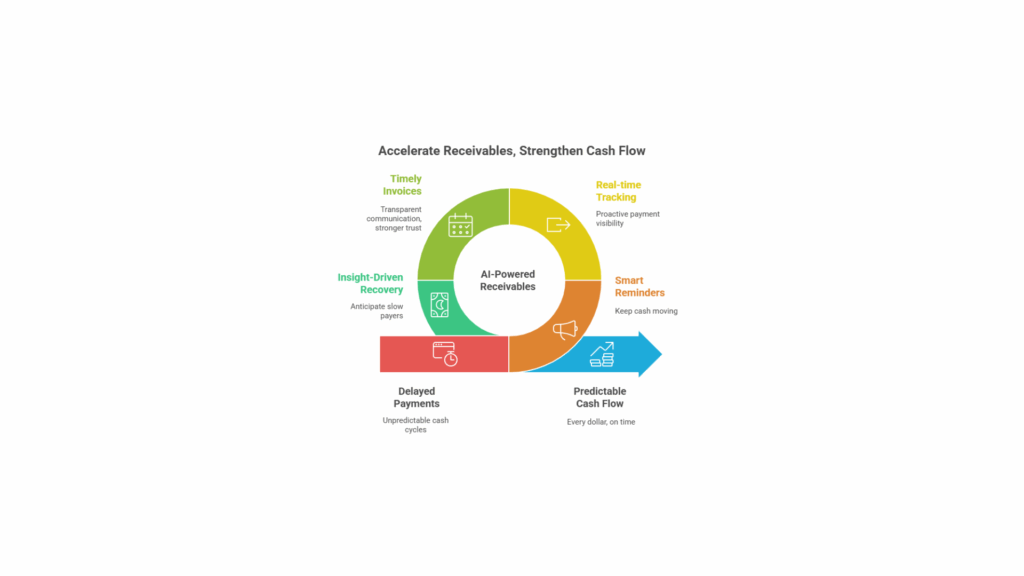
AI and data analytics are reshaping how companies manage accounts receivable. Predictive analytics can assess payment patterns, identify clients likely to delay, and help teams prioritize efforts effectively. These insights also assist in forecasting cash flow, allocating resources, and optimizing collection timelines. By transforming raw receivable data into actionable intelligence, businesses gain a powerful tool for preventing delays and improving financial predictability.

Utilize Information to Forecast and Prevent Disruptions

Leading finance departments today rely equally on data analysis and communication. Data analytics tools can identify customers experiencing changes in payment behavior, pinpoint bills at risk of late payment, and suggest modifications to payment terms or follow-up schedules. Rather than pursuing overdue payments, organizations transition to preventing payment delays, evolving from reactive to preventive accounts receivable strategies. These forecasting tools particularly benefit accounting firms handling numerous clients by improving financial projections, optimizing staff allocation, and enhancing cash flow management.

Early Payment Incentives and Strategic Negotiations

A balanced mix of incentives and structured negotiation can accelerate payments without compromising client relationships. Offering small discounts for early payments can motivate clients to clear dues promptly. At the same time  formal late fee clauses serve as a gentle deterrent against habitual delays. However, applying these measures strategically  based on client behavior and business volume  ensures fairness and long-term collaboration.

Continuous Monitoring, Process Refinement & Governance

Minimizing accounts receivable delays requires an ongoing systematic transformation rather than a single initiative. Financial departments must consistently track essential metrics including Days Sales Outstanding invoice maturity periods, disagreement frequencies, and recovery performance. Routine assessment sessions, thorough analysis of delayed payment causes, and workflow improvements are crucial. Companies that regularly evaluate and modify their accounts receivable processes each month typically experience enhanced cash flow results and improved financial reputation.

Conclusion

Delayed accounts receivable extends beyond mere accounting challenges it signifies locked capital, postponed expansion, and heightened exposure. Through implementing structured credit policies, streamlining invoice processes, maintaining proactive client communication, utilizing analytics, and tracking metrics regularly, American companies and accounting practices convert Accounts Receivable management into a strategic advantage. 

Kariwala & Co. LLP collaborates with clients to execute these approaches, accelerating payment collection, enhancing cash flow, and fostering robust financial health ensuring each outstanding receivable transforms into capital that powers business expansion.

Reference:

Accounts Receivable Management Best PracticesJohn G. Salek
https://www.kariwala.pro/services/accounting/


Read more

AI-Powered Reconciliation: Speeding Up Ledger Accuracy

Introduction: From Manual to Intelligent Reconciliation

For many years, the reconciliation process represented one of accounting’s most labor-intensive procedures. Financial professionals would painstakingly review each transaction by hand, align payment records, fix accounting entries, and address discrepancies between bank records and company books  work that frequently required hours or multiple days to complete.

Kariwala & Co. LLP has revolutionized this conventional approach using artificial intelligence driven automation. Our advanced reconciliation technology now accomplishes these same tasks within minutes rather than hours, providing exceptional precision and productivity for our clients across the United States.

How AI Transforms Reconciliation

Our artificial intelligence-driven reconciliation system employs smart automation technology to integrate with customer financial information and persistently monitors, detects, and aligns transactions throughout accounting books, financial statements, and payment documentation.

What sets this apart is the learning capability  the system evolves with every transaction, recognizing recurring payment patterns, memorizing account behaviors, and auto adjusting for recurring variances.

This intelligent layer of automation eliminates repetitive manual work and provides a real time snapshot of financial accuracy across all ledgers.

Reconciliation in Minutes: The New Standard

In the past, balancing one month’s worth of banking transactions required 2-3 hours of hands-on work for each account. Using artificial intelligence for reconciliation, this identical task is now finished in just 2-3 minutes while preserving 99% precision.The platform performs comprehensive matching across multiple layers at once  comparing bank records with general ledger entries, matching accounts payable with accounts receivable, and aligning vendor information with customer data  guaranteeing that all information sources remain synchronized while immediately identifying any discrepancies.This accelerated reconciliation process not only enhances the speed of monthly financial closing procedures but also provides leadership with real-time insight into the organization’s financial status throughout any given month.

How Kariwala & Co. LLP Implements AI Reconciliation for U.S. Clients

We provide U.S. businesses and CPA firms with a fully managed reconciliation process powered by advanced AI technology.
Here’s how we streamline reconciliation end-to-end:

  • Data Integration:We integrate our clients’ financial software, banking data feeds, and account statements within one streamlined automated platform.
  • Intelligent Pairing: Artificial intelligence analyzes transaction details including descriptions, dates, and monetary values, automatically detecting complete, partial, or divided matches.
  • Continuous Monitoring: The system harmonizes data continuously during daily operations instead of postponing this process until monthly accounting periods conclude.
  • Exception Handling: Any unmatched or suspicious transaction is highlighted for accountant review with full audit traceability.
  • Real-Time Reporting: Customers get instant updates on reconciled transactions, outstanding discrepancies, and cash balance overviews

This end-to-end structure ensures that financial accuracy is maintained continuously rather than checked retrospectively.

Why U.S. Businesses and CPA Firms Rely on This Process

Our AI-powered reconciliation brings measurable benefits that go beyond time savings:

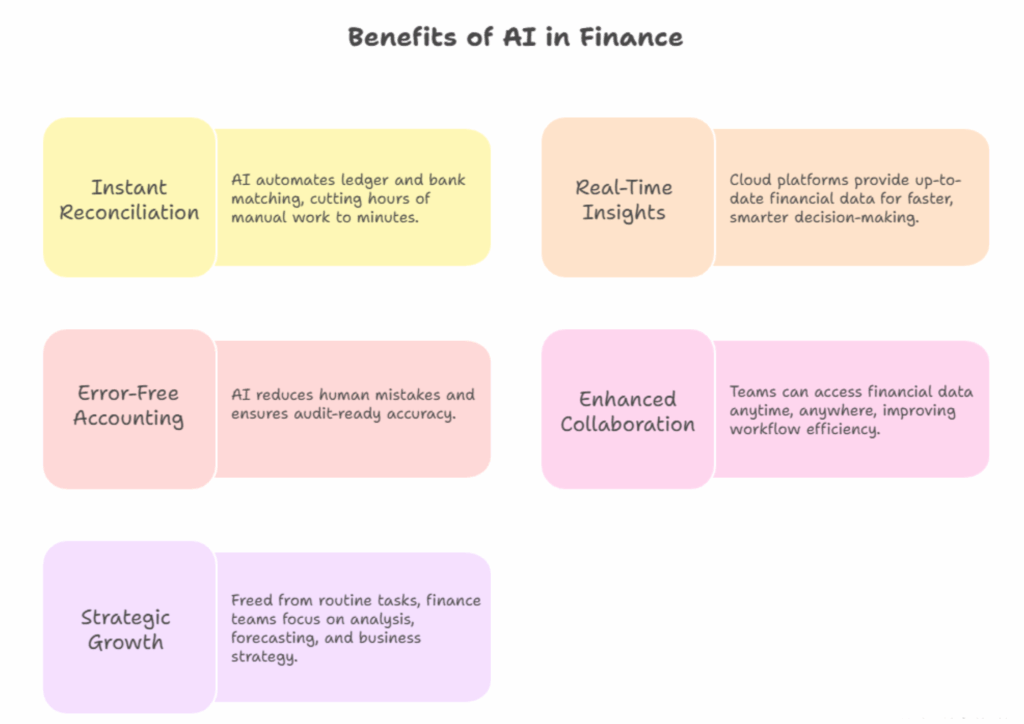
  • Speed and Efficiency: Financial processes that previously required hours of examination can now be balanced in just a few minutes.
  • Error Reduction: Intelligent matching eliminates manual oversight errors, ensuring cleaner books.
  • Enhanced Cash Flow Control:Immediate reconciliation offers current insight into incoming and outgoing transactions.
  • Audit Readiness: Every transaction carries a digital verification trail, making audit preparation simpler and faster.
  • Cost Optimization: Decreased labor time and streamlined handling of irregularities substantially reduce operational expenses.

CPA practices can achieve enhanced precision in client documentation and accelerated period-end processes, which builds stronger client partnerships and improves operational dependability.

AI’s Learning Advantage: Accuracy That Improves Over Time

Our system’s intelligence expands through each reconciliation process. As time progresses, it gains insights from how users interact with it, recognizing trends like repeated payment discrepancies, duplicate records, or rounding problems, and automatically incorporates these learnings into subsequent reconciliation tasks. This predictive intelligence transforms reconciliation from a reactive task into a proactive process.
Instead of finding discrepancies after the fact, our system anticipates and prevents them, ensuring continuously clean ledgers and accurate financial statements.

Real-Time Financial Visibility for Better Decisions

Because reconciliations happen continuously, clients no longer have to wait until month-end to view accurate balances.
CFOs, controllers, and CPA firms can access up to the minute ledger data, improving cash flow planning, forecasting, and budgeting accuracy.

This immediate visibility enables executives to reach quicker, more assured monetary choices supported by dependable information.

Why Kariwala & Co. LLP is the Right Partner for AI-Powered Reconciliation

  • Our artificial intelligence driven reconciliation process delivers rapid results, precise outcomes, and comprehensive financial transparency. Tasks that previously required hours of verification can now be accomplished within minutes while maintaining the same level of exactness.
  • Through immediate matching and verification processes, all financial transactions remain accurate and free from errors, providing companies with current insights into their monetary movements and enhanced fiscal oversight. Integrated tracking records streamline regulatory compliance and facilitate seamless audit readiness.
  • Through the elimination of manual processes and the implementation of automated exception management, our solution enables American CPA practices and businesses to reduce time expenditure, lower expenses, and accelerate their book-closing procedures while maintaining superior accuracy and dependability in their financial information.

We don’t just reconcile accounts, we build trust in financial data, enabling our clients to operate with complete confidence and precision.

Conclusion

AI-powered reconciliation represents the future of accurate and efficient financial management.
At Kariwala & Co. LLP, we make that future a reality for our clients  replacing manual hours with machine intelligence and ensuring every ledger, statement, and transaction aligns perfectly.

For U.S. businesses seeking to modernize their accounting processes, our AI-powered reconciliation services offer speed, reliability, and strategic financial insight  all in real time. At Kariwala & Co. LLP, we focus on converting complicated accounting procedures into efficient, technology-driven systems that ensure both effectiveness and precision. Our reconciliation offerings deliver instant ledger validation, guaranteeing accurate documentation and comprehensive financial transparency for American companies and certified public accounting practices. Through the use of smart automation technology, we assist our clients in conserving precious time, minimizing operating expenses, and enabling more informed, analytics-based financial choices. At our company, each financial transaction goes beyond simple documentation to provide enhanced understanding, oversight, and business intelligence.

Reference:

Accounting Information Systems — Marshall B. Romney & Paul J. Steinbart
https://www.kariwala.pro/services/accounting/


Read more

The Future of Accounting: Cloud, AI, and Real-Time Reporting

From Traditional Accounting to Intelligent Systems

Traditional accounting relied on manual data entry, delayed reconciliations, and periodic financial reviews. This often meant businesses were making decisions based on outdated information.
Today, cloud-based accounting platforms like QuickBooks Online, Xero, Zoho Books, and Sage Intacct have changed the landscape. They allow real-time access, centralized data storage, and collaborative work—no matter where the teams are located.

This transformation enables accountants to move beyond compliance and become true financial strategists. AI-driven platforms can now categorize transactions, detect anomalies, and generate reconciled financial statements instantly.

The basic problem (why reconciliation used to take hours)

Bank and ledger reconciliation traditionally takes time because it requires collecting bank statements and GL entries, normalizing formats, matching transactions (often one-to-many or many-to-one), finding and explaining exceptions, and posting adjustments. When humans do matching, they must read descriptions, compare amounts and dates, search invoices, and apply judgement — a process that scales linearly with transaction volume and variance in descriptions. Manual reconciliation therefore becomes a bottleneck as transaction frequency and complexity grow.

The automation recipe: five capabilities that shrink time

Modern systems combine five technical capabilities that compress the reconciliation workflow from hours to minutes:

  1. Continuous bank feeds and streaming ingestion. Bank feeds (via Plaid/Yodlee/bank APIs) push transactions automatically into the accounting environment as soon as they clear, eliminating manual statement import delays and giving the reconciliation engine live inputs. Many cloud accounting platforms (Xero, QuickBooks, NetSuite) and specialist tools rely on always-on feeds to begin matching immediately.
  2. High-accuracy data extraction (OCR + document intelligence). Tools like Hubdoc, Dext (Receipt Bank), AutoEntry and Tipalti capture invoices/receipts with OCR and AI that extracts line-items and vendor codes. Clean, structured documents make it far easier to match payments to invoices automatically.
  3. Rules engines and machine learning (ML) matching. Reconciliation platforms use deterministic rules (amount + invoice ID + reference) and probabilistic ML (fuzzy matching on vendor name, amounts within tolerance, date proximity, payment patterns). Over time ML “learns” common mappings and increases auto-match rates. Products like NetSuite’s transaction matcher, ReconArt and AutoRek emphasize automated matching engines for millions of transactions in minutes.

Exception management and workflow. Instead of scanning whole batches, humans focus only on exceptions. Platforms centralize exceptions, provide contextual documents (invoice copy, payment trail) and route tasks to the right reviewer with audit trails — drastically reducing cognitive load and resolution time. ReconArt and AutoRek both advertise fully automated exception workflows.

Impact on CPA Firms and Finance Teams

The adoption of cloud, AI, and real-time tools is transforming the role of accountants.
Instead of focusing on manual bookkeeping, CPA firms can now allocate more time to strategic advisory, budget forecasting, and risk management.US CPA firms, in particular, are leveraging tools like BlackLine, FloQast, and Vic.ai to standardize close processes, automate journal entries, and detect anomalies in financial data—improving both accuracy and turnaround time.

Key Advantages for Accounting Teams:

  • 80–90% reduction in repetitive manual tasks
  • 50% faster month-end closing cycles
  • Improved accuracy with AI-assisted reconciliation
  • Enhanced compliance through audit trails and automatic data validation

How AI Enables Instant Ledger and Bank Reconciliation

Modern AI tools use transaction pattern recognition and machine learning algorithms to automate reconciliation. Here’s how:

  • Data Fetching: The AI fetches bank feeds via APIs from multiple accounts.
  • Transaction Matching: It automatically compares every bank entry with general ledger transactions using rules learned from past data.
  • Anomaly Detection: If mismatches are found — say, a duplicate payment — the system flags it for human verification.
  • Auto-Posting: Once verified, it updates the ledger instantly, completing the reconciliation process.

Example Software in Use:

  • Xero: Uses bank feed automation and AI for smart matching.
  • QuickBooks Online: Auto-categorizes and reconciles bank transactions with AI-based pattern learning.
  • Zoho Books: Integrates with OCR and AI bots for real-time invoice verification.
  • Sage Intacct: Offers continuous audit-ready reconciliation, powered by AI and cloud analytics.
  • BlackLine: Enterprise-level automation platform that reconciles complex accounts in seconds, used by Fortune 500 companies.

The Future Outlook: Human Expertise Meets Digital Intelligence

As automation takes over routine tasks, accountants are evolving into financial data analysts and strategic partners.
The future accounting department will combine:

  • AI-driven accuracy,
  • Cloud-based collaboration, and
  • Human intelligence for judgment and ethical oversight.

This synergy will empower firms to forecast trends, identify risks early, and deliver real-time financial advice to clients.
Ultimately, the future of accounting isn’t about replacing people—it’s about enhancing their decision-making power through technology.

Realistic Example: From 3 hours to ~3 minutes

Below is a hypothetical but realistic scenario built using patterns we see in case studies.

  • A mid-sized company has one bank account and ~500 bank transactions per day, alongside ~200 invoice payments.
  • Before automation: Every day, finance team exports bank statement, imports into Excel, manually matches each bank line to ledger entries (often mismatches due to fee lines or partial payments), takes ~1.5 hours; rest of the batch waits until month-end; month-end takes additional ~5 hours to reconcile old gaps and post journal entries. Total approx 6.5-7 hours “cleaning up” each month just for that bank-ledger reconciliation.
  • After implementing: uses cloud ledger (e.g. NetSuite), connects bank feed, uses ZoneReconcile or AutoRek; defines matching rules; sets up fuzzy match and OCR supplier invoice ingestion; auto-posts standard matches; exceptions are <5% and those exceptions are surfaced to a dashboard. On a typical day, the system matches ~95-97% of bank entries automatically. The daily reconciliation (all bank lines) takes ~2-3 minutes for the system to do matching and auto-post; the human review of exceptions takes additional ~5-10 minutes. At month end, almost no backlog remains, so final cleanup takes under an hour, not several.
  • This kind of result corresponds with what Tide achieved (manual 3-4 hours → 15 minutes) and what Juni/Volt achieved with Stacks (95% automation, multiple reconciliations in a single day).

 How These Technologies Complement Each Other

Cloud, AI, and real-time reporting are not isolated innovations; they form an interconnected ecosystem that redefines the entire finance function.

  • The cloud serves as the digital infrastructure, ensuring secure, scalable access to financial data.
  • AI leverages that data to uncover insights, automate operations, and predict outcomes.
  • Real-time reporting delivers those insights instantly to decision-makers.

Together, these technologies create a continuous feedback loop — where data flows seamlessly, intelligence is extracted automatically, and decisions are made dynamically.

Conclusion

Cloud computing, AI, and real-time reporting are redefining the accounting profession. Businesses adopting these technologies can close books faster, detect anomalies earlier, and make data-driven decisions with confidence.
Accounting is no longer a backward-looking function—it’s the strategic nerve center of the modern enterprise.

Reference:

Cloud Accounting and AI Integration in Practice — Wiley Finance, 2022 Edition.


Read more