
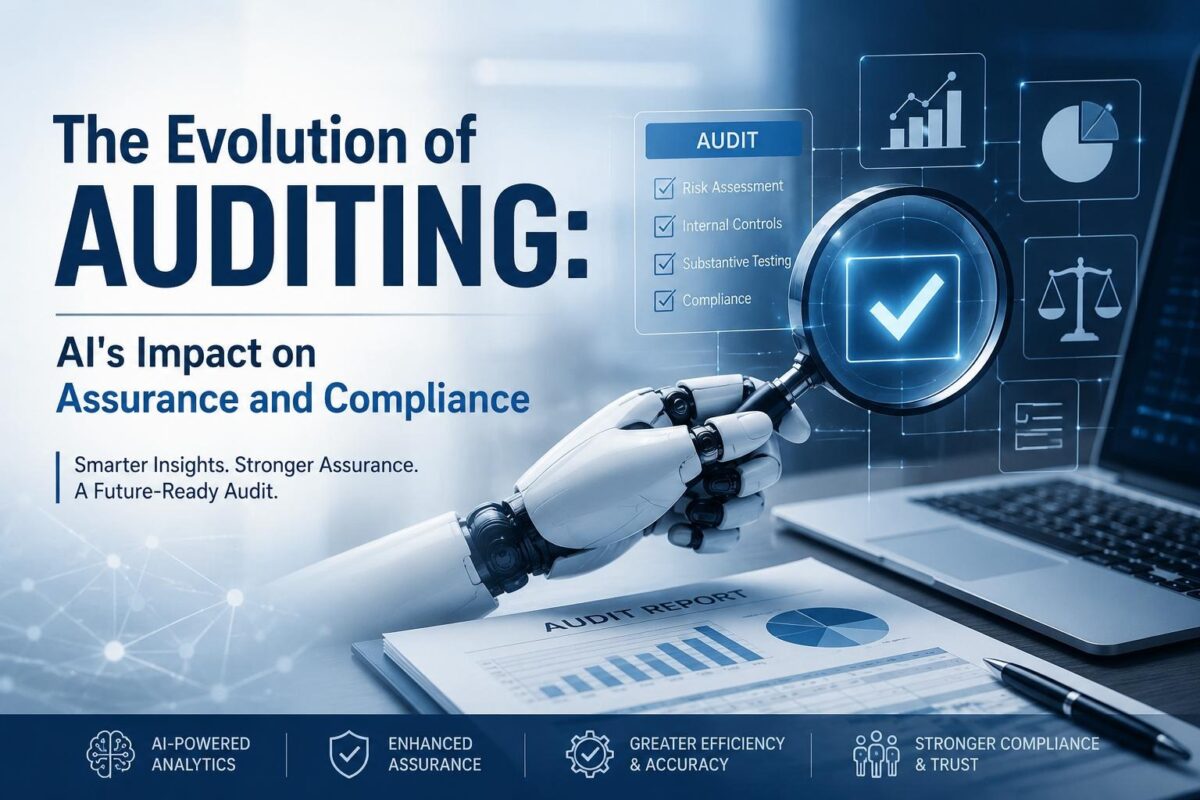
Artificial Intelligence is transforming traditional auditing methods, which previously relied on manual sampling and document reviews. AI enables faster analysis of massive datasets, improves anomaly detection, and enhances assurance quality. By automating repetitive tasks, AI does not replace auditors but instead empowers them to focus on risk evaluation, strategic insights, and complex judgments.
Why AI Is Changing the Audit Landscape
The shift toward AI in auditing is fueled by several key demands:
- Exploding data volumes: Managing massive quantities of financial transactions.
- Stricter oversight: Meeting expanding regulatory and compliance rules.
- Instant analytics: Accessing real-time financial insights.
- Securing assets: Heightening focus on active fraud prevention.
- Saving resources: Maximizing operational efficiency and cutting costs.
- Modernized environments: Adapting to digital transformation across finance.
Modern organizations reject purely historical audits. They now demand accelerated reporting, proactive risk detection, and continuous monitoring all year round.
Traditional Auditing vs AI-Powered Auditing
| Area | Traditional Auditing | AI-Powered Auditing |
| Data Review | Sample-based testing | Analysis of entire datasets |
| Processing Speed | Manual and time-consuming | Automated and significantly faster |
| Error Detection | Depends on sampling | Detects hidden anomalies across all transactions |
| Fraud Detection | Periodic review | Continuous monitoring and pattern recognition |
| Risk Assessment | Historical analysis | Predictive and data-driven insights |
| Compliance Monitoring | Manual verification | Automated compliance checks |
| Documentation | Paper or spreadsheet-based | Digital documentation with audit trails |
| Reporting | Periodic | Near real-time dashboards and reports |
How AI Is Transforming Audit Processes
1. Intelligent Data Analysis
Artificial Intelligence processes millions of accounting entries in minutes. It highlights hidden, unusual transactions by categorizing threats into clear operational risk areas:
Invoice & Vendor Risks
- Duplicate invoices: Copycat billing errors or split-payment fraud schemes.
- Unusual vendor payments: Out-of-pattern disbursements or unverified supplier changes.
Bookkeeping & Journal Risks
- Unusual journal entries: Manual adjustments posted to incorrect or rare cost centers.
- Round dollar transactions: Large, exact-figure entries (e.g., ₹5,00,000) that lack organic asset or tax calculations.
Timeline Risks
- Off-hour transactions: Financial actions logged late at night or outside standard local business hours.
2. Continuous Auditing
Instead of reviewing financial records once or twice a year, AI enables continuous monitoring of transactions throughout the year.
Benefits include:
- Earlier detection of issues
- Faster corrective actions
- Reduced audit surprises
- Improved governance
3. Enhanced Fraud Detection
Machine learning algorithms recognize behavioral patterns and identify transactions that deviate from normal business activity.
AI can identify:
- Duplicate payments
- Ghost vendors
- Suspicious employee reimbursements
- Unauthorized access to financial systems
- Unusual purchasing behavior
4. Automated Document Review
Modern AI tools can automatically review:
- Invoices
- Purchase orders
- Contracts
- Bank statements
- Tax documents
- Vendor agreements
This significantly reduces manual verification time while improving consistency.
Benefits of AI in Auditing
Artificial Intelligence (AI) fundamentally transforms the auditing profession by shifting it from reactive, sample based checking to proactive, full-population analysis. This technology acts as a powerful complement to human oversight, allowing auditors to dedicate more time to complex problem-solving and critical risk interpretation.
100% Data Coverage vs. Sampling
- Comprehensive Testing: Traditional audits rely heavily on statistical sampling, which can miss low-frequency anomalies. AI tools can process 100% of journal entries, bank statements, and transactions seamlessly.
- Hidden Pattern Visibility: Testing the complete dataset allows machine learning algorithms to uncover isolated or complex discrepancies that would otherwise go unnoticed.
Proactive Fraud Detection and Continuous Monitoring
- Real-Time Guardrails: Instead of waiting for annual or periodic reviews, AI enables real-time auditing and continuous compliance tracking.
- Instant Risk Flags: Systems automatically compare historical trends with current transaction logs to instantly catch duplicated expenses, unauthorized transactions, or weird accounting changes.
Automation of Repetitive Operations
- Seamless Reconciliation: Intelligent automation matching platforms like DataSnipper automate vendor ledger reconciliations, invoice verification, and data extraction from multi-page PDFs into uniform workpapers.
- Minimized Error Risk: Shifting repetitive tasks—such as rule-based data entries—to AI reduces the natural human error caused by tedious, manual fatigue.
Advanced Unstructured Document Parsing
- Rapid Contract Reviews: Natural Language Processing tools instantly extract highly nuanced information from large compliance papers, lease agreements, and corporate policies.
- Cross Document Verification: AI can quickly scan legal contracts to flag non-compliance or trace discrepancy linkages back to original documentation.
Challenges Organizations should consider
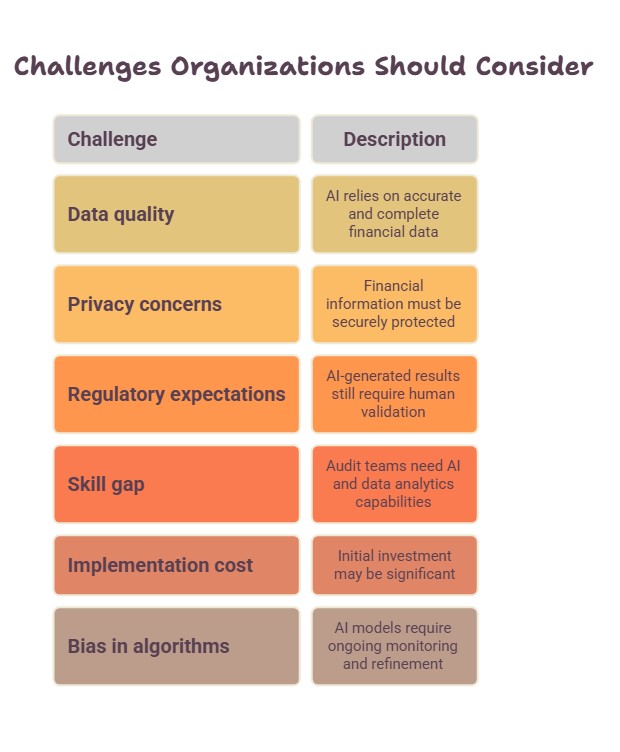
AI Will Not Replace Professional Judgment
AI will not replace human auditors because it cannot replicate professional skepticism, ethical judgment, or business context. While AI excels at data processing, human expertise remains irreplaceable for complex valuations, internal control assessments, and stakeholder communication. The future of the profession relies on close collaboration between advanced technology and human oversight.
Now that we have covered the entire article, I can help you compile everything into a final product. I can:
- Merge all summaries into a cohesive executive report.
- Transform these points into a slide deck script for a presentation.
- Create a comprehensive study guide with key definitions.
Preparing for the Future of Auditing
Organizations must take specific steps to successfully deploy AI-enabled auditing. These steps focus on data readiness, workforce training, and governance:
Data & Infrastructure Readiness
- High-quality financial data management: Centralise and clean data to provide reliable inputs for AI systems.
- Secure digital document management: Protect confidential financial records with encrypted, accessible storage.
Process & Technology Integration
- Continuous monitoring systems: Move from periodic checks to real-time, automated transaction scanning.
- Regular AI model reviews: Audit algorithms frequently to verify accuracy, eliminate drift, and ensure fairness.
People, Governance & Oversight
- Targeted workforce training: Upskill audit teams in data analytics and tool management.
- Strong internal governance controls: Establish clear boundaries for how automated insights affect financial decisions.
Key Takeaways
- AI is transforming auditing by automating repetitive tasks and enabling analysis of entire datasets.
- Continuous auditing allows organizations to identify risks and anomalies throughout the year rather than only during periodic reviews.
- Human expertise remains indispensable for professional judgment, ethical decision making, and interpreting complex business scenarios.
Conclusion
Artificial Intelligence represents a critical evolution in the auditing profession by significantly improving operational efficiency, expanding data capabilities, and enabling continuous compliance and assurance. Instead of eliminating human jobs, AI functions as an intelligent tool designed to empower auditors. The ultimate success of the industry relies on a balanced ecosystem that pairs automated technological accuracy with indispensable human governance and professional expertise.