
Skip to main content Skip to search

Archives for AI

Choosing the Right Expense Management Software: Ramp vs Expensify vs Brex

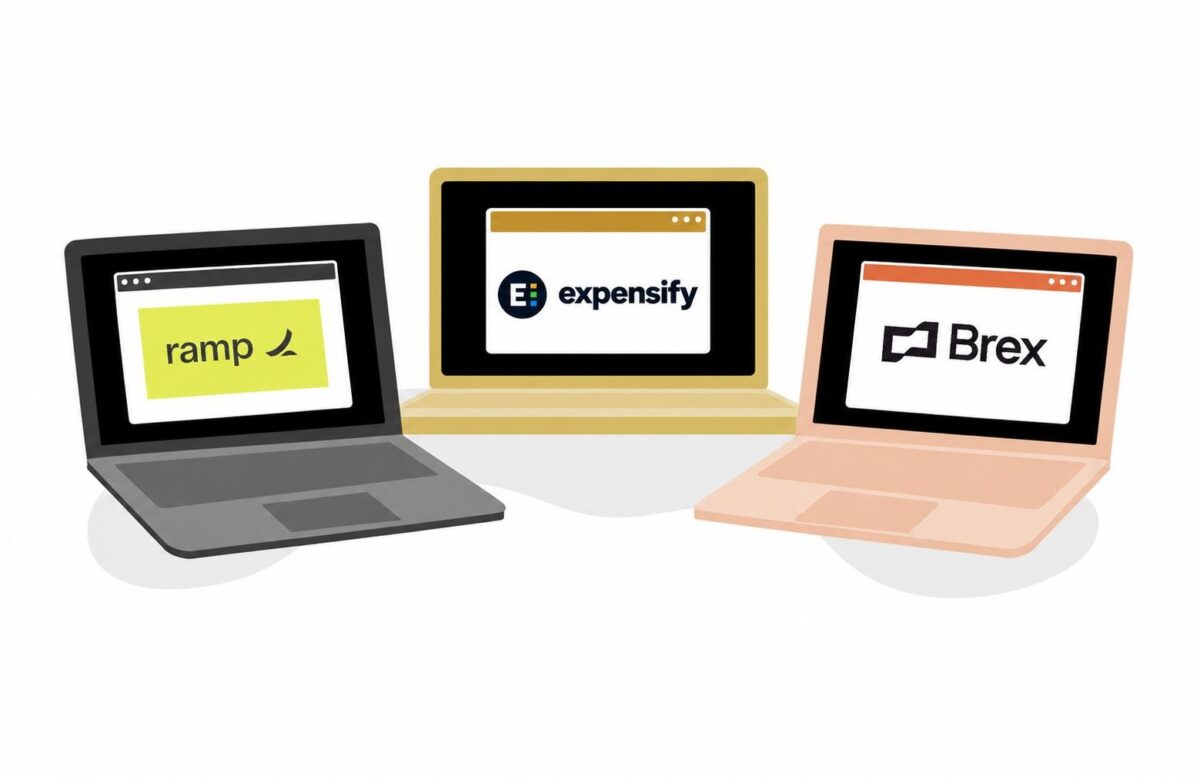
Expense management has moved past manual receipt tracking. As businesses grow, finance teams need to control costs, gain insight, speed up reimbursements, and ensure compliance while cutting admin. Modern platforms automate these tasks. However, choosing the right solution among many options can be difficult. Ramp, Expensify, and Brex are popular U.S. platforms. While they all streamline expense management, they suit different business needs, sizes, and financial approaches. The wrong choice can mean higher costs, poor workflows, and limited growth. The right choice can boost financial control, improve employee experience, and offer real time spending data.

Why Expense Management Software Matters More Than Ever

Instead of viewing expense software as merely a reimbursement tool, organizations now consider it part of their broader financial technology ecosystem.

A modern expense platform can help businesses:

  • Automate receipt collection
  • Track spending in real time
  • Reduce manual bookkeeping
  • Detect unusual transactions
  • Enforce company spending policies
  • Speed up month end close

For growing businesses, these capabilities translate into stronger financial governance and better decision making.

Meet the Three Leading Platforms

PlatformBest Known ForIdeal Business Type
RampCost savings and automationGrowing companies focused on operational efficiency
ExpensifyEmployee expense reporting and reimbursementsSmall to mid sized businesses with frequent employee expenses
BrexCorporate cards with integrated spend managementHigh growth startups and venture backed companies

Each platform solves expense management differently.

Understanding Their Core Philosophy

Instead of comparing features first, it is important to understand the problem each platform is trying to solve.

Ramp

Ramp focuses on reducing unnecessary business spending.

Rather than simply recording expenses, Ramp actively identifies opportunities to save money through spending analytics, vendor insights, and automation.

Its philosophy is simple:

Spend less through smarter financial intelligence.

Expensify

Expensify concentrates on making employee expense reporting effortless.

Its strength lies in simplifying receipt capture, travel expenses, mileage tracking, and reimbursement workflows.

Its core mission is:

Make expense reporting almost invisible.

Brex

Brex approaches finance from a broader perspective.

Instead of only managing expenses, it combines:

  • Corporate cards
  • Employee spend controls
  • Budget approvals
  • Travel management

Its objective is to become an all in one financial operations platform.
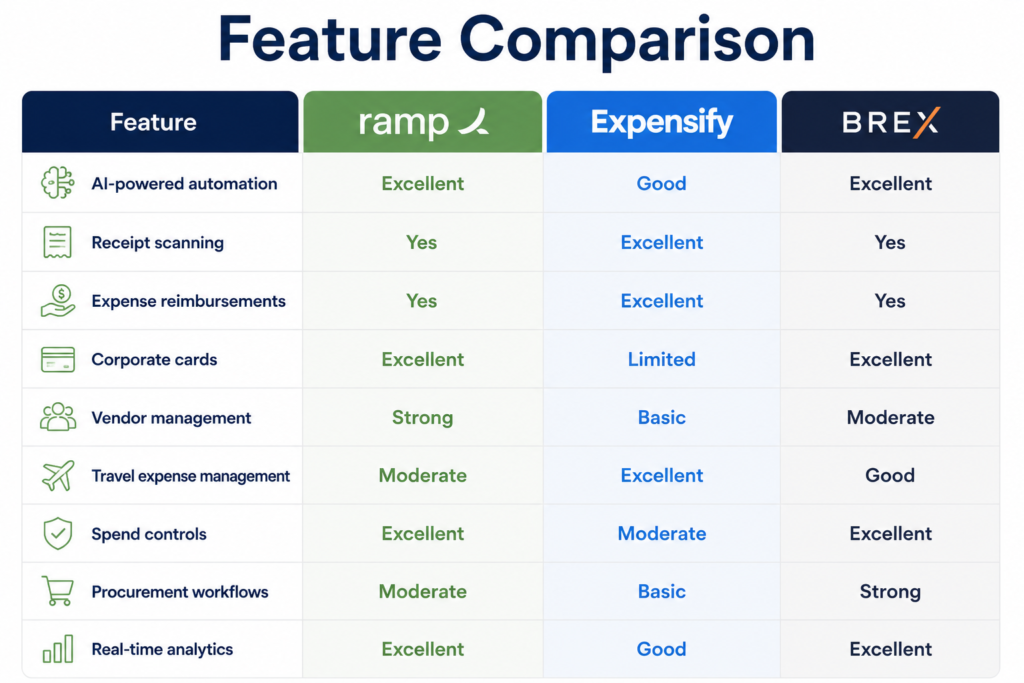
Which Platform Fits Your Business More

Choosing the right solution depends more on your business model than on the number of features offered.

If your priority is cost reduction then:

Ramp offers detailed spending intelligence and automation that helps finance teams identify unnecessary expenses before they become recurring costs.

If your workforce travels frequently then:

Expensify remains one of the easiest platforms for managing travel receipts, mileage reimbursement, and employee expense claims.

If you are a fast growing startup then:

Brex provides an integrated ecosystem that combines spending, budgeting, procurement, and corporate cards within a single platform.

Common Mistakes Businesses Make

Many organizations invest in expense software without considering long term operational needs.

Common mistakes include:

  • Choosing software based only on price
  • Ignoring accounting system compatibility
  • Underestimating employee adoption
  • Overlooking approval workflows
  • Selecting tools that cannot scale with business growth

The Future of Expense Management

Expense management is evolving beyond simple receipt digitization. New platforms use AI for predictive financial insights, automated policy violation detection, spending optimization recommendations, and real time cash flow visibility. With finance teams adopting AI workflows, expense software is becoming a strategic decision tool, not just administrative.

Conclusion

Choosing the right expense management software is key to financial efficiency, governance, and growth. Ramp focuses on cost savings and automation, Expensify on employee reporting, and Brex on integrated financial operations for growing companies. Instead of asking which is best overall, finance leaders should consider which platform best fits their business model, spending habits, and future expansion. Aligning expense management tech with financial strategy improves visibil ity, compliance, and spending decisions in a digital world.
Read more

The Evolution of Auditing: AI’s Impact on Assurance and Compliance

Artificial Intelligence is transforming traditional auditing methods, which previously relied on manual sampling and document reviews. AI enables faster analysis of massive datasets, improves anomaly detection, and enhances assurance quality. By automating repetitive tasks, AI does not replace auditors but instead empowers them to focus on risk evaluation, strategic insights, and complex judgments. 

Why AI Is Changing the Audit Landscape

The shift toward AI in auditing is fueled by several key demands:

  • Exploding data volumes: Managing massive quantities of financial transactions.
  • Stricter oversight: Meeting expanding regulatory and compliance rules.
  • Instant analytics: Accessing real-time financial insights.
  • Securing assets: Heightening focus on active fraud prevention.
  • Saving resources: Maximizing operational efficiency and cutting costs.
  • Modernized environments: Adapting to digital transformation across finance. 

Modern organizations reject purely historical audits. They now demand accelerated reporting, proactive risk detection, and continuous monitoring all year round. 

Traditional Auditing vs AI-Powered Auditing

AreaTraditional  AuditingAI-Powered  Auditing
Data ReviewSample-based testingAnalysis of entire datasets
Processing SpeedManual and time-consumingAutomated and significantly faster
Error DetectionDepends on samplingDetects hidden anomalies across all transactions
Fraud DetectionPeriodic reviewContinuous monitoring and pattern recognition
Risk AssessmentHistorical analysisPredictive and data-driven insights
Compliance MonitoringManual verificationAutomated compliance checks
DocumentationPaper or spreadsheet-basedDigital documentation with audit trails
ReportingPeriodicNear real-time dashboards and reports 

How AI Is Transforming Audit Processes

1. Intelligent Data Analysis

Artificial Intelligence processes millions of accounting entries in minutes. It highlights hidden, unusual transactions by categorizing threats into clear operational risk areas: 

Invoice & Vendor Risks

  • Duplicate invoices: Copycat billing errors or split-payment fraud schemes.
  • Unusual vendor payments: Out-of-pattern disbursements or unverified supplier changes. 

Bookkeeping & Journal Risks

  • Unusual journal entries: Manual adjustments posted to incorrect or rare cost centers.
  • Round dollar transactions: Large, exact-figure entries (e.g., ₹5,00,000) that lack organic asset or tax calculations. 

Timeline Risks

  • Off-hour transactions: Financial actions logged late at night or outside standard local business hours.

2. Continuous Auditing

Instead of reviewing financial records once or twice a year, AI enables continuous monitoring of transactions throughout the year.

Benefits include:

  • Earlier detection of issues
  • Faster corrective actions
  • Reduced audit surprises
  • Improved governance

3. Enhanced Fraud Detection

Machine learning algorithms recognize behavioral patterns and identify transactions that deviate from normal business activity.

AI can identify:

  • Duplicate payments
  • Ghost vendors
  • Suspicious employee reimbursements
  • Unauthorized access to financial systems
  • Unusual purchasing behavior

4. Automated Document Review

Modern AI tools can automatically review:

  • Invoices
  • Purchase orders
  • Contracts
  • Bank statements
  • Tax documents
  • Vendor agreements

This significantly reduces manual verification time while improving consistency.

Benefits of AI in Auditing

Artificial Intelligence (AI) fundamentally transforms the auditing profession by shifting it from reactive, sample based checking to proactive, full-population analysis. This technology acts as a powerful complement to human oversight, allowing auditors to dedicate more time to complex problem-solving and critical risk interpretation. 

100% Data Coverage vs. Sampling

  • Comprehensive Testing: Traditional audits rely heavily on statistical sampling, which can miss low-frequency anomalies. AI tools can process 100% of journal entries, bank statements, and transactions seamlessly. 
  • Hidden Pattern Visibility: Testing the complete dataset allows machine learning algorithms to uncover isolated or complex discrepancies that would otherwise go unnoticed. 

Proactive Fraud Detection and Continuous Monitoring

  • Real-Time Guardrails: Instead of waiting for annual or periodic reviews, AI enables real-time auditing and continuous compliance tracking. 
  • Instant Risk Flags: Systems automatically compare historical trends with current transaction logs to instantly catch duplicated expenses, unauthorized transactions, or weird accounting changes. 

Automation of Repetitive Operations

  • Seamless Reconciliation: Intelligent automation matching platforms like DataSnipper automate vendor ledger reconciliations, invoice verification, and data extraction from multi-page PDFs into uniform workpapers.
  • Minimized Error Risk: Shifting repetitive tasks—such as rule-based data entries—to AI reduces the natural human error caused by tedious, manual fatigue. 

Advanced Unstructured Document Parsing

  • Rapid Contract Reviews: Natural Language Processing  tools instantly extract highly nuanced information from large compliance papers, lease agreements, and corporate policies.
  • Cross Document Verification: AI can quickly scan legal contracts to flag non-compliance or trace discrepancy linkages back to original documentation. 

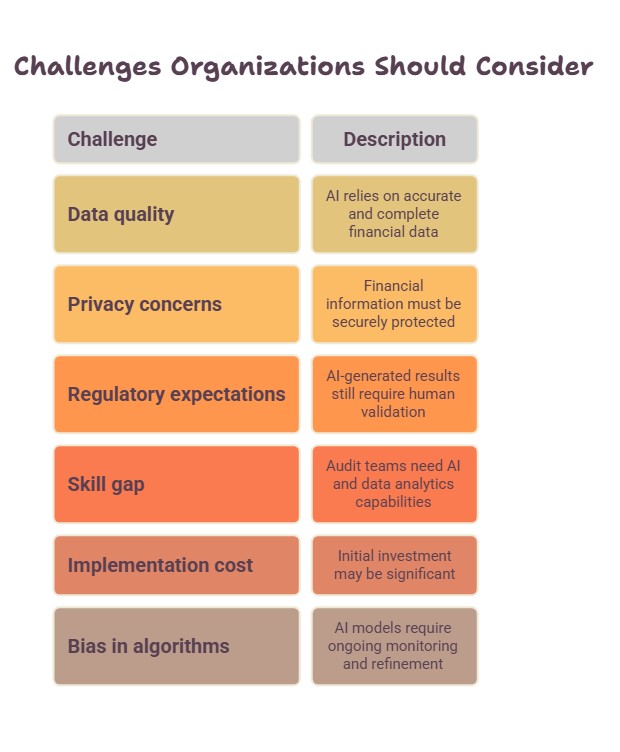
Challenges Organizations should consider

AI Will Not Replace Professional Judgment

AI will not replace human auditors because it cannot replicate professional skepticism, ethical judgment, or business context. While AI excels at data processing, human expertise remains irreplaceable for complex valuations, internal control assessments, and stakeholder communication. The future of the profession relies on close collaboration between advanced technology and human oversight. 

Now that we have covered the entire article, I can help you compile everything into a final product. I can:

  • Merge all summaries into a cohesive executive report.
  • Transform these points into a slide deck script for a presentation.
  • Create a comprehensive study guide with key definitions. 

Preparing for the Future of Auditing

Organizations must take specific steps to successfully deploy AI-enabled auditing. These steps focus on data readiness, workforce training, and governance:

Data & Infrastructure Readiness

  • High-quality financial data management: Centralise and clean data to provide reliable inputs for AI systems.
  • Secure digital document management: Protect confidential financial records with encrypted, accessible storage. 

Process & Technology Integration

  • Continuous monitoring systems: Move from periodic checks to real-time, automated transaction scanning.
  • Regular AI model reviews: Audit algorithms frequently to verify accuracy, eliminate drift, and ensure fairness. 

People, Governance & Oversight

  • Targeted workforce training: Upskill audit teams in data analytics and tool management.
  • Strong internal governance controls: Establish clear boundaries for how automated insights affect financial decisions.

Key Takeaways

  • AI is transforming auditing by automating repetitive tasks and enabling analysis of entire datasets.
  • Continuous auditing allows organizations to identify risks and anomalies throughout the year rather than only during periodic reviews.
  • Human expertise remains indispensable for professional judgment, ethical decision making, and interpreting complex business scenarios.

Conclusion

Artificial Intelligence represents a critical evolution in the auditing profession by significantly improving operational efficiency, expanding data capabilities, and enabling continuous compliance and assurance. Instead of eliminating human jobs, AI functions as an intelligent tool designed to empower auditors. The ultimate success of the industry relies on a balanced ecosystem that pairs automated technological accuracy with indispensable human governance and professional expertise. 

Read more