
The American corporate finance landscape is rapidly changing. Traditionally, companies relied on large in-house teams, expensive CFOs, rigid hierarchies, and high overhead. By 2026, this is shifting towards a more flexible, tech driven, and strategic model. Businesses are now creating leaner finance departments using Fractional CFOs, outsourced accounting, automation, and modern financial tools. Many are finding this improves their financial stability.
Kariwala & Co. LLP tracks this shift from rigid to agile financial operations, which leads to better decisions, higher profits, and growth.
The Traditional Finance Model Is Under Pressure
The old finance structure worked in a slower business environment.
Companies had time to review quarterly reports, manually process transactions, and maintain large back office departments. But today’s market conditions are completely different.
Modern businesses face:
- Rapid economic fluctuations
- Pressure of Inflationary
- Employee costs rising
- Increasing compliance complexity
- Supply chain uncertainty
- Disruption of Technology
- Investor expectations for real time data
In such an environment, businesses cannot afford slow financial decision making.
What ExactlyFractional Is a CFO?
A Fractional CFO offers businesses flexible, part-time financial leadership. This provides executive financial expertise without the full time cost of a large finance team, though their value extends beyond mere cost reduction.
Modern Fractional CFOs help businesses:
- Build financial strategies
- Improve profitability
- Forecast future growth
- Analyze operational performance
- Create investor ready reports
- Optimize cash flow management
- Reduce financial risks
- Strengthen internal controls
For many growing businesses, this model delivers the strategic guidance they need without unnecessary operational heaviness
Why Businesses Are Moving Toward Leaner Finance Structures
Companies are increasingly adopting lean finance models because they want:
- Greater financial flexibility
- Lower executive hiring costs
- Faster strategic decision making
- Access to specialized expertise
- Scalable financial leadership
- More efficient operational structures
Businesses today are focusing less on large teams and more on smart financial efficiency.
The Shift from Traditional CFO Models to Flexible Finance Leadership
| Traditional CFO Model | Fractional CFO Model |
| Full time executive cost | Flexible cost structure |
| Long term employment commitment | On demand expertise |
| Fixed organizational role | Scalable financial support |
| Higher overhead expenses | Cost efficient leadership |
This shift reflects how modern businesses are prioritizing agility and operational efficiency.
Why Fractional CFO Services Are Growing Rapidly in the U.S.
Several economic and business trends are driving this rise:
• Economic Uncertainty
Businesses want strategic financial guidance without significantly increasing fixed costs.
• Startup & Mid-Market Growth
Growing companies often need CFO expertise before they are ready for a full time executive hire.
• Data-Driven Decision Making
Modern businesses require deeper financial analysis and forecasting capabilities.
• Remote & Flexible Work Culture
Virtual finance leadership has become more accepted and operationally effective.
The modern CFO role is becoming more strategic, flexible, and technology driven.
Outsourcing Firms Are Also Evolving
This shift is also redefining the role of accounting outsourcing firms.
Earlier, outsourcing was mostly associated with bookkeeping and transactional support.
Today, businesses expect much more.
Modern outsourcing partners now contribute to:
- Financial analysis
- KPI reporting
- Process optimization
- Compliance management
- Cash flow visibility
- Strategic reporting support
At Kariwala & Co. LLP, we believe the future of accounting lies in combining operational efficiency with strategic financial insight.
Businesses no longer want finance teams that only report numbers.
They want finance partners who help interpret those numbers and turn them into smarter business decisions.
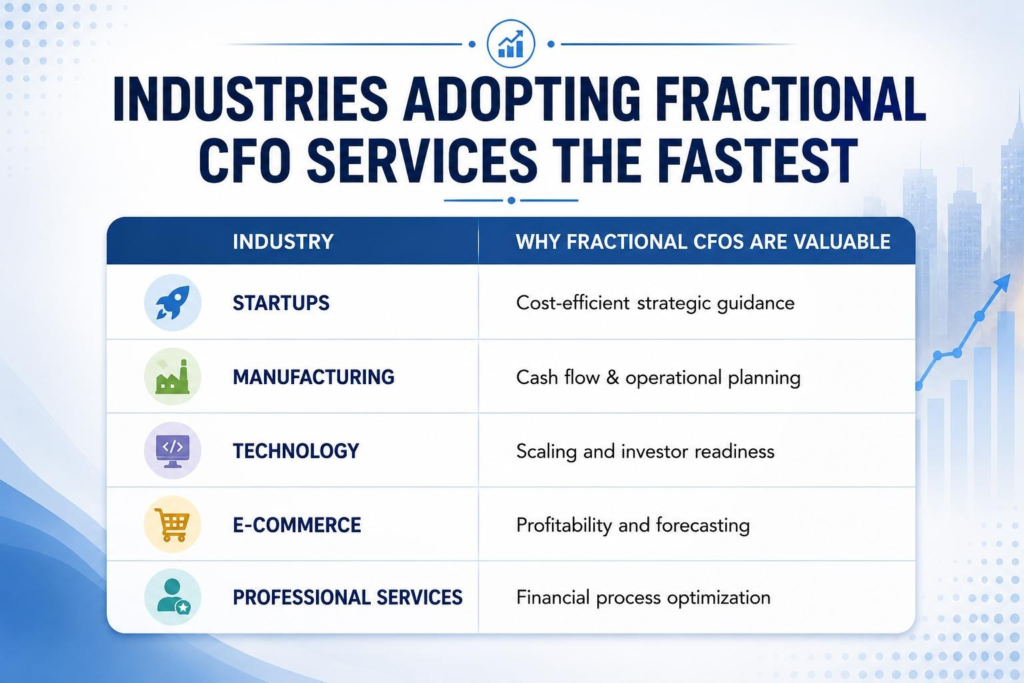
Industries Adopting Fractional CFO Services the Fastest
The Bigger Financial Trend Behind This Shift
The proliferation of fractional Chief Financial Officer services signifies a broader evolution within the realms of finance and accounting. Enterprises no longer perceive finance departments solely as operational units tasked with reporting and regulatory adherence. Rather, financial functions are now anticipated to spearhead:
- Business strategy
- Performance insights
- Risk management
- Growth planning
This means companies are looking for financial leadership that is not only technically skilled, but also agile and business-focused.
Conclusion
Fractional CFO services are revolutionizing financial leadership in the U.S. Businesses are opting for flexible, efficient, and strategic finance structures over large executive teams, seeking scalable expertise that meets operational demands. This trend prioritizes agility and insight over mere cost reduction, aligning finance functions with contemporary business needs.