

Why Profit Alone Cannot Keep a Business Alive
Many people mistakenly believe that making a profit guarantees a company’s financial health, but profitable businesses fail every year due to a critical misunderstanding: profit and cash are not the same thing. While profit is an accounting measure showing revenue minus expenses on paper, cash is the actual money available to pay daily obligations like salaries, rent, and taxes. A business can report high profits because it books revenue before customers actually pay, yet it will quickly face financial distress or bankruptcy if it lacks the liquid cash to cover its immediate bills. Therefore, business owners and investors must prioritize liquidity alongside profitability to ensure long term survival.
A Simple Example
The Pizza Shop Example
Imagine you sell $10,000 worth of pizzas to a school for a big party on credit.
- The Income Statement: Your ingredients and labor cost $7,000. On paper, you made a healthy $3,000 profit.
- The Cash Reality: The school will not pay your invoice for 60 days, so you collect $0 cash today.
- The Crisis: Your ingredients supplier and staff demand their $7,000 payment immediately.
Even though you are profitable, you face a $7,000 cash shortage and could go out of business tomorrow because you cannot pay your immediate bills.
Why Profitable Companies Still Go Bankrupt
1. Poor Cash Flow Management
Cash flow is often described as the lifeblood of every business.
A company may generate healthy profits but still fail if cash is not managed properly. When money enters the business more slowly than it leaves, financial pressure builds quickly.
Common warning signs include:
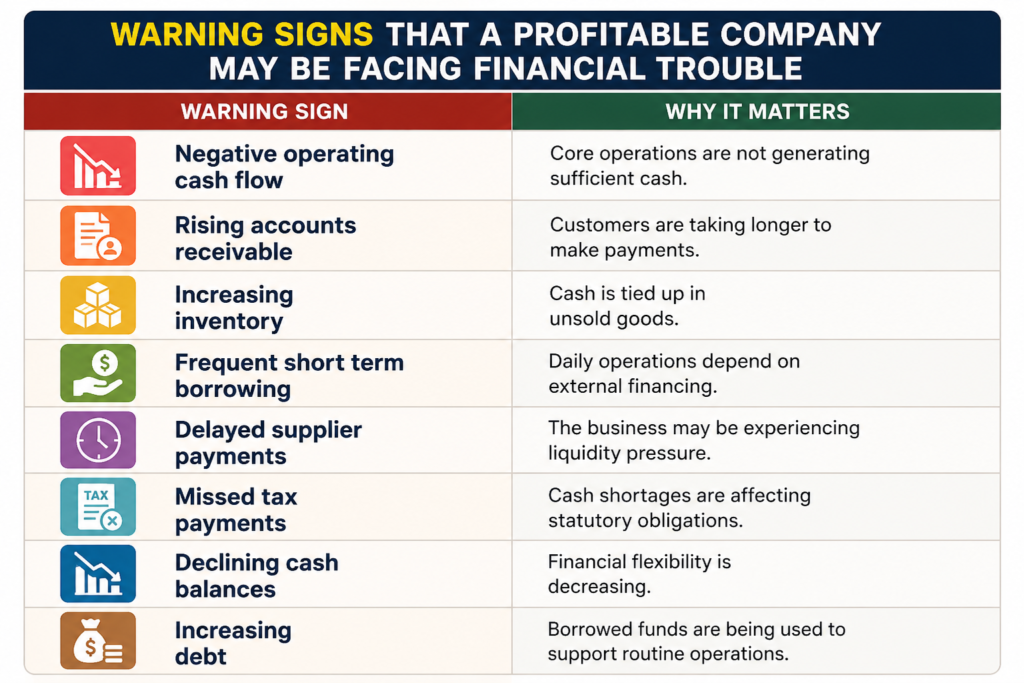
- Late Supplier Payments: Delaying bills due to missing funds.
- Payroll Struggles: Finding it difficult to pay employee salaries on time.
- Overdraft Reliance: Frequently using bank overdrafts to survive.
- Short-Term Debt: Depending on quick loans for routine expenses.
2. Excessive Credit Sales
Offering generous credit terms boosts sales but creates severe liquidity gaps when customer payments take longer than supplier deadlines. For example, if customers pay in 120 days but suppliers demand payment in 30 days, the business must fund operations for 90 days out of pocket. As sales grow, more cash gets trapped in unpaid invoices, starving the company of the working capital needed to survive.
3. Rapid Business Growth
Rapid expansion can accidentally destroy a business by burning through cash faster than it generates revenue.
The Cost of Growth
- Upfront Expenses: Buying inventory and hiring staff before sales happen.
- Infrastructure: Investing heavily in larger facilities and equipment early.
- Delayed Returns: Paying immediate bills while waiting months for new customer cash.
Without strict cash planning, rapid growth creates a severe cash shortage that can cause bankruptcy.
4. Excess Inventory
Unsold inventory traps vital cash inside the warehouse, severely hurting daily liquidity.
Why Cash Gets Locked Up
- Overstocking: Buying more products than the market demands.
- Slow Items: Holding goods that take too long to sell.
- Obsolescence: Storing outdated items that can no longer be sold.
- Bad Forecasting: Misjudging future customer purchasing trends.
Excessive inventory increases storage costs while starving the business of operational cash.
5. Heavy Debt Obligations
Debt repayments can quickly consume a company’s available cash regardless of how healthy its profits look on paper.
The True Cost of Debt
- Principal: Repaying the original loan amount regularly.
- Interest: Covering the ongoing cost of borrowing.
- Fees: Paying bank charges and administration costs.
- Covenants: Meeting strict financial compliance rules.
If these fixed cash outflows outweigh incoming revenue, the business will face a severe liquidity crisis.
6. Delayed Customer Payments
Accounts receivable represent valuable future money, but you cannot use unpaid invoices to cover immediate expenses.
The Problem With Delayed Collections
- Payroll: Employees still expect on time salaries.
- Suppliers: Vendors still demand prompt payment.
- Taxes: Government deadlines do not change.
- Utilities: Monthly bills must be settled.
As customers delay payments, paper wealth grows but actual cash shortages become severe.
7. Significant Capital Expenditure
Investing in long-term assets drains immediate cash reserves even though the expense is spread out over many years on paper.
Where Cash Disappears
- Equipment: Buying manufacturing machinery upfront.
- Property: Purchasing or upgrading buildings.
- Fleet: Acquiring delivery vehicles.
- Tech: Funding information technology systems.
While these purchases are recorded as assets and depreciated slowly, the massive initial cash outflow severely reduces daily liquidity.
8. Poor Working Capital Management
Working capital measures a company’s ability to meet its short term financial obligations.
Formula
Working Capital = Current Assets − Current Liabilities
Poor working capital management traps cash in non liquid assets, leaving profitable companies unable to pay daily bills.
Key Operational Failures
- Excessive Receivables: Letting customers delay invoice payments too long.
- High Inventory: Overstocking goods that sit unsold in warehouses.
- Low Cash: Failing to keep an emergency cash buffer.
- Debt Reliance: Using expensive short term loans for routine costs.
Without efficient management, working capital dries up and triggers operational failure.
Warning Signs That a Profitable Company May Be Facing Financial Trouble
How Companies Can Prevent This Situation
Successful businesses monitor cash just as carefully as they monitor profit.
Effective Management Practices
- Monthly Forecasting: Preparing detailed cash flow projections every single month.
- Prompt Collection: Following up on overdue customer payments without delay.
- Supplier Negotiation: Agreeing on favourable payment terms with vendors.
- Emergency Reserves: Maintaining a cash buffer for unexpected expenses.
- Inventory Control: Managing warehouse stock levels efficiently to avoid waste.
- Debt Reviews: Checking borrowing levels regularly to keep loans manageable.
- Ratio Monitoring: Tracking key liquidity ratios to measure financial health.
- Cash Comparison: Comparing actual operating cash flow against reported profit.
- Cross Department Unity: Improving coordination between finance, sales, procurement, and operations.
Why Strong Profits Do not Always Mean a Healthy Business
One of the biggest misconceptions in business is assuming that profit and cash flow are the same thing. While profitability measures how much a business earns after deducting expenses, cash flow reflects the actual movement of money into and out of the business. A company can report impressive profits on its financial statements yet struggle to pay salaries, suppliers, or loan installments if cash is tied up in receivables or inventory.
In today’s economic environment, investors, lenders, and business owners are placing greater emphasis on cash flow management than ever before. Businesses with consistent and predictable cash flow are considered more resilient because they can meet short term obligations, invest in growth opportunities, and navigate periods of market uncertainty without relying heavily on external financing.
Key Financial Metrics Every Business Should Monitor
| Financial Metric | Formula | Purpose |
| Operating Cash Flow | Reported in the Cash Flow Statement | Measures cash generated from business operations. |
| Current Ratio | Current Assets ÷ Current Liabilities | Evaluates the ability to meet short term obligations. |
| Quick Ratio | (Current Assets − Inventory) ÷ Current Liabilities | Measures immediate liquidity. |
| Days Sales Outstanding | (Accounts Receivable ÷ Credit Sales) × 365 | Shows the average time customers take to make payment. |
| Inventory Holding Period | (Average Inventory ÷ Cost of Goods Sold) × 365 | Indicates how long inventory remains before being sold. |
| Days Payable Outstanding | (Accounts Payable ÷ Cost of Goods Sold) × 365 | Measures the average time taken to pay suppliers. |
| Cash Conversion Cycle | Days Sales Outstanding + Inventory Holding Period − Days Payable Outstanding | Measures how quickly cash invested in operations returns to the business. |
Best Practices for Finance Teams
Essential Best Practices
- Rolling Forecasts: Preparing cash flow projections covering at least thirteen weeks.
- Credit Reviews: Checking customer creditworthiness before extending terms.
- Credit Limits: Establishing clear limits on how much customers can borrow.
- Receivables Tracking: Monitoring overdue invoices on a regular basis.
- Inventory Audits: Conducting periodic reviews of warehouse stock levels.
- Debt Planning: Organizing loan repayments well in advance of deadlines.
- Stress Testing: Simulating cash flow performance under different business scenarios.
- Dual Reporting: Presenting profitability and cash flow reports to management.
- Liquidity Monitoring: Checking key cash indicators monthly instead of just income.
Conclusion
Profitability is just paper performance, but cash is what keeps a business alive. A company will fail the moment it cannot pay its daily bills, no matter how high its reported profits look. Long term survival requires prioritizing actual cash flow, managing working capital tightly, and tracking liquidity to protect against economic uncertainty.
The most important lesson is simple: Profit shows how well a business performs, but cash determines whether it survives.