
Organizations dedicate significant energy to managing spending, elevating liquidity, and enforcing operational checks. Despite these efforts, a disregarded vulnerability introduces unwanted expenses and hazards to enterprises: zombie vendors. This term describes outdated supplier accounts remaining active within an institutional ledger despite showing zero recent transactions. These files typically originate from single purchases, dissolved entities, or replaced contractors. While seemingly benign, stagnant profiles create hidden financial leaks, execution barriers, and regulatory penalties. Regular audits are essential to prevent dormant listings from aggregating silently and causing continuous revenue depletion.
What Are Zombie Vendors?
Zombie vendors represent a silent, creepy drain on corporate cash. These are inactive supplier accounts that linger in accounting software long after their usefulness expires, creating open doorways for fraud, double payments, and system chaos. Think of them as administrative ghosts haunting the ledger, waiting to cause unexpected financial damage.
An organization’s vendor registry can quickly transform into a graveyard of dead accounts, which usually include:
- Stagnant Accounts: Suppliers with zero financial activity or outbound payments for over twelve consecutive months.
- Defunct Businesses: Former commercial partners that quietly closed doors or dissolved operations years ago.
- One Time Wonders: Temporary contractors onboarded for isolated projects that concluded long ago.
- Cloned Records: Identical corporate profiles accidentally entered multiple times into the database.
- Ousted Competitors: Outdated merchants officially replaced by newly approved organizational alternatives.
- Broken Profiles: Fragmented listings containing missing tax information or invalid corporate addresses.
Many enterprises continuously onboard exciting new partners but completely forget to clean out old files. This one-way growth leaves corporate databases cluttered with digital debris that complicates routine tracking and invites unnecessary risks.
Why Businesses Should Be Concerned About Zombie Vendors
At first glance, an inactive supplier record may not seem problematic. However, these dormant records can become entry points for fraud, payment errors, compliance issues, and operational inefficiencies.
| Key Risks Associated with Zombie Vendors | |
| Risk Area | Potential Impact on Business. |
| Fraud Risk | Unauthorized payments through dormant vendor accounts. |
| Duplicate Payments | Payments made to duplicate vendor records. |
| Compliance Issues | Inaccurate supplier information affecting reporting obligations. |
| Audit Concerns | Weak internal controls and poor data governance. |
| Operational Inefficiency | Additional time spent searching and validating supplier records. |
| Financial Leakage | Unnecessary losses through errors and control failures. |
Even if each issue appears small individually, the combined financial impact can be substantial.
The Hidden Financial Cost of Inactive Suppliers
Many organizations focus on major expenses while overlooking small inefficiencies that gradually reduce profitability. Zombie vendors contribute to this hidden financial drain in several ways.
1. Increased Risk of Fraud
Unmonitored vendor profiles expose corporate finances to severe exploitation. Internal compliance teams rarely monitor inactive entries, making them prime targets for manipulation. Bad actors easily reactivate these dormant profiles to inject unauthorized charges, seamlessly bypassing standard corporate filters that only scrutinize newly created suppliers.
An expanded database increases the corporate attack surface, facilitating critical exploits including:
- Ghost billing: Submitting fabricated corporate statements through dormant accounts.
- Diversion scams: Altering routing credentials to intercept legitimate disbursements.
- Rogue routing: Directing corporate payments straight into fraudulent bank accounts.
- Mirror profiling: Creating deceptive duplicate suppliers to obscure malicious extractions.
2. Duplicate Vendors and Duplicate Payments
Growing supplier databases accelerate profile duplication. Lacking transparency, financial administrators accidentally create fresh profiles when historical records are hard to find. This loop causes multiple active credentials for the same enterprise to accumulate silently.
These redundant profiles trigger undetected financial errors, including:
- Double billing: Processing identical invoices across separate profiles.
- Redundant disbursements: Issuing multiple payments for one obligation.
- Skewed ledgers: Maintaining incorrect balances across duplicate files.
- Muddled tracking: Fragmenting corporate transaction history.
- Complex reconciliations: Creating tedious account balancing tasks.
3. Higher Administrative Costs
Cluttered supplier databases drive up corporate administrative expenses. Routine financial tasks become highly time consuming, directly reducing productivity across accounting and procurement teams.
Staff members waste valuable operational hours navigating system clutter to manage avoidable tasks, including:
- Record hunting: Searching through bloated databases for correct supplier entries.
- Data verification: Manually confirming outdated or conflicting merchant information.
- Duplicate reviews: Auditing repetitive system entries for the same vendor.
- Error correction: Expending labor to fix preventable payment mistakes.
- Profile updating: Constantly refreshing obsolete historical files.
4. Compliance and Regulatory Challenges
Obsolete vendor profiles spark severe compliance failures. Outdated tax IDs, banking credentials, and registration records trigger reporting errors and audit penalties. Regulatory bodies view messy master files as a direct failure of corporate governance and internal controls.
This data decay sparks critical organizational risks:
- Reporting errors: Submitting inaccurate tax records.
- Audit failures: Exposing weak internal controls.
- Regulatory fines: Breaching strict data mandates.
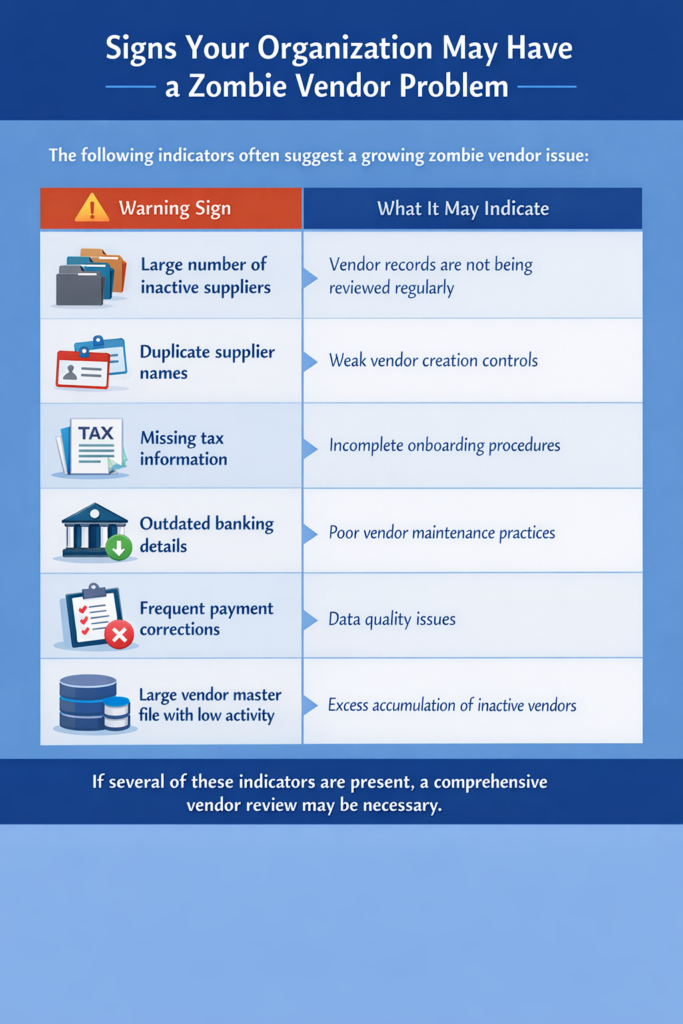
How Zombie Vendors Affect Different Departments
The impact of inactive suppliers extends beyond the finance department.
| Department | Potential Impact |
| Accounts Payable | Increased payment errors and duplicate processing. |
| Procurement | Difficulty identifying approved suppliers. |
| Finance | Reduced reporting accuracy. |
| Internal Audit | Greater audit testing and review requirements. |
| Compliance | Increased regulatory and documentation risks. |
| Management | Reduced visibility into supplier relationships |
This is why vendor management should be viewed as an organization wide responsibility rather than simply an accounting function.
Best Practices for Eliminating Zombie Vendors
Structured management procedures effectively neutralize zombie vendor risks. Regular, annualized database audits allow procurement teams to isolate stagnant accounts and maintain financial system integrity.
Internal auditors should evaluate every listing using specific criteria:
- Activity window: Has the enterprise issued payments within twelve months?
- Operational status: Is the supplier still actively doing business?
- Data integrity: Is the profile information complete and correct?
- Business necessity: Does the organization still require this partner?
Establish Clear Vendor Lifecycle Policies
Structured vendor lifecycle policies effectively prevent supplier database accumulation. Establishing rigorous, formal protocols ensures corporate files remain tightly controlled through every operational stage, from initial creation and formal approval to continuous monitoring and periodic review. By maintaining this structured oversight, organizations can promptly execute account deactivation the moment a supplier is no longer required, stopping the accumulation of unnecessary digital clutter.
Strengthen Vendor Approval Procedures
Before creating a new supplier, organizations should verify:
- Legal business existence
- Tax registration details
- Banking information
- Business contact details
- Required documentation
Strong onboarding controls reduce duplicate and fraudulent vendor creation.
Monitor Inactive Vendors
Many organizations establish automated reports that identify vendors with no activity over a specified period.
Examples include:
- No transactions in 12 months
- No transactions in 24 months
- Missing compliance documentation
- Expired supplier information
These reports allow finance teams to take corrective action before risks increase.
The Business Benefits of Vendor Master File Cleanup
Organizations that regularly review and maintain supplier records often experience measurable benefits.
| Benefit | Business Impact |
| Reduced Fraud Risk | Stronger payment controls. |
| Improved Data Accuracy | Better financial reporting. |
| Increased Efficiency | Faster processing and decision making. |
| Better Compliance | Improved audit readiness. |
| Reduced Financial Leakage | Lower risk of unnecessary payments. |
| Stronger Internal Controls | Enhanced governance and accountability. |
Conclusion
Hidden zombie vendors expose companies to severe fraud, duplicate payments, compliance penalties, and operational friction. Maintaining an accurate vendor master file is a strategic financial control mechanism, not a basic administrative task. By conducting regular database reviews, tightening onboarding protocols, and deactivating obsolete records, organizations actively protect their profitability and reduce risk. Proactive vendor management is an absolute necessity in complex modern business environments.