
From Traditional Accounting to Intelligent Systems
Traditional accounting relied on manual data entry, delayed reconciliations, and periodic financial reviews. This often meant businesses were making decisions based on outdated information.
Today, cloud-based accounting platforms like QuickBooks Online, Xero, Zoho Books, and Sage Intacct have changed the landscape. They allow real-time access, centralized data storage, and collaborative work—no matter where the teams are located.
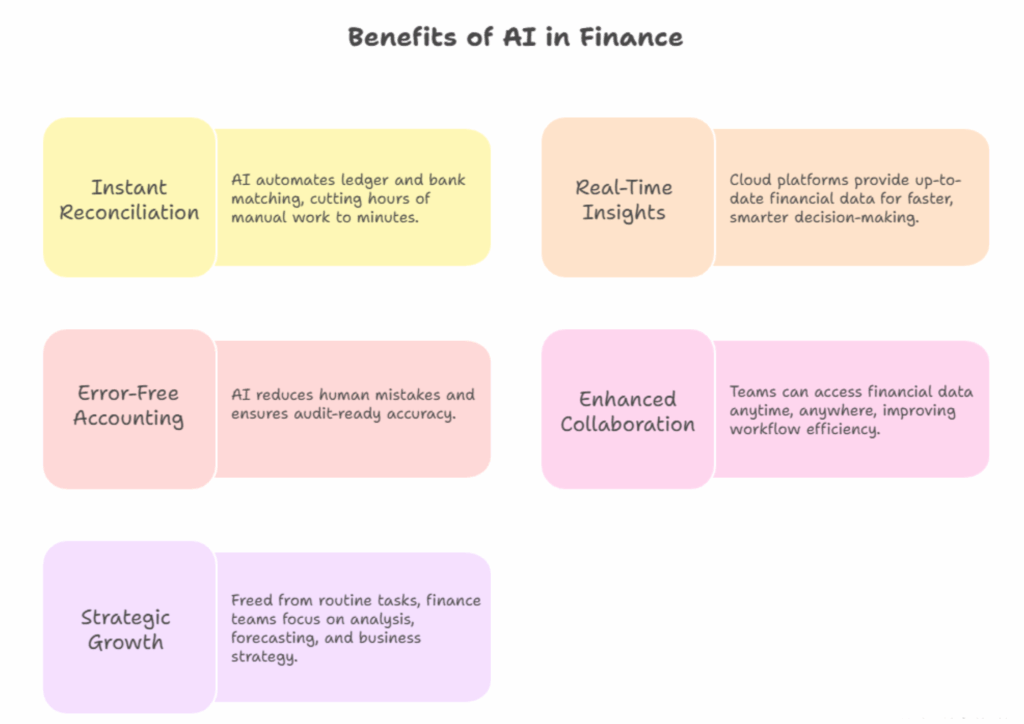
This transformation enables accountants to move beyond compliance and become true financial strategists. AI-driven platforms can now categorize transactions, detect anomalies, and generate reconciled financial statements instantly.
The basic problem (why reconciliation used to take hours)
Bank and ledger reconciliation traditionally takes time because it requires collecting bank statements and GL entries, normalizing formats, matching transactions (often one-to-many or many-to-one), finding and explaining exceptions, and posting adjustments. When humans do matching, they must read descriptions, compare amounts and dates, search invoices, and apply judgement — a process that scales linearly with transaction volume and variance in descriptions. Manual reconciliation therefore becomes a bottleneck as transaction frequency and complexity grow.
The automation recipe: five capabilities that shrink time
Modern systems combine five technical capabilities that compress the reconciliation workflow from hours to minutes:
- Continuous bank feeds and streaming ingestion. Bank feeds (via Plaid/Yodlee/bank APIs) push transactions automatically into the accounting environment as soon as they clear, eliminating manual statement import delays and giving the reconciliation engine live inputs. Many cloud accounting platforms (Xero, QuickBooks, NetSuite) and specialist tools rely on always-on feeds to begin matching immediately.
- High-accuracy data extraction (OCR + document intelligence). Tools like Hubdoc, Dext (Receipt Bank), AutoEntry and Tipalti capture invoices/receipts with OCR and AI that extracts line-items and vendor codes. Clean, structured documents make it far easier to match payments to invoices automatically.
- Rules engines and machine learning (ML) matching. Reconciliation platforms use deterministic rules (amount + invoice ID + reference) and probabilistic ML (fuzzy matching on vendor name, amounts within tolerance, date proximity, payment patterns). Over time ML “learns” common mappings and increases auto-match rates. Products like NetSuite’s transaction matcher, ReconArt and AutoRek emphasize automated matching engines for millions of transactions in minutes.
Exception management and workflow. Instead of scanning whole batches, humans focus only on exceptions. Platforms centralize exceptions, provide contextual documents (invoice copy, payment trail) and route tasks to the right reviewer with audit trails — drastically reducing cognitive load and resolution time. ReconArt and AutoRek both advertise fully automated exception workflows.
Impact on CPA Firms and Finance Teams
The adoption of cloud, AI, and real-time tools is transforming the role of accountants.
Instead of focusing on manual bookkeeping, CPA firms can now allocate more time to strategic advisory, budget forecasting, and risk management.US CPA firms, in particular, are leveraging tools like BlackLine, FloQast, and Vic.ai to standardize close processes, automate journal entries, and detect anomalies in financial data—improving both accuracy and turnaround time.
Key Advantages for Accounting Teams:
- 80–90% reduction in repetitive manual tasks
- 50% faster month-end closing cycles
- Improved accuracy with AI-assisted reconciliation
- Enhanced compliance through audit trails and automatic data validation
How AI Enables Instant Ledger and Bank Reconciliation
Modern AI tools use transaction pattern recognition and machine learning algorithms to automate reconciliation. Here’s how:
- Data Fetching: The AI fetches bank feeds via APIs from multiple accounts.
- Transaction Matching: It automatically compares every bank entry with general ledger transactions using rules learned from past data.
- Anomaly Detection: If mismatches are found — say, a duplicate payment — the system flags it for human verification.
- Auto-Posting: Once verified, it updates the ledger instantly, completing the reconciliation process.
Example Software in Use:
- Xero: Uses bank feed automation and AI for smart matching.
- QuickBooks Online: Auto-categorizes and reconciles bank transactions with AI-based pattern learning.
- Zoho Books: Integrates with OCR and AI bots for real-time invoice verification.
- Sage Intacct: Offers continuous audit-ready reconciliation, powered by AI and cloud analytics.
- BlackLine: Enterprise-level automation platform that reconciles complex accounts in seconds, used by Fortune 500 companies.
The Future Outlook: Human Expertise Meets Digital Intelligence
As automation takes over routine tasks, accountants are evolving into financial data analysts and strategic partners.
The future accounting department will combine:
- AI-driven accuracy,
- Cloud-based collaboration, and
- Human intelligence for judgment and ethical oversight.
This synergy will empower firms to forecast trends, identify risks early, and deliver real-time financial advice to clients.
Ultimately, the future of accounting isn’t about replacing people—it’s about enhancing their decision-making power through technology.
Realistic Example: From 3 hours to ~3 minutes
Below is a hypothetical but realistic scenario built using patterns we see in case studies.
- A mid-sized company has one bank account and ~500 bank transactions per day, alongside ~200 invoice payments.
- Before automation: Every day, finance team exports bank statement, imports into Excel, manually matches each bank line to ledger entries (often mismatches due to fee lines or partial payments), takes ~1.5 hours; rest of the batch waits until month-end; month-end takes additional ~5 hours to reconcile old gaps and post journal entries. Total approx 6.5-7 hours “cleaning up” each month just for that bank-ledger reconciliation.
- After implementing: uses cloud ledger (e.g. NetSuite), connects bank feed, uses ZoneReconcile or AutoRek; defines matching rules; sets up fuzzy match and OCR supplier invoice ingestion; auto-posts standard matches; exceptions are <5% and those exceptions are surfaced to a dashboard. On a typical day, the system matches ~95-97% of bank entries automatically. The daily reconciliation (all bank lines) takes ~2-3 minutes for the system to do matching and auto-post; the human review of exceptions takes additional ~5-10 minutes. At month end, almost no backlog remains, so final cleanup takes under an hour, not several.
- This kind of result corresponds with what Tide achieved (manual 3-4 hours → 15 minutes) and what Juni/Volt achieved with Stacks (95% automation, multiple reconciliations in a single day).
How These Technologies Complement Each Other
Cloud, AI, and real-time reporting are not isolated innovations; they form an interconnected ecosystem that redefines the entire finance function.
- The cloud serves as the digital infrastructure, ensuring secure, scalable access to financial data.
- AI leverages that data to uncover insights, automate operations, and predict outcomes.
- Real-time reporting delivers those insights instantly to decision-makers.
Together, these technologies create a continuous feedback loop — where data flows seamlessly, intelligence is extracted automatically, and decisions are made dynamically.
Conclusion
Cloud computing, AI, and real-time reporting are redefining the accounting profession. Businesses adopting these technologies can close books faster, detect anomalies earlier, and make data-driven decisions with confidence.
Accounting is no longer a backward-looking function—it’s the strategic nerve center of the modern enterprise.
Reference:
Cloud Accounting and AI Integration in Practice — Wiley Finance, 2022 Edition.