

Accounts payable faces significant fraud and value loss risks in the dynamic US business landscape. Deceptive vendors, modified bank information, repeated invoices, and policy violations can silently reduce profits and harm supplier ties. Outdated controls, manual checks, and delayed audits, suited for slower, less complex operations, are inadequate for today’s high-volume, multi-entity AP processes.
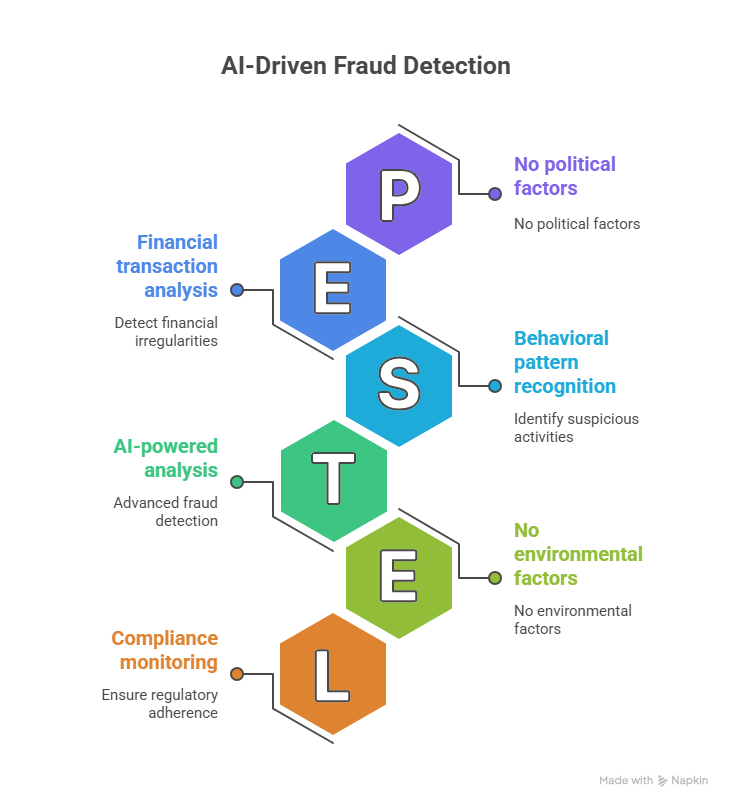
AI systems layer several methods to spot risk:
- Anomaly detection: unsupervised models flag items that deviate from learned norms (amount, frequency, timing, GL code).
- Pattern recognition / supervised ML: trained models identify known fraud signatures using labeled historical cases.
- Entity resolution: fuzzy matching links related records (same vendor with slightly different names/bank details).
Why Accounts Payable needs AI now
In most organizations AP teams face:
- High invoice volume and tight payment timelines
- Repetitive manual checks (three-way matching, vendor validations)
- Multiple people handling invoices, vendor master, and approvals
How AI actually works in Accounts Payable
AI in Accounts Payable is not “magic” it is a set of smart tools that read, match, learn, and flag risks across every invoice and payment. Here’s how it works in practice:
1) Intelligent data capture instead of manual typing
Traditional AP teams key in data from invoices, POs, and GRNs. AI replaces this by:
- Using OCR + machine learning to read invoices (PDF, scans, emails) and extract key data: vendor name, invoice number, date, amount, tax, line items, payment terms, bank details, etc.
- Learning from past corrections – if a user corrects a field once (e.g., vendor name mapping), the system remembers and improves accuracy for next time.
- Handling different formats and layouts from multiple vendors without needing custom templates each time.
Result: High-volume data entry becomes review and approve instead of type and retype.
2) Automated 2-way / 3-way matching powered by rules + patterns
AI engines automatically link:
- Invoices ↔ Purchase Orders (2-way match)
- Invoices ↔ POs ↔ Goods Receipts (3-way match)
They do not just check exact matches; they:
- Tolerate small configurable differences (e.g., quantity tolerance, rounding differences).
- Recognize partial receipts (e.g., invoice for 80 units when 100 were ordered but only 80 received so far).
- Flag exceptions when patterns look unusual (wrong vendor, unusual price, unexpected quantity).
This reduces manual matching work and helps AP teams focus only on true exceptions, not every single invoice.
3) Duplicate and look-alike invoice detection
Fraud and error often exploit weaknesses in duplicate checking. AI goes beyond exact matches and checks for look-alike patterns, such as:
- Same vendor, similar amount, but slightly different invoice numbers (I-1001 vs I-l001, 0 vs O).
- Same invoice number and amount but different dates.
- Sequential invoices arriving unusually close together or with suspiciously similar values.
By using fuzzy matching and pattern recognition, the system catches duplicates that normal ERP duplicate checks may miss.
4) Vendor master and bank detail validation
A common fraud route is changing vendor bank details or using fake vendors. AI helps by:
- Monitoring changes to vendor master data (address, bank account, tax ID) and flagging high-risk combinations (e.g., change requested just before a big payment run).
- Checking if new bank accounts are repeatedly linked to unrelated vendors.
- Scoring new vendors based on unusual characteristics (no history, mismatched address, abnormal invoice patterns).
This helps prevent fake vendor setups and diverted payments.
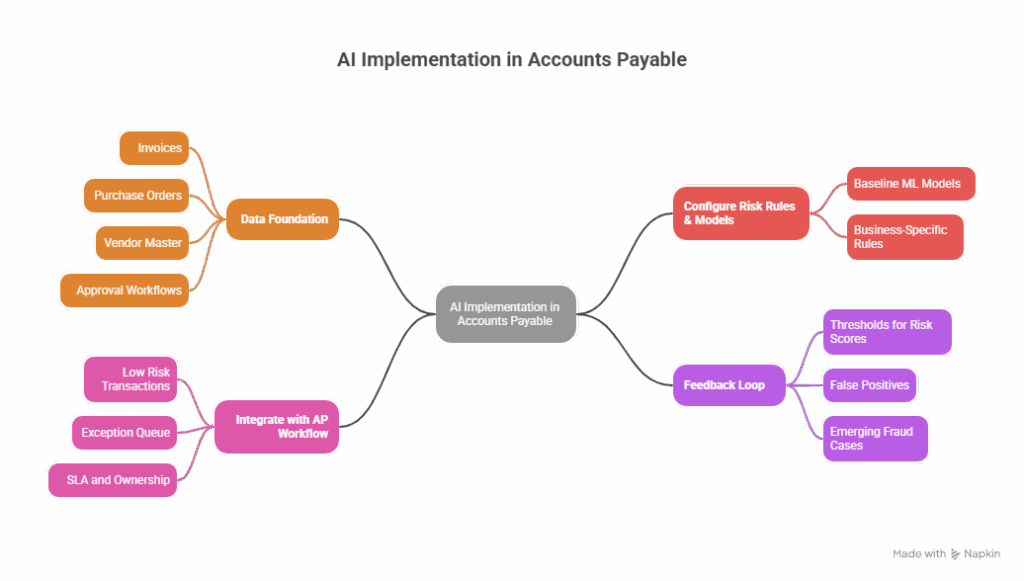
Implementing AI in Accounts Payable: practical roadmap
AI enhances Accounts Payable by automating tasks, boosting fraud detection, and providing real-time risk analysis. It integrates with existing AP systems for invoice, vendor, and payment management, working alongside ERP and approval workflows. AI acts as a risk oversight tool, flagging suspicious items while accelerating legitimate.
Where an outsourcing partner fits in (Kariwala & Co. LLP)
A partner like Kariwala & Co. LLP can:
- Run the end-to-end AP process (invoice capture, validation, posting, reconciliations) with AI-based checks embedded.
- Manage exception queues, contacting vendors for clarifications and coordinating with your internal approvers.
- Provide regular risk reports fraud patterns spotted, duplicate payments prevented, vendor risk rankings.
Conclusion
AI fraud detection makes Accounts Payable more controlled and data-driven. It instantly analyzes invoices, vendor changes, and approvals to prevent fraud, reduce errors, and speed up processing, easing the burden on AP staff. AI in AP provides secure, intelligent fund management with strong governance and expert support.
Reference:
COSO / ACFE Fraud Risk Management Guide (2023 edition) for the idea of structured fraud risk assessment, continuous monitoring and using analytics/automation as part of fraud controls.