

Business owners aim for a successful exit at maximum valuation, not just profit. Financial records are key to trust, whether via acquisition, private equity, or merger. Many businesses have hidden accounting issues that are not apparent in daily work but can detail deals during due diligence. Exit ready books are crucial.
These are accurate, transparent, and audit ready, meeting valuation expectations. Without them, profitable businesses risk valuation discounts, delays, or failed deals.
What Are Exit Ready Books?
Exit ready books are financial records that are:
- Fully reconciled and accurate
- Compliant with US GAAP principles
- Free from inconsistencies and unexplained balances
They ensure that when a buyer reviews your financials, they see confidence not confusion.
Why Exit Readiness Matters More Than You Think
Most business owners prepare for an exit too late but often when a buyer is already involved.
By then, issues like:
- Unreconciled accounts
- Revenue inconsistencies
- Poor documentation
Key Impact:
- Lower valuation multiples
- Increased due diligence timelines
- Higher risk perception for buyers
In competitive deals, clean books can increase valuation by 10–30%, while messy books can reduce it just as quickly.
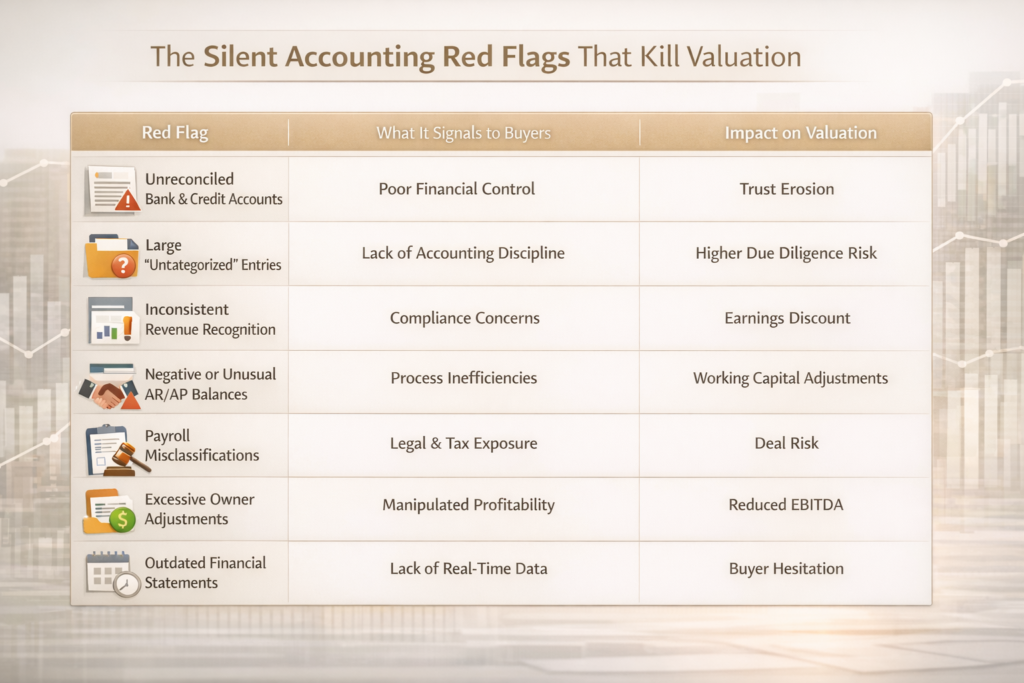
Deep Dive: How These Red Flags Destroy Value
1. Unreconciled Accounts
When accounts do not match bank statements, buyers assume:
- Transaction is missing
- Potential fraud happened
- Controls of internal system is weak
This leads to immediate valuation skepticism.
2. Revenue Recognition Issues
Incorrect revenue timing violates US GAAP principles.
Buyers often:
- Recalculate revenue
- Adjust EBITDA downward
This directly reduces your valuation multiple.
3. Poor Accounts Receivable Management
Unclear AR aging or unapplied cash signals:
- Weak collections
- Inflated revenue
Result: Buyers apply bad debt discounts.
4. Payroll & Compliance Risks
Misclassifying employees vs contractors can trigger:
- IRS penalties
- Legal exposure
Buyers may pause or restructure the deal.
Stakeholder Impact Analysis
For Business Owners
Messy books mean:
- Lower exit price
- Longer deal cycles
- Lost negotiation power
For Buyers & Investors
Red flags increase:
- Risk perception
- Audit effort
- Need for price adjustments
For CPA Firms & Advisors
Poor bookkeeping:
- Increases cleanup workload
- Damages credibility during due diligence
Exit Readiness Checklist
To make your books exit ready, focus on the following:
Core Financial Hygiene
- Monthly bank and credit card reconciliations
- Clean general ledger with zero suspense balances
- Accurate chart of accounts
Revenue & Expense Accuracy
- GAAP compliant revenue recognition
- Clear expense categorization
- Removal of duplicate or personal expenses
Working Capital Clarity
- Clean Accounts Receivables aging (no unapplied cash)
- Accurate Accounts payable tracking
- Inventory reconciliation
Compliance & Documentation
- Payroll properly classified
- Tax filings aligned with books
- Supporting documentation for all entries
Before vs After: The Valuation Difference
| Scenario | Before Cleanup | After Exit-Ready Books |
| Financial Accuracy | Questionable | Verified & reliable |
| Buyer Confidence | Low | High |
| Due Diligence Time | Extended | Streamlined |
| Valuation Multiple | Discounted | Optimized |
| Deal Closure Probability | Uncertain | Strong |
Case Insight
A mid-sized US service business approached a buyer with:
- $5M reported revenue
- Unreconciled accounts
- $300K in unclear adjustments
After cleanup:
- Revenue was restated to $4.6M
- EBITDA became more credible
- Buyer confidence increased
Final Result:
- Deal closed successfully
- Valuation improved due to transparency not inflated numbers
Why It Matters for Growing Businesses
Exit readiness is not just for companies planning to sell.
It helps in:
- Raising capital
- Securing loans
- Attracting investors
- Scaling operations confidently
In short, exit-ready books are equal to business ready books.
Conclusion
Financial credibility drives business valuation. Hidden accounting issues, even in profitable firms, can reduce offers due to buyer uncertainty during due diligence. Exit-ready financial records, ensuring accuracy and transparency, expedite deals, enhance negotiation, and boost valuation. Buyers assess your number’s integrity, not just growth. Well-organized financials build credibility for a better exit and higher value.
References:
- Financial Accounting Standards Board (FASB)
- American Institute of Certified Public Accountants (AICPA)