

In today’s rapidly evolving business landscape, integration is not just a trend it’s a necessity. The days of operating multiple, disconnected systems for accounting, sales, inventory, payroll, and procurement are fading fast. For modern U.S. companies and CPA firms, connecting Enterprise Resource Planning (ERP) systems with accounting has become the cornerstone of achieving operational efficiency, transparency, and real-time insight. When financial data seamlessly flows across departments, businesses gain not only speed and accuracy but also the strategic advantage of making faster, smarter decisions.
The Power of Integration
The integration of ERP systems with accounting processes revolutionizes routine financial management. By connecting all divisions from sales through purchasing via a unified information platform, organizations encounter reduced mistakes and accelerated operational flow. Rather than depending on hand-processed reconciliations, financial transactions are updated instantaneously and automatically, providing immediate insight into the company’s fiscal status.
The Core Idea: Unifying Operations and Finance
ERP systems function as the backbone of an organization, connecting various operations such as order processing, supply chain management, inventory control, human resources, and manufacturing. When combined with accounting functions, this integrated framework guarantees that all business activities are immediately captured in the financial documentation.
To illustrate, when a purchase order is approved, it simultaneously updates stock levels, creates accounts payable entries, documents expenditures, and generates accounting entries instantaneously. This process removes the need for manual input, minimizes mistakes, and maintains alignment between financial records and actual business operations. The result is a harmonized enterprise where the finance department doesn’t merely track figures but actively steers the organization using precise, up-to-date information.
Why Integration Matters to Businesses and CPA Firms
Enterprise Resource Planning and accounting system integration enables American corporations to transition from a reactive financial management approach to a proactive strategic methodology. Instead of deferring reconciliation processes until the conclusion of monthly reporting periods, financial professionals and departmental supervisors can conduct real-time monitoring of transactional activities, thereby facilitating immediate identification of emerging patterns, potential risks, and strategic opportunities. For certified public accounting firms servicing diverse client portfolios, such integration provides enhanced access to refined, contemporaneous data, expedited financial closing procedures, and superior accuracy in financial reporting documentation. This technological advancement empowers these professional service organizations to transcend traditional compliance-focused services and evolve toward comprehensive advisory consulting, thereby assisting clients in optimizing cash flow management, working capital efficiency, and overall organizational profitability.
Operational and Financial Benefits
| Before Integration | After ERP-Accounting Integration |
| Manual data entry & duplication | Automated data flow between systems |
| High risk of errors & delayed closes | Real-time updates & quicker closing cycles |
| Departmental silos | Unified operational and financial data |
| Time-consuming reconciliations | Instant reconciliation and automated matching |
| Reactive decision-making | Real-time dashboards and proactive insights |
This transformation isn’t just technological it’s strategic. By merging financial and operational visibility, companies eliminate delays, gain control, and build the foundation for scalability.
Strategic Implications for U.S. CPA Firms
Accounting firms across the United States are progressively implementing comprehensive solutions for their clientele to enhance operational effectiveness and precision. Through ERP system integration, accounting professionals eliminate the need to solicit numerous reports or await reconciliation processes, as they gain direct access to live data streams from their clients’ operational systems.This transformation minimizes reliance on manual processes, expedites monthly closing procedures, and enables firms to concentrate on consultative services including financial projections, budget planning, and strategic guidance instead of data correction activities. Essentially, ERP integration transforms the accountant’s function from a data recorder to a strategic business consultant.
Automating Workflows and Reducing Manual Overhead
Traditional manual procedures for data input, record alignment, journal entries, and account reconciliation present considerable challenges in terms of time consumption and susceptibility to errors. Through systematic integration, these operational workflows undergo automation: commercial transactions automatically generate corresponding financial records, stock movements seamlessly update both cost accounting and financial ledgers, and inter-organizational transactions achieve autonomous reconciliation. Comprehensive industry analyses demonstrate that Enterprise Resource Planning integrations substantially diminish manual data input requirements, thereby enhancing operational efficiency and minimizing error frequencies.
Through the elimination of repetitive tasks from finance personnel responsibilities, organizations can strategically reallocate human capital toward analytical functions, strategic consultation, and organizational enhancement initiatives. Within the context of Certified Public Accounting practices, this transformation enables more efficient portfolio management while delivering enhanced value propositions to clientele.
Expected Obstacles and Solutions for Managing Them
Naturally, integration does not occur automatically and is accompanied by inherent risks. Prevalent obstacles encompass: disparate master data elements (including customer records, vendor information, and accounting structures), incongruent process frameworks across organizational divisions (encompassing sales, finance, and operations), and organizational resistance from personnel accustomed to established operational procedures. Achievement depends upon meticulous master data remediation, comprehensive process documentation across business units, and systematic implementation progressing from fundamental modules to comprehensive deployment. Initial accomplishments establish organizational confidence; structured governance mechanisms ensure institutional responsibility.
Strengthening Compliance, Auditability and Internal Control
In the U.S., accounting teams face increasing regulatory scrutiny, audits, and governance expectations. An integrated ERP accounting environment enhances internal controls automatically: transactions are logged end-to-end, audit trails are comprehensive, and systemic deviations can be flagged via standardized workflows.
For auditors or internal compliance teams, this unified architecture simplifies review the documentation is built in, the chain of events is traceable, and reconciliation is timely. The risk of non-compliance, adjustments, or manual errors is markedly reduced, thus elevating the credibility of financial reporting.
Future-Ready Finance: Scalable and Adaptive Systems
The integration of ERP and accounting systems establishes a crucial groundwork for emerging technologies such as artificial intelligence-powered forecasting, automated process robotics, and analytical prediction tools. When American companies expand their operations, these unified systems guarantee that financial procedures can accommodate growth while preserving precision, efficiency, and data protection throughout the entire process.
Integration Solutions: Key Insights
While the benefits are clear, successful integration demands disciplined execution. Key considerations include:
- Ensuring data master-cleanliness: unified customer/vendor/ chart of accounts across systems inconsistent masters lead to chaos.
- Defining business process alignment: finance, operations and IT must agree on workflows, timing of postings, responsibilities and exceptions.
- Phasing rollout smartly: start with core modules (finance + procurement + sales) then expand to advanced modules such as HR, manufacturing, CRM.
- Monitoring metrics: track close-cycle time, reconciliation time, manual entry volume, error-rate these signal progress and areas for refinement.
- Building change management and training: users must trust the integrated environment and abandon old work-arounds for maximum effect.
Conclusion
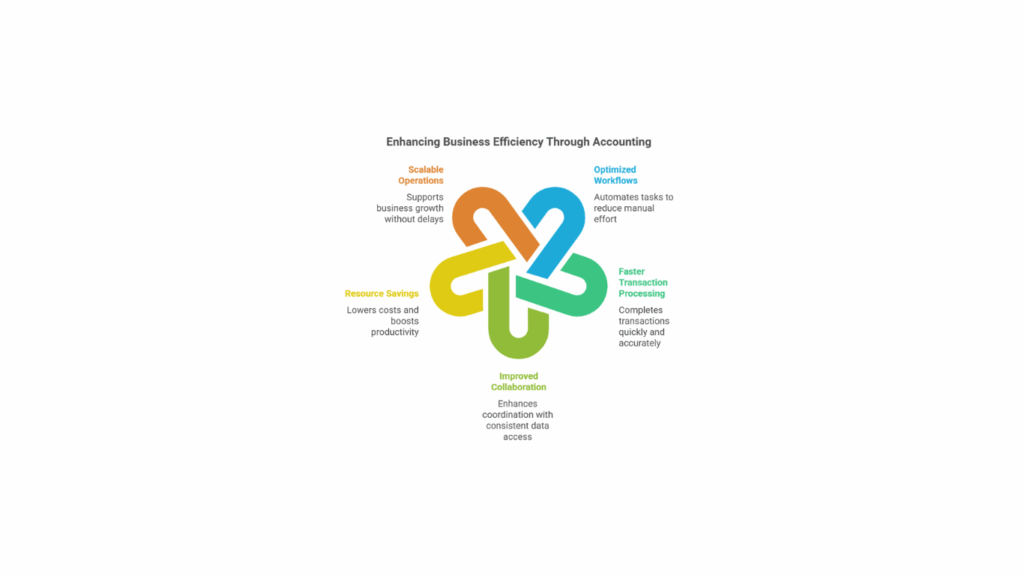
The incorporation of Enterprise Resource Planning systems with accounting functions transcends mere technological advancement, representing a strategic transformation toward more intelligent, expeditious, and transparent organizational operations. For United States enterprises, this integration facilitates immediate financial reconciliation, automated data precision, and perpetual fiscal oversight. For Certified Public Accounting practices, it delivers enhanced operational efficiency, instantaneous reporting capabilities, and the capacity to provide comprehensive analytical insights to clientele.
Kariwala & Co. LLP assists U.S. businesses and CPA firms with ERP-accounting integrations to streamline financial operations, boost efficiency, and enable better decision-making. We align technology with financial accuracy for real-time business insights.
Reference:
Management Accounting: Information for Decision-Making and Strategy Execution — Anthony A. Atkinson and Robert S. Kaplan