
Why Global Instability Is Becoming a Financial Challenge for U.S. Businesses
Geopolitical uncertainty now significantly impacts U.S. businesses beyond politics, affecting accounting, audits, financial reporting, and growth. Issues like U.S.-China trade, supply chain problems, sanctions, inflation, and cyber threats pressure finance teams and investors.
Global shipping and energy market volatility underscore the link between global politics and finance.
The Growing Impact on U.S. Accounting
For accounting professionals, geopolitical instability is creating new reporting and compliance challenges. Companies with international operations must now provide greater transparency regarding:
- Foreign market exposure
- Dependencies of Supply chain
- Fluctuations of Currency
- Costs related to Inflation
- Political and regulatory risks
Increased uncertainty leads finance teams to focus on asset valuations, inventory costs, impairment tests, and cash flow forecasts. Investors and regulators demand better disclosures on operational risks and future financial health. Supply chains are also changing, with US companies reducing overseas supplier reliance for nearshoring or domestic sourcing. This boosts resilience but raises costs, prompting businesses to review pricing, budgeting, and profit forecasts.
How Audits Are Evolving
Geopolitical risks are also reshaping the audit environment. Auditors are now expected to evaluate more than financial accuracy, they must assess broader operational and compliance risks affecting a business.
Key focus areas include:
- Controls of Cybersecurity
- Sanctions compliance
- Risks of vendor include third party
- Business continuity planning
- Effectiveness of Internal control
With rising cyber threats and global regulatory scrutiny, companies are under greater pressure to strengthen governance frameworks and maintain investor confidence.
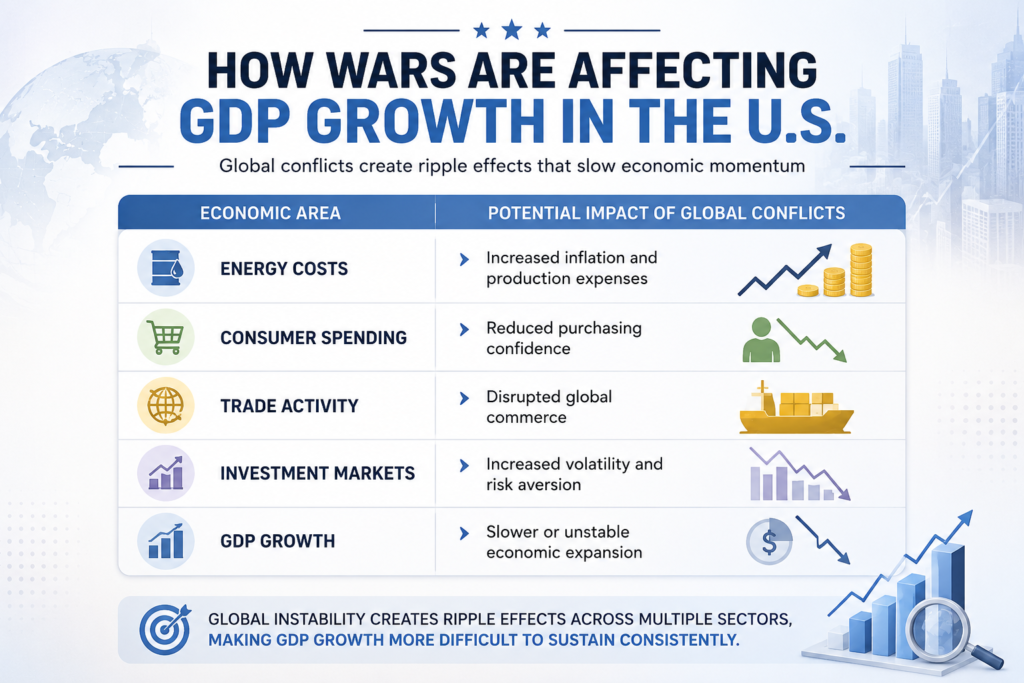
How Wars Are Affecting GDP Growth in the U.S.
Why Accountants and Finance Teams Are Facing Greater Pressure
Finance professionals are now expected to manage challenges that were once considered external macroeconomic issues.
Key areas of pressure include:
- Forecasting Uncertainty
Economic assumptions are subject to swift modification owing to geopolitical occurrences. - Asset Valuation Complexity
Market volatility affects fair value assessments and impairment testing. - Expanded Risk Disclosure Expectations
Stakeholders increasingly expect transparency around geopolitical exposure. - Supply Chain Financial Impact
Disruptions have a significant impact on cost determination, stock control, and the strategic planning of operations. - Cash Flow Monitoring
Businesses must preserve liquidity amid economic unpredictability.
Accounting is no longer just historical reporting,it is becoming strategic risk interpretation.
The Link Between Geopolitics and U.S. GDP
Geopolitical instability directly affects economic growth by influencing investment decisions, consumer confidence, and market stability. When uncertainty rises, businesses often delay expansion plans, hiring, and capital investments, which can slow GDP growth.
At the same time, certain industries are experiencing rapid growth due to global shifts. Sectors such as:
- Cybersecurity
- Artificial Intelligence
- Domestic manufacturing
- Energy infrastructure
- Defense and technology
are attracting increased investment as businesses and governments focus on long term resilience and national security.
The Long Term Impact on U.S. Financial Reporting
Global conflicts are accelerating broader shifts in accounting and finance, including:
✔ Greater emphasis on risk-based reporting
✔ Increased focus on scenario analysis and forecasting
✔ Stronger internal controls around uncertainty assessment
✔ More detailed management discussion disclosures
✔ Increased demand for real-time financial visibility
The future of accounting is becoming more connected to global economics and geopolitical intelligence.
What This Means for Businesses and Financial Leaders
The evolving geopolitical environment is redefining the role of accounting, finance, and audit professionals.
Organizations that adapt successfully are increasingly focusing on:
- Real time financial intelligence
- Risk based decision making
- Stronger compliance frameworks
- Advanced scenario planning
- Diversified supply chain strategies
- Technology driven financial reporting
Final Thoughts
Geopolitical instability has transcended its status as solely an international relations matter, now representing a significant business and financial consideration. Its impact on accounting practices, audit procedures, and overall economic outcomes is escalating as enterprises contend with a progressively unpredictable global landscape.
Entities that prioritize robust financial reporting, preemptive risk mitigation, and judicious strategic foresight will be more advantageously situated to sustain equilibrium and attain enduring prosperity in the forthcoming period.