

Why Lease Accounting Matters Today
For a considerable period, companies rented office spaces, storage facilities, cars, and machinery without reflecting these financial commitments on their balance sheets. Information about operating leases was confined to footnotes, thereby obscuring financial responsibilities from lenders, investors, and internal management. This situation was altered by the implementation of revised lease accounting standards under US GAAP. Currently, the majority of leases are required to be recorded directly on the balance sheet.
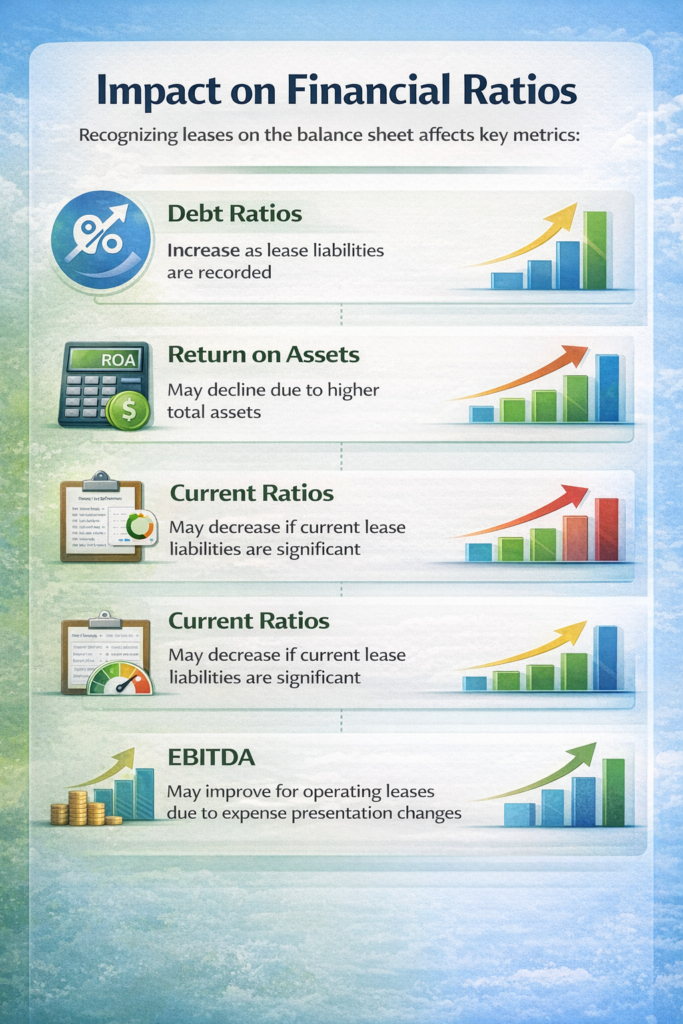
Consequently, lease accounting now impacts reported assets, liabilities, financial metrics, and the evaluation of business risk. Comprehending these modifications is crucial for maintaining precise financial statements and making sound business decisions.
How Lease Accounting Evolved
Previously, under existing GAAP rules, only finance leases were recorded on the balance sheet. Operating leases were not shown, despite involving long term, mandatory payment obligations. This lack of transparency hindered comparisons between companies that leased assets and those that bought them. To resolve this, accounting standard setters implemented ASC 842, aiming to more accurately portray economic realities by acknowledging the rights and responsibilities associated with lease agreements.
Under the new guidance nearly all leases now result in balance sheet recognition.
What Changed Under ASC 842
The most important change is that operating leases are no longer off the balance sheet.
Under ASC 842:
- Both operating and finance leases create a right-of-use (ROU) asset and a lease liability
- Lease classification still matters, but mainly for expense presentation
- Lease obligations are now clearly visible to financial statement users
This shift improves transparency and consistency across financial reporting.
Understanding the ROU Asset and Lease Liability
At lease commencement two items are recorded:
Right-of-Use (ROU) Asset
The ROU asset represents the company’s right to use the leased asset during the lease term. It is measured based on the lease liability, adjusted for prepaid rent, lease incentives, and certain initial costs.
Lease Liability
The lease liability represents the present value of future lease payments. It is discounted using the lessee’s incremental borrowing rate or the rate implicit in the lease if available.
Both balances are adjusted over the life of the lease as payments are made and interest is recognized.
How Lease Accounting Works in Practice
The accounting process typically follows these steps:
- Identify the lease term, including reasonably certain renewal options
- Determine lease payments subject to capitalization
- Discount future payments to calculate the lease liability
- Record the ROU asset and lease liability at commencement
- Recognize ongoing lease expense, interest, and amortization
While the calculations can be complex, the result is a clearer picture of long term obligations
Financial Statement Presentation
Lease accounting affects all three primary statements:
- Balance Sheet: ROU assets and lease liabilities
- Income Statement: Single lease expense for operating leases, interest and amortization for finance leases
- Cash Flow Statement: Principal payments in financing activities; interest typically in operating activities
Cash flows do not change but their classification does.
Broader Business Implications
Lease accounting reform is more than a technical change. It influences:
- Lease-versus-buy decisions
- Contract negotiation strategies
- Debt covenant discussions
- Financial planning and performance measurement
Treating lease accounting as a strategic issue helps organizations manage its impact effectively.
Conclusion
US GAAP now mandates that most leases be recorded as right-of-use assets and lease liabilities. This enhances transparency but alters financial metrics. Companies must accurately identify, measure, and disclose leases for correct financial reporting.
A systematic approach to lease accounting ensures financial statements accurately represent the economic effects of leasing choices.